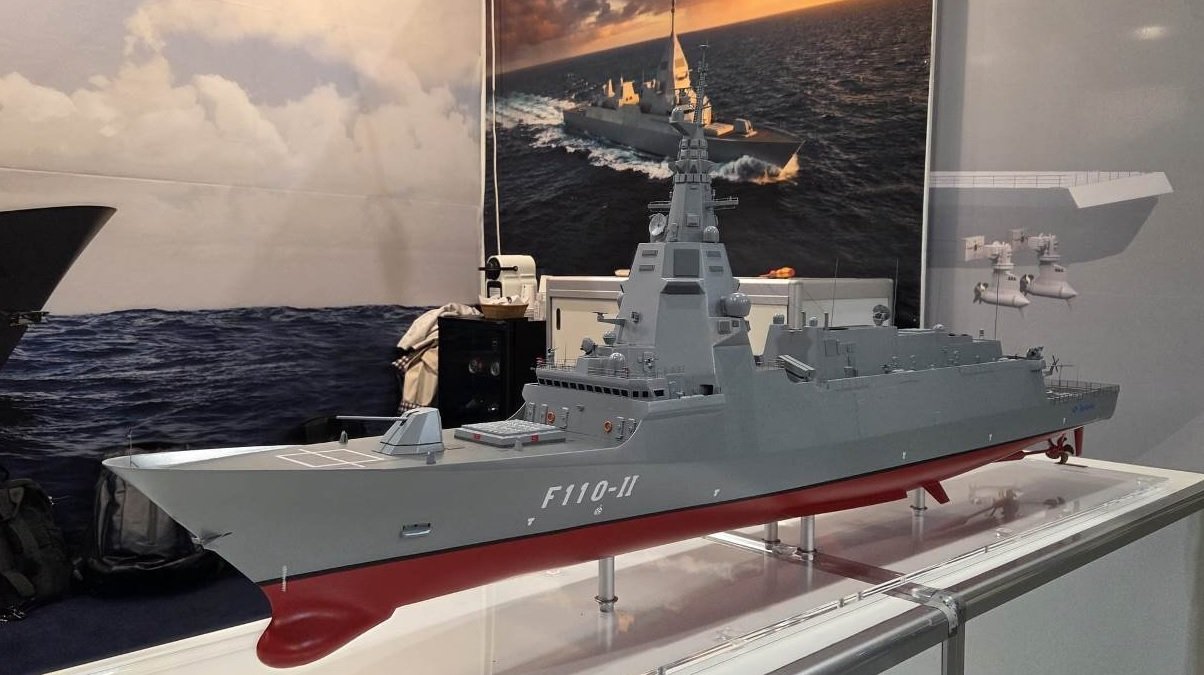
ERNING, DENMARK — Spanish shipbuilder Navantia has publicly displayed a scale model of its F-110 Flight II frigate for the first time at DALO Industry Days 2026 in Herning, Denmark. The event was held on August 19-20 and brought together defence companies, government representatives and military delegations.
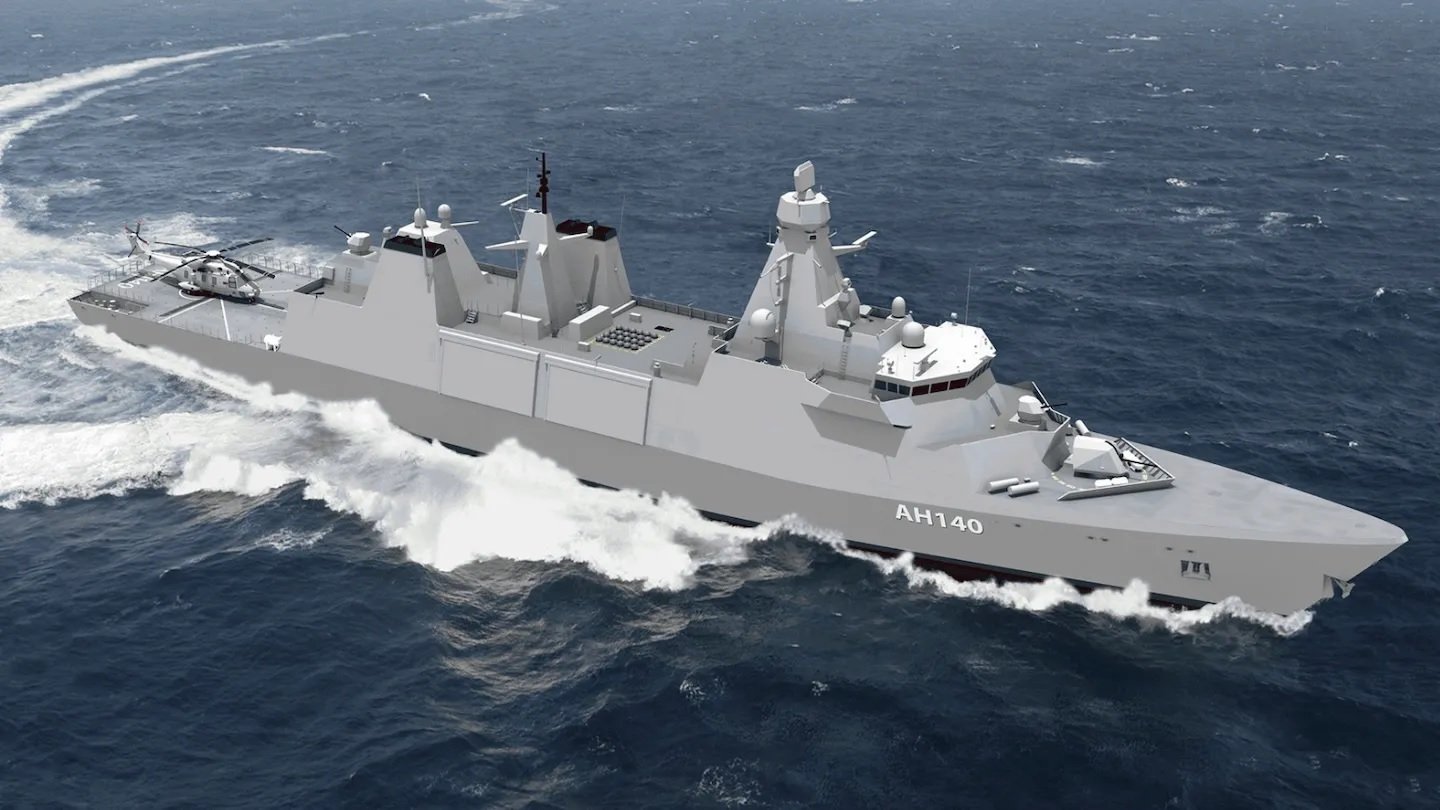
Navantia describes the design as the F-110 Flight II for Spain and the F-110 IAMD (Integrated Air and Missile Defence) configuration for the international market. The design is an enlarged and enhanced development of the F-110 frigates being built for the Spanish Navy, with substantially greater air-defence capacity while retaining anti-submarine warfare (ASW) and anti-surface warfare (ASuW) capabilities.
Navantia displayed the F-110 IAMD alongside its ALFA 4000 and ALFA 3000 frigate designs as part of its effort to develop a long-term industrial relationship with Denmark. The company has identified Denmark as a strategic partner and is presenting its naval designs in connection with the country's future fleet requirements.
Larger Hull and Higher Speed
The F-110 Flight II is approximately 150 metres long, around five metres longer than the Flight I design, with a maximum beam of 18.6 metres. Its full-load displacement is approximately 6,700 tonnes, around 500-600 tonnes above the baseline configuration. Navantia's displayed configuration has a maximum speed of more than 29 knots, compared with more than 26 knots for the Flight I design.
The frigate is designed for a cruising speed above 18 knots and a range of approximately 4,100 nautical miles. The design uses a CODLAG propulsion arrangement, supporting both endurance and reduced acoustic signatures.
The ship is designed around a crew of approximately 150 personnel, with additional accommodation for mission specialists and command personnel. The configuration also includes a multi-mission bay intended to accommodate RHIBs, unmanned systems and modular mission equipment.
The enlarged design is intended to support operations requiring greater air-defence capability while retaining the F-110's multi-mission role.
64-Cell Mk 41 Vertical Launch System
The largest change is the increase in vertical-launch missile capacity.
The baseline F-110 Flight I has a 16-cell Mk 41 Vertical Launching System (VLS). The Flight II/IAMD configuration displayed by Navantia increases this to 64 cells.
The VLS arrangement consists of:
- 48 Mk 41 Strike Length cells forward of the bridge
- 16 Mk 41 Tactical Length cells positioned farther aft, inside the superstructure ahead of the helicopter hangar
The configuration therefore provides four times the number of VLS cells found on the Flight I ships.
The proposed missile capacity includes up to 64 SM-2 surface-to-air missiles, or up to 256 RIM-162 Evolved Sea Sparrow Missiles (ESSM) when quad-packed, or a combination of the two, depending on the selected loadout.
For anti-surface warfare, the design carries eight Kongsberg Naval Strike Missiles (NSM) in two quadruple launchers. Its main gun is the Leonardo OTO 127/64 LW 127 mm naval gun.
Close-in and short-range defence is provided by two Escribano E&M Sentinel 30 30 mm remote weapon stations, four Sentinel 2.0 12.7 mm remote weapon stations and additional heavy machine guns. The design also incorporates six SRBOC Mk 36 decoy launchers, a directed-energy weapon, loitering-munition launchers and a dedicated counter-unmanned aerial system capability.
For anti-submarine warfare, the frigate is equipped with two twin Mk 32 Mod 9 torpedo launchers for Mk 54 lightweight torpedoes. The aviation facilities are designed to support helicopters including the NH90 and MH-60R, along with unmanned aerial systems.
Upgraded SPY-7 Radar
The F-110 Flight II retains the Lockheed Martin AN/SPY-7(V)2 S-band solid-state multifunction radar, but with a larger array configuration.
Each radar array in the Flight II design is shown with 100 sub-array suites (SAS), compared with 68 SAS on the Flight I configuration. The larger number of sub-arrays provides additional radar capacity for detecting, tracking and discriminating multiple targets.
The radar is integrated with Navantia's SCOMBA combat management system through the Aegis International Aegis Fire Control Loop (IAFCL). The configuration also includes Cooperative Engagement Capability (CEC) for sharing tactical information between compatible platforms.
The Spanish Navy describes SPY-7 as a digital, software-defined radar designed to support multiple missions, including air surveillance, air defence and ballistic-missile defence functions.
Terminal guidance for the surface-to-air missile system is provided by Raytheon's AN/SPG-62 fire-control radars and Mk 99 Fire Control Systems.
Electronic Warfare and Underwater Sensors
The F-110 IAMD's integrated mast incorporates several systems supplied by Spanish defence company Indra. These include the PRISMA-25X solid-state radar for surface surveillance and low-altitude air-target tracking, the Rigel i110 electronic support and countermeasures systems, the Regulus i110 communications electronic support measures system, an identification-friend-or-foe system and the IRST i110 infrared search-and-track system developed with Technobit.
Navantia also provides systems including the DORNA fire-control radar for the main gun, the HERMESYS integrated communications system, the DIGITAL TWIN system and the MINERVA integrated navigation bridge system.
The underwater sensor suite is supplied by Thales and includes the BLUEMASTER hull-mounted sonar, CAPTAS-4 Compact variable-depth sonar, TUUM-6 underwater communications system and BLUESCAN acoustic data-fusion software.
Saab provides the naval laser-warning system, while Lockheed Martin supplies the AN/SLQ-25E NIXIE torpedo countermeasure system.
Built Around the Existing F-110 Design
Navantia is positioning the Flight II as an evolution of the F-110 rather than a completely new frigate design. The company says its F-110 programme is already under execution for the Spanish Navy and is meeting its planned schedule. The first five F-110 ships are part of the current Spanish programme, with construction already underway on multiple vessels.
The Flight II configuration retains the platform's multi-mission architecture while adding substantially greater missile capacity, increased radar-array capacity and higher speed.
Navantia also highlights survivability features, including separated machinery spaces, fire zones, damage-control measures and CBRN protection. The design incorporates modularity and growth margins intended to allow additional systems and capabilities to be integrated as requirements change.
The company is presenting the F-110 IAMD to international customers, including in Denmark, while the same Flight II concept is also associated with future Spanish Navy requirements. However, the configuration displayed at DALO should be distinguished from a confirmed Danish procurement contract; Navantia's official DALO announcement describes the F-110 IAMD as a design being presented as part of its cooperation and strategic-partnership efforts with Denmark.
The F-110 Flight II therefore represents a significant increase in the F-110's air-defence capacity, particularly through its 64-cell Mk 41 VLS and enlarged SPY-7 radar configuration, while retaining the ASW, ASuW and multi-mission characteristics of the original F-110 design.
——— End of Article ———