Europe — March 12, 2026 : European NATO members are increasingly focused on a critical operational issue in modern air and missile defence: sustaining defensive operations during prolonged high-intensity conflicts. Recent multinational exercises and analytical assessments indicate that while allied forces possess significant detection and interception capabilities, maintaining those capabilities over extended periods presents a growing strategic challenge.
In response to this evolving operational environment, Israeli defence technology firm Omnisys has presented its artificial intelligence-driven BRO (Battle Resource Optimization) platform as a software-based solution designed to improve the management of interceptor inventories and mission planning in complex air defence operations. The system’s air defence-focused module, known as BRO-AD, is designed to support Ballistic Missile Defence (BMD) and Integrated Air and Missile Defence (IAMD) missions across large-scale conflict scenarios.
NATO Exercises Highlight Sustainability Concerns
Insights from multinational NATO training events in Europe have highlighted the scale of the challenge. During recent exercises, including the early-2026 iteration of Dynamic Front 26, allied forces evaluated their ability to operate in high-density threat environments involving large numbers of incoming targets.
Dynamic Front 26 was conducted primarily in Romania and involved multiple NATO members, including the United States. The exercise focused on integrating multi-domain fires, improving artillery interoperability, and testing command-and-control coordination across distributed battlefields. Live-fire drills and operational simulations were used to replicate large-scale combat scenarios involving simultaneous threats across multiple domains.
Exercise data and independent assessments indicate that allied systems demonstrated the ability to detect, track, and engage up to 1,500 targets within the first 24 hours of a simulated conflict. Within that engagement volume, air defence units were required to intercept approximately 600 to 1,200 threats, including ballistic missiles, cruise missiles, and unmanned aerial vehicles (UAVs).
While these results demonstrate significant sensor and engagement capacity, analysts note that such high engagement rates could rapidly deplete interceptor inventories during sustained operations.
Interceptor Inventory Depletion Risk
Operational modelling from the exercises suggests that under continuous large-scale attacks, interceptor stocks could be exhausted within a matter of days. In these scenarios, the rate at which defensive missiles are used may exceed standard replenishment capabilities.
As a result, the issue has shifted from purely technological capability—such as detection and interception—to long-term operational endurance. The ability to maintain effective defensive coverage beyond the first waves of attacks depends heavily on how efficiently available interceptor resources are allocated.
This dynamic is particularly relevant for NATO’s layered air defence networks that combine multiple interceptor systems designed for different threat types and engagement ranges. Managing the use of these interceptors efficiently becomes essential in high-intensity environments involving ballistic missiles, cruise missiles, and UAV swarms.
Omnisys BRO System and BRO™-AD Module
To address this operational challenge, Omnisys has developed the BRO system, a suite of mission optimization tools designed to support planning, execution, and post-mission analysis across multiple defence domains. The company reports more than 25 years of experience in defence mission optimization and decision-support systems.
Within the BRO architecture, the BRO-AD module is specifically tailored for air defence missions. The platform operates as a vendor-agnostic software layer, meaning it can work with equipment from different suppliers without requiring hardware replacement.
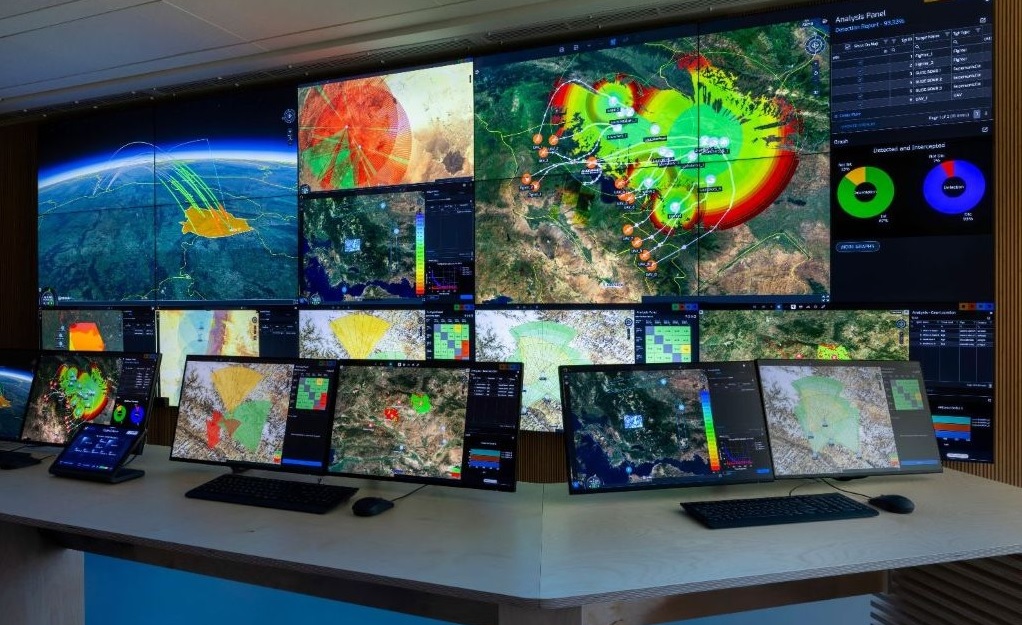
The system creates a physics-based digital twin of the operational battlespace, modelling several critical variables simultaneously, including:
-
Available interceptor inventories
-
Weapon performance parameters
-
Environmental and weather conditions
-
Terrain limitations
-
Real-time threat behavior and trajectories
Using these inputs, the platform’s AI-driven optimization engine continuously evaluates engagement scenarios and generates decision-support recommendations for commanders.
AI-Based Decision Support Across the Kill Chain
BRO-AD provides real-time analytical outputs across multiple stages of the air defence engagement process. These include recommendations on:
-
Prioritization of defended assets
-
Selection of appropriate interceptors for each threat
-
Sequencing of engagements within layered defence networks
-
Allocation of interceptor resources across multiple sectors
The objective of the system is to reduce unnecessary expenditure of high-value interceptors and improve the efficiency of engagement decisions during high-volume attack scenarios. By optimizing how interceptors are used, the system aims to preserve munitions for later phases of a conflict and extend overall defensive endurance.
For multinational operations involving multiple NATO countries and cross-border coordination, the system can also provide continuously updated decision support that reflects the combined resources and threat environment across participating forces.
Integration With Existing C4I Systems
Omnisys states that BRO-AD is designed to integrate directly with existing command networks rather than requiring new hardware procurement. The platform can connect with current sensors, interceptors, and command systems used by NATO forces.
This includes compatibility with established C4I architectures—Command, Control, Communications, Computers, and Intelligence systems—, which form the backbone of modern air defence networks.
The vendor-agnostic design also allows the modelling of mixed fleets of interceptors and sensors from multiple manufacturers, a common situation in NATO’s multinational defence architecture.
At the same time, the system is designed to preserve sovereign control over sensitive performance data, enabling national forces to maintain confidentiality regarding classified system parameters.
Applications for Long-Term Force Development
In addition to real-time operational support, the BRO-AD platform can be used for simulation-based planning and capability development.
Through its digital twin modelling and AI analysis tools, defence planners can test different air defence architectures and evaluate the operational impact of various procurement options. These simulations can help quantify trade-offs between interceptor inventories, system performance, and long-term sustainability.
Such modelling allows defence authorities to assess air defence effectiveness not only in terms of interception success rates but also in terms of endurance and resource sustainability during extended conflicts.
Industry Perspective
According to Omnisys leadership, the shift toward endurance-focused planning reflects the changing nature of modern missile warfare.
“Future air defence will be measured not only by interception capability, but by the ability to sustain defensive performance over time,” said Alfred (Fredi) Tzimet, Deputy CEO of the company.
Tzimet stated that BRO-AD is intended to help commanders manage interceptor resources more efficiently, preserve high-value munitions, and maintain operational effectiveness during prolonged high-intensity attacks.
Growing Importance of Resource Optimization
As missile and drone threats increase in volume and complexity, defence analysts increasingly view resource optimization as a core requirement of modern air defence systems. High-volume attacks involving mixed threats can place significant pressure on interceptor inventories, particularly during the early stages of a conflict.
Technologies designed to optimize the use of existing assets—rather than relying solely on increased interceptor stockpiles— are therefore becoming an increasingly important element of military planning within NATO and other allied defence networks.
——— End of Article ———