GREENBELT, Md. — May 30, 2026 : NASA is preparing an unprecedented commercial spacecraft-servicing mission to extend the operational life of the Neil Gehrels Swift Observatory, a scientific satellite facing increasing orbital decay after more than two decades in low Earth orbit.
The mission, scheduled for launch no earlier than June 2026, will attempt to raise Swift’s orbit before atmospheric drag forces the spacecraft to re-enter Earth’s atmosphere, potentially ending one of NASA’s most important astrophysics programs dedicated to observing short-lived cosmic events. The operation is being conducted in partnership with Arizona-based Katalyst Space Technologies, which will deploy a robotic servicing spacecraft known as LINK to rendezvous with and reposition the observatory.
NASA officials view the mission as both an operational effort to preserve an active scientific platform and a demonstration of emerging commercial satellite-servicing capabilities intended to support long-term sustainability of spacecraft operating in orbit.
Swift Observatory remains operational despite growing orbital challenge
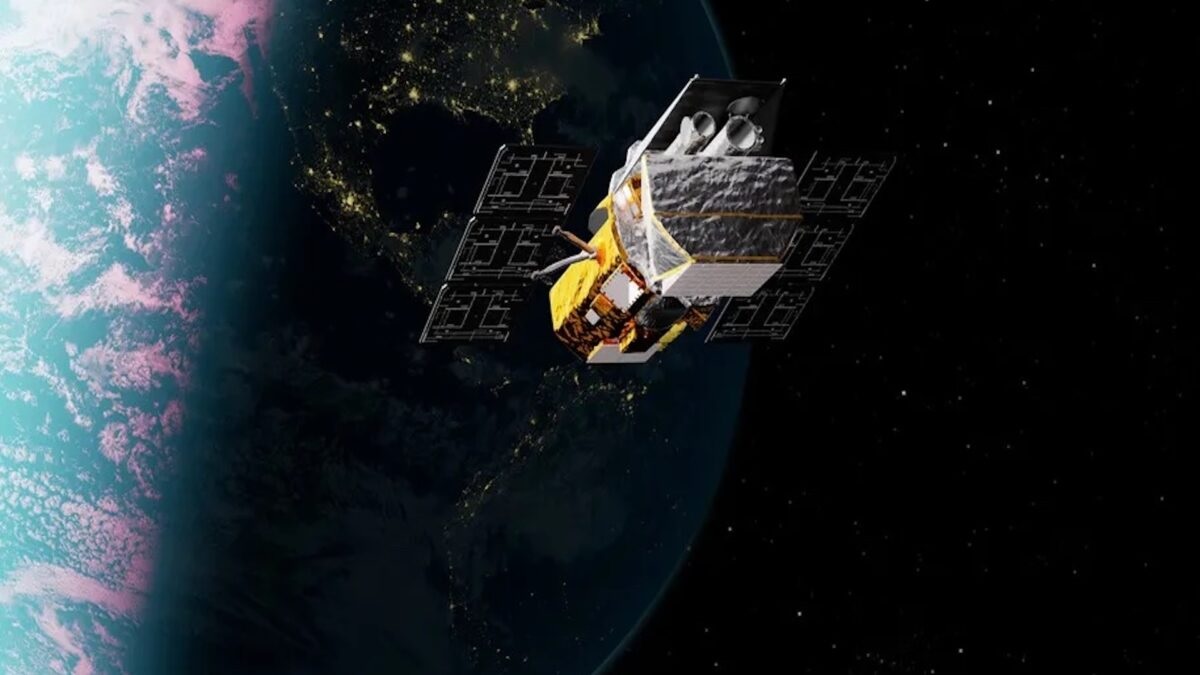
Launched on Nov. 20, 2004, the Neil Gehrels Swift Observatory was developed to detect and study gamma-ray bursts, among the most energetic electromagnetic explosions in the universe. The spacecraft was designed to rapidly identify these brief but powerful cosmic events and immediately reposition itself to collect follow-up observations.
Over the last 21 years, Swift has become a major component of NASA’s astrophysics fleet, contributing to research involving gamma-ray bursts, neutron star mergers, supernovae, black holes, active galaxies and other transient astronomical events.
The observatory carries three primary scientific instruments capable of observing the universe across multiple wavelengths, including gamma-ray, X-ray, ultraviolet and visible light. Its Burst Alert Telescope is responsible for detecting gamma-ray bursts and triggering rapid spacecraft targeting, while onboard follow-up instruments help astronomers analyze newly detected cosmic activity.
Despite remaining fully operational, Swift is facing an increasingly serious orbital problem. The spacecraft was originally placed in low Earth orbit at an altitude of roughly 600 kilometers but was launched without an onboard propulsion system, meaning it cannot independently raise or maintain its orbit.
Solar activity accelerates orbital decay
Since launch, atmospheric drag has gradually lowered Swift’s orbital altitude. However, NASA reported that orbital decay accelerated significantly following increased solar activity associated with the recent solar maximum cycle, which peaked in 2024.
Solar activity heats and expands Earth’s upper atmosphere, increasing atmospheric density at higher altitudes and producing greater drag on spacecraft operating in low Earth orbit. According to NASA, this process caused Swift’s altitude to steadily decline to approximately 370 kilometers.
Orbital projections conducted during 2025 indicated that, without intervention, the spacecraft could re-enter Earth’s atmosphere and burn up by mid-to-late 2026 or potentially before the end of the year depending on atmospheric conditions. Because Swift lacks propulsion capability, NASA determined that external assistance would be required to preserve the observatory and extend scientific operations.
NASA awards Katalyst contract for robotic servicing mission
To prevent the loss of the spacecraft, NASA awarded a $30 million contract in September 2025 to Flagstaff, Arizona-based Katalyst Space Technologies to conduct a commercial orbital-servicing mission.
Under the agreement, Katalyst will launch its 400-kilogram robotic servicing spacecraft, LINK, which is specifically designed to autonomously rendezvous with, inspect and maneuver satellites in orbit.
The mission is scheduled to launch no earlier than June 2026 aboard Northrop Grumman’s Pegasus XL launch vehicle. Unlike conventional rockets launched from fixed ground pads, Pegasus XL is deployed from a modified Stargazer L-1011 aircraft during flight, allowing increased flexibility for orbital insertion and improved access to mission-specific trajectories.
NASA selected Pegasus partly because Swift operates in an orbital inclination that can be reached efficiently through the air-launched system.
LINK spacecraft faces complex capture operation
Once deployed into orbit, LINK will begin autonomous rendezvous and proximity operations to intercept the observatory.
The servicing spacecraft is equipped with lidar imaging systems, navigation sensors and three robotic arms designed to support spacecraft inspection and capture. Engineers face a significant challenge because Swift was never designed for in-orbit servicing.
Unlike more recently designed satellites that may include docking mechanisms or servicing interfaces, Swift lacks dedicated docking ports, grappling fixtures and standardized attachment hardware.
To address those limitations, LINK will first perform a detailed flyby inspection to evaluate spacecraft condition, confirm orientation and identify structural attachment points. Following inspection, robotic grippers are expected to attach to one of Swift’s load-bearing structural flanges originally designed for launch integration rather than servicing operations.
After securing the observatory, LINK will activate onboard Hall-effect thrusters to conduct an orbital reboost maneuver intended to move Swift into a safer and more stable orbit above approximately 300 kilometers.
Mission planners expect the maneuver to significantly extend Swift’s operational life and allow continued scientific observations before the robotic spacecraft detaches following completion of the boost.
NASA modifies Swift operations to preserve altitude
The mission is progressing under a compressed development timeline. While satellite-servicing missions typically require years of planning and systems integration, NASA and Katalyst advanced the project from contract award to launch preparation in roughly eight months due to the urgency created by Swift’s declining altitude.
To increase the probability of mission success, NASA temporarily adjusted Swift’s operations during early 2026 to reduce atmospheric drag and preserve altitude.
Controllers suspended portions of the observatory’s science activities, powered down the Burst Alert Telescope and halted rapid spacecraft-targeting maneuvers that normally allow Swift to quickly reposition toward new gamma-ray burst detections.
NASA also placed the spacecraft into a low-drag orientation designed to minimize atmospheric resistance and conserve onboard power while engineers continued orbital tracking and mission planning.
Flight dynamics teams at NASA’s Goddard Space Flight Center continue generating updated orbital forecasts and weekly assessments to ensure Swift remains above approximately 300 kilometers, a threshold considered important for maximizing the likelihood of a successful servicing mission.
Environmental testing completed ahead of launch
As preparations continue, LINK recently completed a series of environmental and systems tests at NASA’s Goddard Space Flight Center in Maryland.
Testing included vibration evaluations, thermal-vacuum assessments, robotic arm deployment checks, propulsion verification and spacecraft systems validation intended to confirm launch readiness and operational reliability during orbital servicing.
NASA officials stated that successful completion of these milestones supports final launch integration efforts ahead of the June 2026 launch opportunity.
Mission could influence future orbital infrastructure planning
Beyond preserving Swift, the mission is being closely watched as a demonstration of commercial robotic satellite-servicing technology.
If successful, the operation would become the first known instance of a privately developed robotic spacecraft autonomously rendezvousing with, capturing and boosting an operational U.S. government scientific satellite that was not originally designed for servicing.
Government agencies and commercial aerospace firms are increasingly investing in technologies capable of satellite inspection, orbital repositioning, refueling, component replacement, debris management and mission-life extension as operators seek alternatives to replacing expensive spacecraft prematurely.
For NASA, the mission provides an opportunity to preserve a still-functional observatory that continues producing valuable astrophysics data more than 20 years after launch. During its operational lifetime, Swift has detected thousands of gamma-ray bursts and played a major role in time-domain astronomy through rapid observations of short-duration cosmic phenomena.
The mission also reflects broader cooperation between government agencies and commercial aerospace providers in maintaining orbital infrastructure. Rather than replacing an aging but operational observatory, NASA is attempting to preserve an existing spacecraft through robotic servicing — an approach that may influence how future scientific satellites are designed, operated and maintained.
NASA and Katalyst Space Technologies are continuing final mission readiness activities ahead of the planned June 2026 launch window as teams complete preparations for one of the agency’s most significant robotic spacecraft-servicing demonstrations in low Earth orbit.
——— End of Article ———