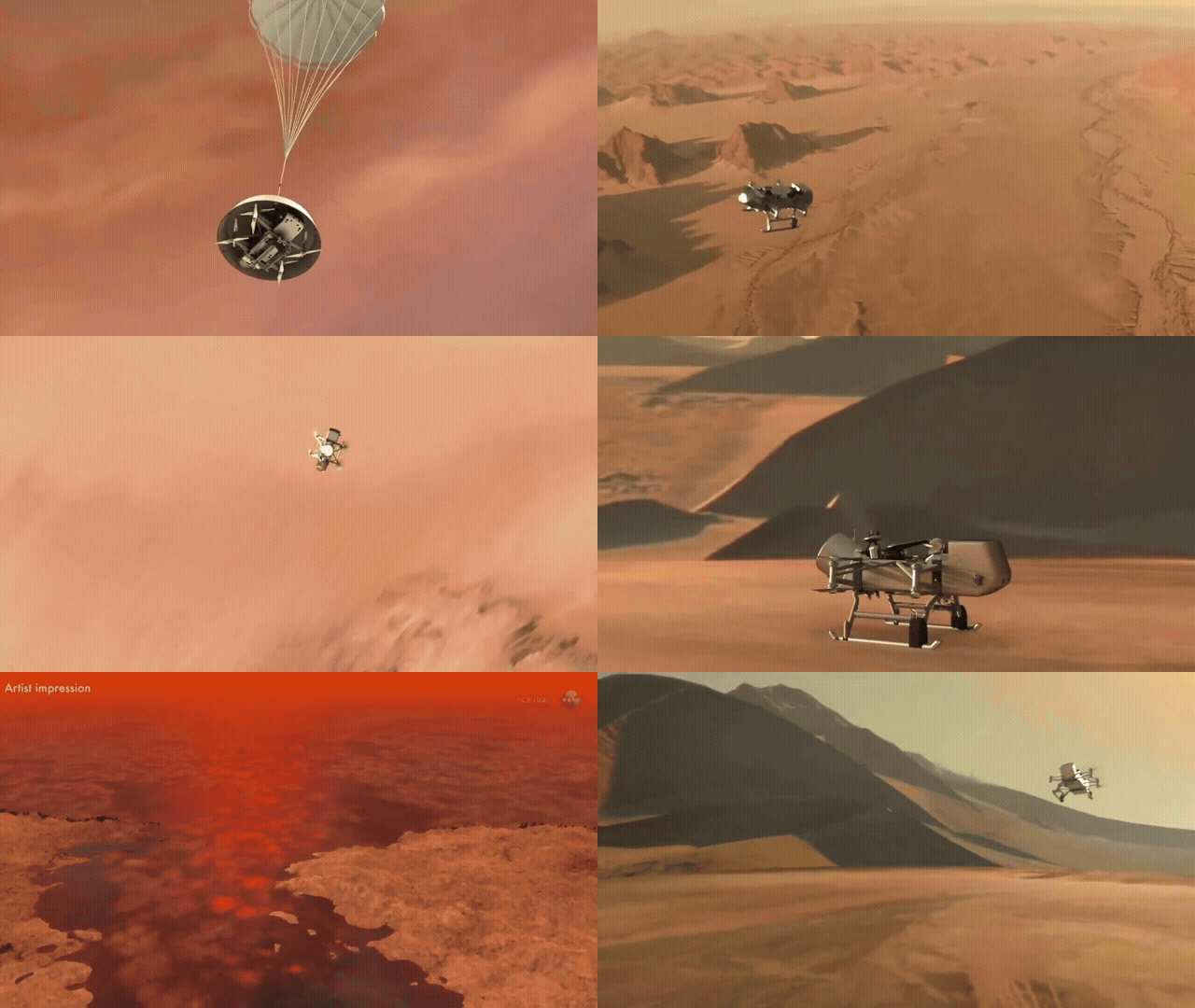
LAUREL, Maryland — March 2026 : NASA has formally entered the full integration and testing phase of its Dragonfly mission, a nuclear-powered rotorcraft lander designed to explore Saturn’s largest moon, Titan. The milestone marks the transition from design and simulation to physical assembly of the flight system at the Johns Hopkins Applied Physics Laboratory (APL) in Laurel, Maryland, following the mission’s Critical Design Review.
Dragonfly is scheduled to launch no earlier than July 2028 aboard a SpaceX Falcon Heavy rocket from Kennedy Space Center, beginning an approximately six-year cruise to Titan with arrival targeted in 2034. The mission, with an estimated cost of $3.35 billion, is designed to conduct the first aerial exploration of another planetary body.
Integration and Testing Progress Across Multiple Facilities
Integration activities began in early March 2026, with engineers at APL focusing on the spacecraft’s core avionics systems. The Integrated Electronics Module (IEM), which functions as the central computing and data-handling unit, and the Power Switching Units (PSUs) have been successfully powered on and tested through the lander’s main electrical harness.
Additional subsystems, including the flight radio and communications hardware, are scheduled for delivery and integration over the coming months. Parallel work is ongoing at Lockheed Martin Space in Littleton, Colorado, where the aeroshell and cruise-stage components are undergoing assembly and testing. These systems will protect the spacecraft during its interplanetary transit and atmospheric entry at Titan.
Thermal and environmental validation is also underway. APL is conducting tests in a dedicated “Titan Chamber” to evaluate the performance of the spacecraft’s approximately 3-inch-thick Solimide-based insulating foam under cryogenic conditions. Full system-level environmental testing is planned for 2027 ahead of final launch preparations.
Aerodynamic validation has already been completed at NASA’s Langley Research Center using heavy gases in the Transonic Dynamics Tunnel to simulate Titan’s dense atmospheric conditions.
Mission Profile and Flight Plan
Dragonfly will launch during a window between July 5 and July 25, 2028. After a deep-space cruise lasting roughly six years, the spacecraft will enter Titan’s atmosphere and execute a descent sequence lasting approximately two hours—significantly longer than Mars landings due to Titan’s thick atmosphere.
Upon arrival, Dragonfly will initially land in the Shangri-La dune fields near Titan’s equatorial region. The mission will then follow a multi-site “leapfrog” exploration strategy, progressively relocating across the surface toward Selk Crater, a scientifically significant impact site where past interactions between liquid water and organic materials may have occurred.
The primary science phase is planned for approximately 3.3 years, during which the rotorcraft is expected to visit between 20 and 30 locations and travel up to 115 kilometers (70 miles).
Rotorcraft Design and Flight Capabilities
Dragonfly is a fully autonomous, car-sized rotorcraft lander designed to operate in Titan’s unique environment. The vehicle measures approximately 3.85 meters in length and width and 1.75 meters in height, with a mass ranging between 450 kilograms (landing configuration) and approximately 875 kilograms depending on system configuration references.
Its structure consists of aluminum panels, internal decks, an aluminum honeycomb fuselage, and polymethacrylimide-based foam insulation for thermal protection.
The rotor system uses an X8 octocopter configuration with eight rotors arranged in four pairs of coaxial, counter-rotating blades mounted on four arms. Each rotor has a diameter of approximately 1.35 meters (53 inches). This distributed electric propulsion system provides redundancy, allowing continued flight even in the event of partial system failure.
Titan’s atmosphere—composed primarily of nitrogen with methane components—is approximately four times denser than Earth’s, while surface gravity is about one-seventh of Earth’s. These conditions reduce the power required for flight by a factor of roughly 40 compared to Earth, enabling efficient powered flight.
The rotorcraft is designed to cruise at approximately 10 meters per second, reach altitudes up to 4,000 meters, and cover distances of 8 to 10 kilometers per flight. Each flight is expected to last about 30 minutes and occur once every Titan day (approximately 16 Earth days), with energy accumulated during the preceding night.
Autonomous Navigation and Communications
Due to the distance between Earth and Saturn, communication delays range from one to two hours one-way, making real-time control impossible. Dragonfly is therefore designed for full autonomy.
Navigation systems include lidar, inertial measurement units, navigation cameras, pressure sensors, and wind sensors to assess terrain and atmospheric conditions in real time. The spacecraft will autonomously select safe landing zones and execute pre-programmed flight paths.
Communications will be conducted via NASA’s Deep Space Network using a combination of high-gain and medium-gain antennas, supported by a 100-watt traveling-wave tube amplifier and an X-band Frontier radio developed by APL.
Nuclear Power System and Energy Management
Solar power is not viable on Titan due to extremely low sunlight levels—approximately 0.001 percent of that received by Earth. Dragonfly is therefore powered by a Multi-Mission Radioisotope Thermoelectric Generator (MMRTG) supplied by the U.S. Department of Energy.
The MMRTG uses the decay of plutonium-238 dioxide to generate heat, which is converted into electricity through 768 thermocouples using the Seebeck effect. The system contains eight General Purpose Heat Source (GPHS) modules, each housing plutonium fuel pellets clad in iridium and protected by graphite and carbon-based shielding.
At the beginning of its operational life, the MMRTG produces approximately 110 watts of electrical power and about 2,000 watts of thermal energy. By the time Dragonfly reaches Titan after its six-year cruise, electrical output is expected to decline to approximately 70–72 watts.
Energy is stored in a 134 ampere-hour lithium-ion battery, which is charged continuously by the MMRTG, particularly during Titan’s approximately eight-Earth-day night. The stored energy is then used to power flight operations during the daytime.
The MMRTG also plays a critical role in thermal management by providing continuous waste heat to maintain internal temperatures during both cruise and surface operations. The system has no moving parts, contributing to long-term reliability, and is based on the same technology used in NASA’s Curiosity and Perseverance Mars rovers.
Scientific Instruments and Payload Capabilities
Dragonfly carries a comprehensive suite of scientific instruments designed to investigate Titan’s chemistry, geology, and atmospheric processes:
The Dragonfly Mass Spectrometer (DraMS), developed by NASA’s Goddard Space Flight Center, will analyze drilled samples for complex organic molecules and prebiotic chemistry.
The Dragonfly Gamma-Ray and Neutron Spectrometer (DraGNS), developed by APL and Goddard, will measure elemental composition beneath the surface without direct sampling.
The Dragonfly Geophysics and Meteorology Package (DraGMet), developed by APL, will monitor atmospheric conditions, including temperature, pressure, wind, and seismic activity.
The DragonCam imaging system, developed by Malin Space Science Systems, will provide both macroscopic and microscopic imaging capabilities for terrain mapping and material analysis.
The spacecraft is equipped with drill systems mounted on its landing skids, enabling collection of surface and shallow subsurface samples. A pneumatic transfer system delivers these samples directly to onboard instruments for analysis.
Environmental Challenges and Engineering Solutions
Titan presents a combination of extreme environmental conditions. Surface temperatures average approximately −179 degrees Celsius, requiring advanced insulation and continuous heating from the MMRTG.
The dense atmosphere extends the entry, descent, and landing phase to approximately two hours. Additionally, Titan’s long rotational period—equivalent to about 16 Earth days—creates slow-changing atmospheric dynamics that must be accounted for in mission planning.
Power management remains a key constraint due to the limited electrical output of the MMRTG. Flight operations, scientific measurements, and communications must be carefully scheduled to balance energy consumption and battery recharge cycles.
Radiation effects from the RTG on spacecraft systems were analyzed during development using Monte Carlo N-Particle (MCNP) simulations to ensure instrument integrity.
Mission Duration and Long-Term Operations
The total mission duration, including cruise and surface operations, is expected to be approximately 10 years. The MMRTG itself is designed for an operational lifespan of up to 17 years, including pre-launch storage.
The plutonium-238 fuel has a half-life of approximately 88 years, allowing for extended mission potential beyond the nominal science phase, provided mechanical systems remain functional in Titan’s harsh environment.
Dragonfly’s mobility represents a significant advancement over traditional stationary landers, enabling repeated sampling across diverse geological environments.
Scientific Significance
Building on data from the Cassini-Huygens mission, Dragonfly is designed to investigate Titan’s carbon-rich environment and assess its potential for prebiotic chemistry and habitability. The mission will provide insights into chemical processes that may resemble those that preceded the emergence of life on Earth.
With integration and testing continuing through 2027, NASA’s Dragonfly mission remains on track for its planned 2028 launch, marking a major step forward in planetary exploration using aerial robotic systems.
——— End of Article ———