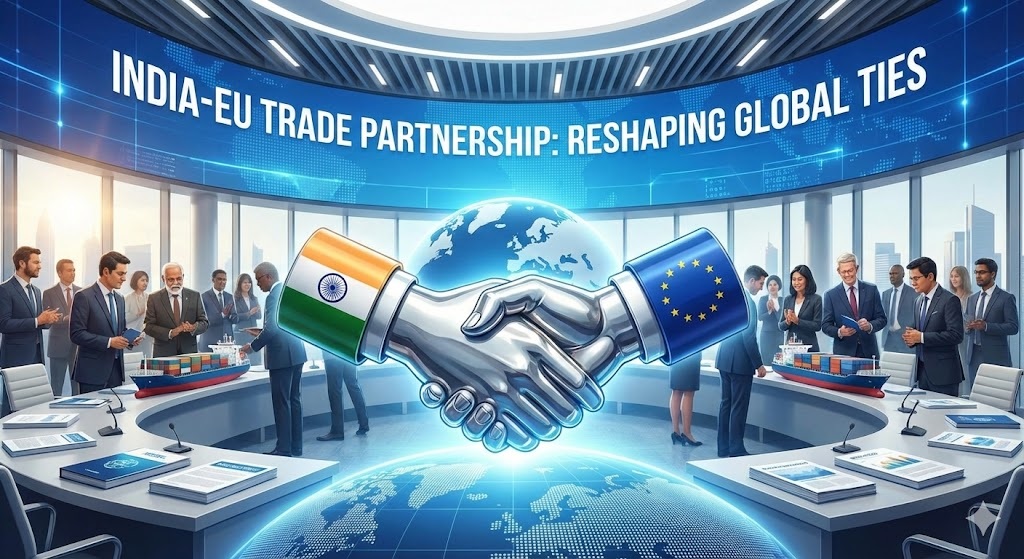
NEW DELHI : The European Union and India are preparing to unveil what officials on both sides are calling the “mother of all free trade agreements” as leaders gather in New Delhi on 27 January for the 16th EU-India Summit, a meeting expected to reset one of the world’s most consequential economic relationships.
At the heart of the summit will be the adoption of a joint EU-India Comprehensive Strategic Agenda, aimed at elevating cooperation far beyond trade to include supply chains, technology, climate policy and geopolitical coordination. But it is the long-awaited free trade agreement (FTA)—now nearing political closure after years of stalled negotiations—that has drawn the greatest attention in global capitals and corporate boardrooms.
Why It is Being Called the “Mother of All FTAs”
The scale of the proposed deal is unprecedented for India and rare even by EU standards. Together, the EU and India represent a combined market of more than 1.8 billion people and nearly one-quarter of global GDP. Bilateral trade in goods and services, currently estimated at $180 billion annually, is projected to double to $360 billion within the next decade.
Unlike narrower trade pacts, the India-EU agreement spans tariffs, services, investment protection, regulatory alignment, digital trade and sustainable development. Officials describe it as a structural re-engineering of economic ties, rather than a simple tariff-cutting exercise, designed to anchor supply chains at a time of rising global fragmentation.
Tariffs: Big Cuts, But Clear Red Lines
One of the most closely watched elements of the deal is market access for European manufactured goods, particularly automobiles. Under the proposed framework, India plans to slash import tariffs on a limited number of EU-made cars priced above €15,000, reducing duties to 40 percent from current levels that can reach as high as 110 percent. Over time, those tariffs are expected to fall further, potentially reaching 10 percent.
The move represents a major breakthrough for European automakers such as Volkswagen, Mercedes-Benz, BMW and Renault, which have long argued that India’s high import duties effectively shut them out of the world’s fastest-growing large car market.
At the same time, New Delhi has drawn firm boundaries. Battery electric vehicles (EVs) will be excluded from tariff cuts for the first five years of the agreement, a deliberate effort to protect domestic manufacturers and safeguard billions of dollars in ongoing EV investments.
India has also resisted EU demands for near-total liberalisation. While Brussels pushed for eliminating tariffs on 95 percent of goods, Indian negotiators have capped concessions closer to 90 percent, preserving policy space in politically sensitive sectors.
Agriculture And Dairy Left Out
In a significant political signal, agriculture and dairy products have been excluded entirely from the pact. These sectors, which employ millions in India and remain highly protected in both economies, were always expected to be the most contentious areas. Their exclusion removes a major negotiating obstacle, while also underscoring the limits of trade liberalisation.
Gains for Indian Exporters
While Europe’s carmakers stand to benefit, Indian exporters are also positioned for substantial gains. Reduced tariffs and simplified regulatory standards are expected to boost exports of textiles, garments and jewellery to the EU market. Services trade, particularly in IT and professional services, is also set to expand under mobility and mutual recognition provisions.
Indian officials argue that the agreement will integrate domestic manufacturers into European supply chains, attract high-quality foreign investment, and accelerate technology transfer—especially in advanced manufacturing and clean energy.
Strategic Stakes Beyond Trade
The timing of the deal adds to its significance. Both sides view deeper economic integration as a strategic hedge against global uncertainty, including geopolitical tensions and supply-chain disruptions. For the EU, closer ties with India offer diversification beyond China. For India, the pact strengthens its ambition to become a global manufacturing and investment hub.
If announced as expected this week, the India-EU free trade agreement would mark one of the most ambitious trade undertakings in India’s modern economic history. Its sheer scale, economic reach and geopolitical impact explain why diplomats and analysts alike are calling it the “mother of all deals”—not merely a trade pact, but a long-term blueprint for strategic partnership between two of the world’s largest economic powers.
——— End of Article ———