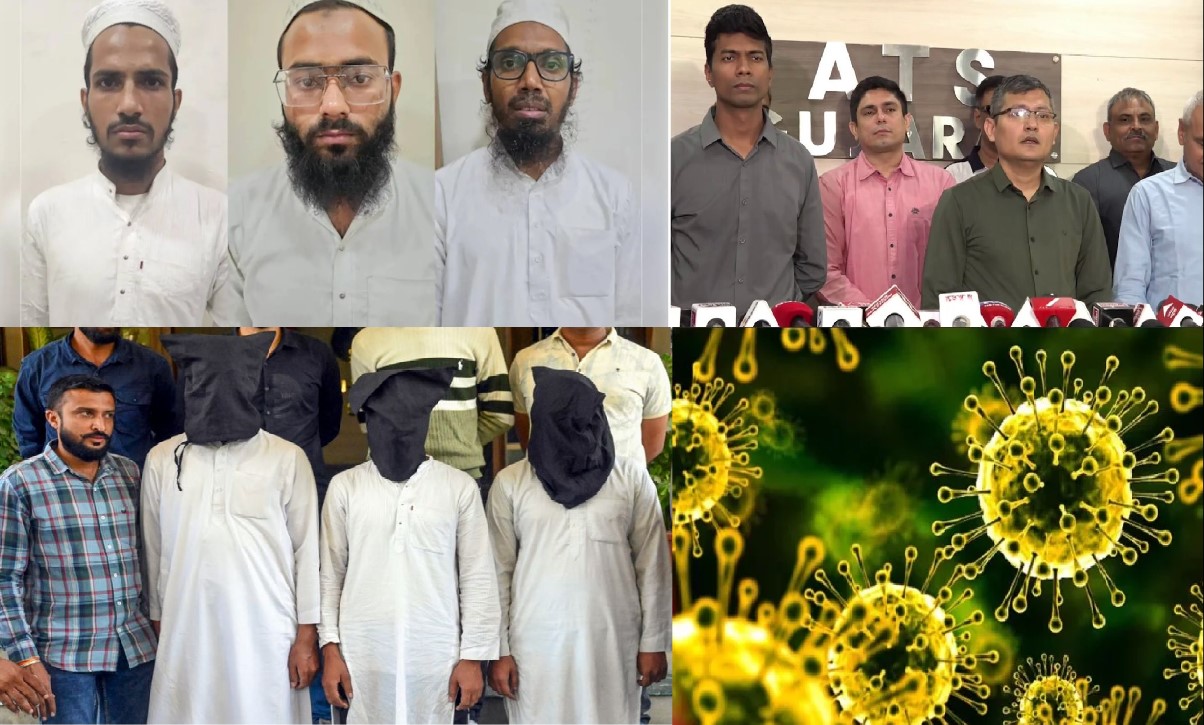
In a major counter-terror breakthrough in India, the Gujarat Anti-Terrorism Squad (ATS) has foiled what could have been one of the most catastrophic biological attacks in India’s history. Acting on precise intelligence, the ATS arrested three individuals — including a doctor with an MBBS degree (Dr. Ahmed Mohiyuddin Saiyed, who worked with Azad Suleman Sheikh and Mohammed Suhail Mohammad Saleem) — who were allegedly preparing the deadly toxin ricin, a biological agent that is nearly 6,000 times more lethal than cyanide and has no known antidote.
The Arrest and Discovery
The operation, conducted near Adalaj on the Ahmedabad–Mehsana highway, led to the arrest of Dr. Ahmed Mohiyuddin Saiyed, a 35-year-old medical graduate from Hyderabad who had earned his MBBS degree from China. Two accomplices from Uttar Pradesh were also taken into custody.
Investigators revealed that the group had already carried out reconnaissance of sensitive sites in Lucknow, Delhi, and Ahmedabad, including religious and political buildings.
During the raid, officials seized firearms, cartridges, chemical materials, and laboratory equipment used to extract ricin from castor beans. Digital evidence also linked the accused to Islamic State Khorasan Province (ISKP), an Afghanistan-based terror outfit. The suspects were reportedly in touch with a handler named “Abu Khadija”, who was providing operational guidance for the plot.
What Is Ricin and Why It’s So Dangerous
Ricin is a naturally occurring toxin derived from the waste product of castor bean processing — a plant commonly used to produce castor oil. While castor oil itself is harmless, the leftover material, called mash, contains ricin, which can be extracted and refined into a lethal biological poison.
Once inside the body, ricin halts protein synthesis, killing cells and causing multi-organ failure. Symptoms of poisoning can vary depending on the exposure route — ingestion, inhalation, or injection — but generally include severe vomiting, bloody diarrhea, respiratory distress, and rapid organ shutdown.
Even microgram quantities can be fatal, and there is no antidote. Treatment is limited to supportive care, making ricin one of the deadliest known biotoxins. The U.S. Centers for Disease Control and Prevention (CDC) lists ricin as a Category B bioterror agent, a classification for agents that can cause widespread illness and panic if released.
A New and More Insidious Form of Terrorism
Experts warn that this case reveals a new phase in terrorism — one moving beyond guns and bombs toward silent, mass-death weapons like biological and chemical agents.
Unlike traditional bomb attacks, which cause instant destruction and are easily visible, biological or toxin-based attacks are stealthier, slower, and harder to trace. Victims may take hours or even days to show symptoms, during which they can unknowingly spread contamination or panic.
Compared to older terror methods, this “new-generation attack” is far more dangerous:
-
Invisible and delayed: No explosion or smoke; the damage unfolds silently.
-
Difficult to detect: Ordinary security systems can’t identify toxins.
-
Impossible to treat effectively: No antidote for ricin means high mortality.
-
Psychological impact: The fear of an “unseen killer” spreads faster than the toxin itself.
-
Minimal logistical requirements: Ricin can be extracted from everyday castor seeds, making it easy to obtain yet devastating in effect.
Security analysts say terrorists are increasingly exploiting science and technology to bypass conventional defenses — blending chemistry, biology, and medical knowledge to create “next-generation” weapons of mass harm.
Global Precedents: Ricin and Biological Attacks Worldwide
While India has rarely faced a biological terror attempt, ricin and other toxins have been used or planned for use in attacks across the world, showing the global pattern of such threats.
-
1978 – The “Umbrella Assassination” (London):
Bulgarian dissident Georgi Markov was assassinated on a London street after being injected with a ricin pellet via a modified umbrella, allegedly by the KGB. He died three days later from multiple organ failure. -
2003 – Ricin Letter Attacks in the U.S.:
Several letters containing ricin were mailed to the White House and the U.S. Senate. The toxin was crudely made but potent enough to kill if inhaled or ingested. -
2013 – Ricin Letters to President Obama:
Another series of ricin-laced letters were sent to then-U.S. President Barack Obama and other officials. Though intercepted, they highlighted how easy it was for individuals to attempt bioterrorism using simple substances. -
1995 – Aum Shinrikyo Sarin Gas Attack (Tokyo):
The Japanese doomsday cult Aum Shinrikyo released sarin nerve gas in the Tokyo subway, killing 13 people and injuring over 1,000. The cult had also experimented with ricin and anthrax, proving how non-state actors could weaponize science. -
2018 – Ricin Attempt in Germany:
German police foiled a plot by a Tunisian national who had produced enough ricin to kill thousands. He planned to use it in a public area before being arrested. -
2020 – Ricin Envelope to the White House:
U.S. law enforcement intercepted a ricin-laced envelope addressed to then-President Donald Trump, again underscoring the recurring use of biological toxins as terror weapons.
These incidents, though geographically and politically varied, share a chilling theme — the accessibility of biological agents and the willingness of terrorists to use them for mass harm.
How Catastrophic the Indian Plot Could Have Been
If the Gujarat cell had succeeded in synthesizing and dispersing ricin, the results could have been devastating beyond imagination.
A small quantity released in a crowded metro station, shopping mall, or religious gathering could have killed hundreds within hours and left thousands sick — with no immediate way to stop the spread.
Because ricin acts silently, the initial symptoms could have been mistaken for food poisoning or viral infection, delaying medical intervention and increasing fatalities. The psychological and economic impact would have rivaled that of a major bomb attack — or worse.
The Suspects and Their Links
Investigations have revealed that Dr. Ahmed Mohiyuddin Saiyed was radicalized online and had been in close contact with operatives of ISIS-Khorasan (Islamic State Khorasan Province – ISKP), who guided him in preparing the deadly toxin Ricin. Communication records show that he used encrypted messaging platforms to receive detailed instructions from his handler, identified as Abu Khadija, a key figure within ISIS-Khorasan’s network operating from Afghanistan.
Saiyed’s medical background made him particularly dangerous — he possessed the scientific understanding of toxicology, chemistry, and human anatomy, enabling him to handle and potentially weaponize biological substances with precision.
His two accomplices were tasked with scouting potential targets across Ahmedabad, Lucknow, and Delhi, and procuring raw materials such as castor beans and chemical equipment needed for ricin extraction. The Gujarat ATS also seized foreign-made pistols, ammunition, and digital evidence, suggesting that the group intended to combine a biological attack with armed violence to maximize casualties and chaos.
Preliminary findings further indicate that the module had links to Pakistan-based intermediaries who may have facilitated funding, logistics, or ideological indoctrination. Investigators believe the group was part of a wider ISIS-Khorasan-backed network attempting to establish sleeper cells inside India.
The case has now been transferred to the National Investigation Agency (NIA) for a nationwide probe into the ISIS-Khorasan-linked ricin terror conspiracy, to trace all handlers, supporters, and cross-border connections involved.
Lessons and Significance
The Gujarat ATS operation represents a landmark success in Indian counter-terrorism. It exposed not just a terror cell but a new trend — the fusion of science, medicine, and terrorism into a weapon of silent destruction.
The case also shows the importance of intelligence-led policing, digital surveillance, and inter-agency coordination. The ATS’s quick action prevented what could have been a mass-casualty event, saving countless lives.
A Broader Security Wake-Up Call
This incident serves as a wake-up call for global and Indian security agencies. The nature of terrorism is evolving — from bombs to biology. The next generation of terror threats may come not from explosions but from colorless, odorless, and invisible killers like ricin, anthrax, or nerve agents.
India’s response now must focus on biosecurity, early detection, and rapid public health response systems. Training hospitals, emergency teams, and laboratories to recognize and contain chemical or biological attacks is essential to national preparedness.
——— End of Article ———