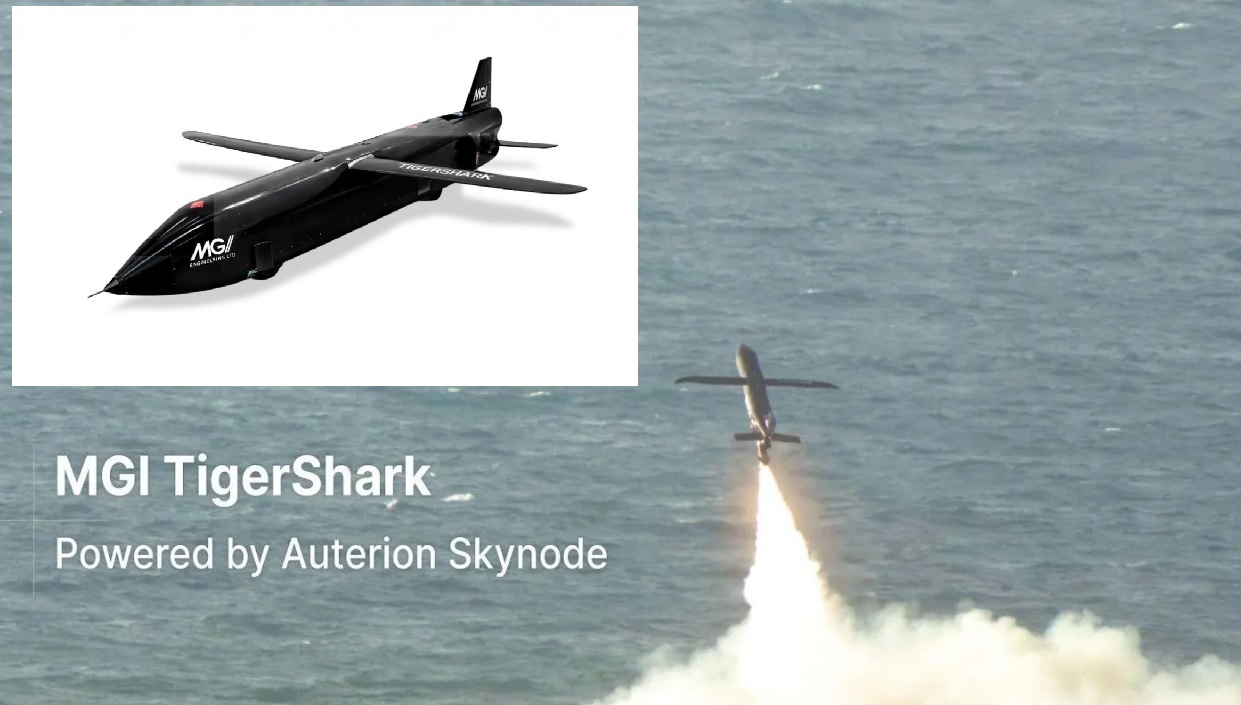
OXFORDSHIRE, UK — April 2, 2026 : MGI Engineering Ltd, in partnership with autonomous systems developer Auterion, has completed the first successful flight tests of the TigerShark uncrewed deep-strike platform. According to the companies, this marks the first successful European test of a newly developed autonomous system in this range and class in more than a decade.
The TigerShark was first presented publicly at the DSEI 2025 defence exhibition in London. It is positioned as a scalable, software-defined alternative to traditional high-end cruise missiles, combining MGI’s expertise in rapid prototyping and advanced systems engineering with Auterion’s open, vendor-agnostic software architecture.
Platform Design and Technical Characteristics
TigerShark is designed as a long-range, one-way attack uncrewed aerial vehicle (UAV) intended for deep-strike missions against high-value targets in high-intensity operational environments.
Technical specifications released by the companies indicate that the platform has an operational range exceeding 1,000 kilometres and a maximum cruising speed of up to 750 km/h. It can carry a payload of up to 300 kilograms, with compatibility for modular configurations including conventional warheads, electronic warfare payloads, or decoy packages.
The system has a maximum take-off weight of approximately 800 kilograms and an empty mass of 170 kilograms. Payload configurations are modular within the 200–300 kilogram range, enabling mission-specific adaptability.
TigerShark is designed to operate in contested environments, including scenarios where Global Navigation Satellite Systems (GNSS) are unavailable. It uses inertial navigation and terrain-mapping systems supported by onboard edge computing for guidance and targeting.
Launch options include ground-based deployment using Rocket-Assisted Take-Off (RATO) as well as vehicle-mounted launch systems. The platform is engineered for salvo operations, allowing multiple units to be launched in coordinated sequences to saturate air defence systems.
The estimated unit cost is approximately $549,000, placing it competitively within the category of compact cruise missile systems while offering a comparatively higher payload capacity.
Software Architecture and System Integration
The TigerShark platform integrates Auterion’s Skynode-N flight controller and software stack, forming the basis of a software-defined architecture. This enables continuous updates, rapid deployment cycles and interoperability across different mission profiles.
The open systems design allows compatibility with third-party sensors, payloads and software, supporting integration into a wide range of operational frameworks. The architecture is intended to support long-term scalability and adaptability without requiring major hardware redesigns.
MGI Engineering applied a “spiral development” methodology to the platform, drawing on its background in motorsport engineering to accelerate iteration cycles and system refinement.
Statements from Company Officials
Mike Gascoyne, Chief Executive Officer of MGI Engineering, stated that the program reflects the company’s engineering approach focused on rapid development and operational requirements.
He said the collaboration with Auterion enabled the integration of autonomous capabilities into a flexible system designed for future upgrades and evolving mission demands.
James East, UK General Manager at Auterion, stated that the project demonstrates the role of software-driven development in advancing autonomous systems. He noted that combining platform design with open architecture enables systems to evolve through software updates, improving capability and interoperability over time.
Development Context and Related Systems
The TigerShark builds on MGI’s earlier SkyShark platform, a tactical mid-range strike UAV with a range of approximately 250 kilometres and a payload capacity of 20 kilograms. While SkyShark is designed for shorter-range missions, TigerShark extends the same modular and scalable design principles into long-range strike operations.
The platform is manufactured in the United Kingdom and is export-licensable, according to MGI Engineering.
Operational Role and Strategic Relevance
Systems such as TigerShark are intended to complement traditional cruise missiles by providing a lower-cost option capable of being deployed in larger numbers. Defence analysts assess that such platforms can play a role in anti-access and area denial (A2/AD) environments by increasing strike mass and complicating air defence responses.
The ability to conduct operations in GNSS-denied and communications-contested environments aligns with current operational requirements observed in modern conflicts.
Future Development Plans
MGI Engineering and Auterion indicated that the successful flight tests mark the beginning of a broader development roadmap. The partnership is expected to expand into additional autonomous systems and capabilities aimed at defence, security and complex mission applications.
Auterion’s technology is currently used by multiple defence organisations, including the United States Department of Defense, the United Kingdom Ministry of Defence, the German Bundeswehr and the Armed Forces of Ukraine. The companies stated that ongoing collaboration will focus on delivering operational flexibility through continued software and system development.
——— End of Article ———