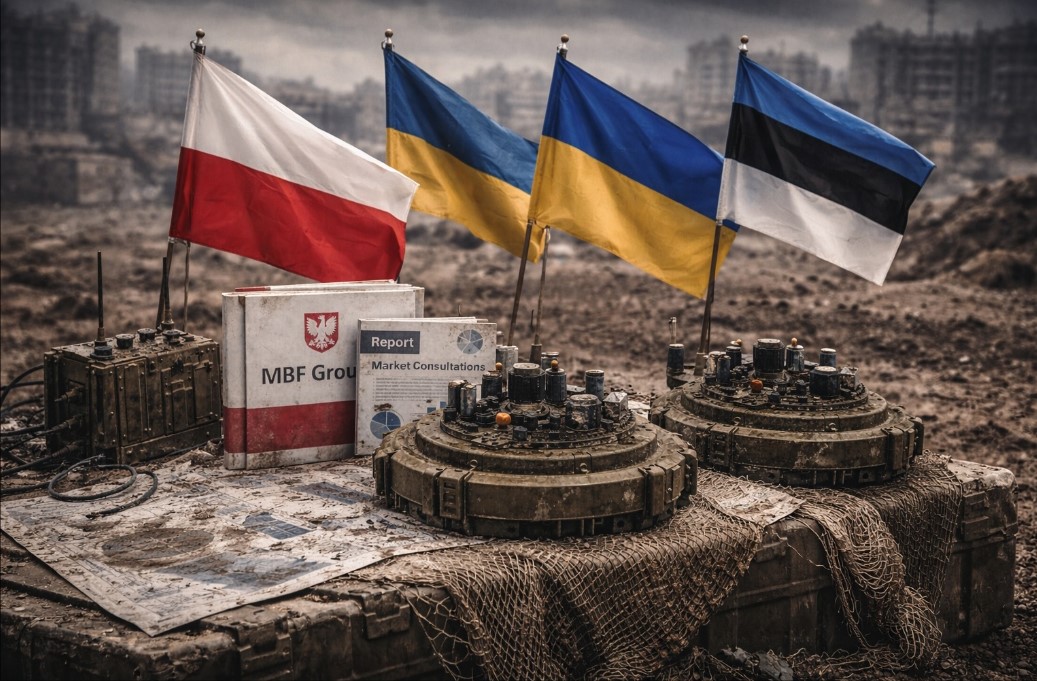
WARSAW — March 23, 2026 : MBF Group S.A., a company listed on the Warsaw Stock Exchange’s NewConnect market since 2012, has established a multinational defense consortium to participate in Poland’s ongoing efforts to modernize battlefield protection systems and border security infrastructure. The initiative brings together partners from Estonia and Ukraine and focuses on deployment-ready, electronically enhanced anti-personnel mine systems and dual-use defense technologies.
Consortium Formation and Structure
The consortium was formed through a multi-stage legal and organizational process completed in March 2026. A Non-Disclosure Agreement (NDA) was signed on March 17, followed by a Memorandum of Understanding (MoU) on March 19, disclosed in Current Report No. 14/2026. A formal consortium agreement was subsequently concluded on March 20 and disclosed in Current Report No. 15/2026.
The partnership integrates MBF Group S.A. as the lead entity, a technology partner headquartered in Tallinn, Estonia, and an affiliated engineering and production base in Kharkiv, Ukraine. The identity of the Estonian partner has not been publicly disclosed due to confidentiality requirements and the protection of commercial interests.
Under the agreed structure, MBF Group serves as the domestic consortium leader, responsible for project coordination, regulatory compliance, and direct engagement with Polish defense institutions. This arrangement satisfies national procurement requirements mandating the participation and leadership of a Polish-based entity in defense tenders.
Submission to the Armament Agency
On March 20, 2026, the consortium submitted an application to participate in preliminary market consultations conducted by the Polish Armament Agency (Agencja Uzbrojenia), the central procurement body of the Ministry of National Defence. The submission, disclosed in Current Report No. 16/2026, relates specifically to the potential procurement of anti-personnel mine systems.
These consultations represent an initial stage in the procurement process, during which the agency evaluates available technologies, gathers technical input, and assesses market readiness for future tenders. MBF Group indicated that further disclosures will follow if the project progresses to formal tender participation or contract award phases. No financial commitments or contract values have been announced.
Technical Concept and System Design
The consortium’s proposal focuses on upgrading conventional battlefield denial systems through the integration of advanced electronic control, sensing, and communication technologies. The systems under consideration include directional, pop-up, and omnidirectional surface-deployed configurations.
Core technical features outlined in the submission include integrated seismic and acoustic sensors designed to detect and classify approaching targets, remote initiation capabilities enabling controlled activation from a distance, and distributed control systems operating over encrypted radio frequency (RF) mesh networks.
This architecture enables decentralized, self-organizing communication between system components. Each node within the network can relay data independently, allowing the system to maintain functionality even if individual elements are disrupted or destroyed. The design is intended to improve resilience and operational continuity in environments affected by electronic warfare and signal interference.
Role of Mesh Networking in Operational Environments
The use of RF mesh networking is central to the system’s operational concept. Unlike traditional centralized communication systems, mesh networks function without reliance on fixed infrastructure. This allows battlefield protection systems to adapt dynamically, rerouting data through alternative nodes in the event of jamming, signal degradation, or physical damage.
Such configurations enhance situational awareness and provide operators with sustained control over distributed assets in contested environments. The approach aligns with broader trends in modern military systems, where decentralization and redundancy are increasingly prioritized.
Production Readiness and Industrial Capacity
According to information provided by the consortium’s technology partner, the proposed solutions have achieved at least Technology Readiness Level 7 (TRL 7), indicating that prototypes have been demonstrated and validated in operational conditions.
The partner has also demonstrated established production capabilities, including the manufacture and delivery of more than 30,000 electronic components currently in use within active systems. This level of industrial maturity positions the consortium to offer systems that are largely deployment-ready, rather than requiring extended development timelines.
By focusing on scalable production and proven technologies, the consortium aims to reduce the time required for field deployment compared to traditional defense acquisition programs, which often span multiple years.
Strategic and Regional Context
The consortium’s proposal reflects evolving defense priorities across Central and Eastern Europe. Countries including Poland, Estonia, Latvia, Lithuania, and Finland are increasingly emphasizing rapidly deployable, scalable solutions for border security and battlefield protection.
This shift is influenced by changing regional security dynamics and ongoing discussions around policy frameworks such as the Ottawa Convention. Several countries in the region have taken steps to reassess or expand their capabilities related to area-denial systems and integrated defensive technologies.
Parameters outlined in the Armament Agency’s consultations suggest that any future procurement program could involve substantial multi-year supply volumes, potentially reaching several million units of core systems and hundreds of thousands of training units.
MBF Group’s Expanding Role in Defense
MBF Group S.A., headquartered at ul. Bysławska 82 in Warsaw, has historically focused on wholesale distribution across multiple sectors, including food products, agricultural commodities, chemicals, technical equipment, and fuels.
In recent years, the company has expanded its activities into defense and security technologies. It was also recognized with the Forbes Diamonds 2026 award, reflecting growth in market value.
Participation in the Armament Agency’s preliminary consultations marks a formal step in MBF Group’s entry into the defense procurement sector. The company has stated that it will continue to provide updates through official disclosures as the project advances through subsequent stages of evaluation and potential procurement.
——— End of Article ———