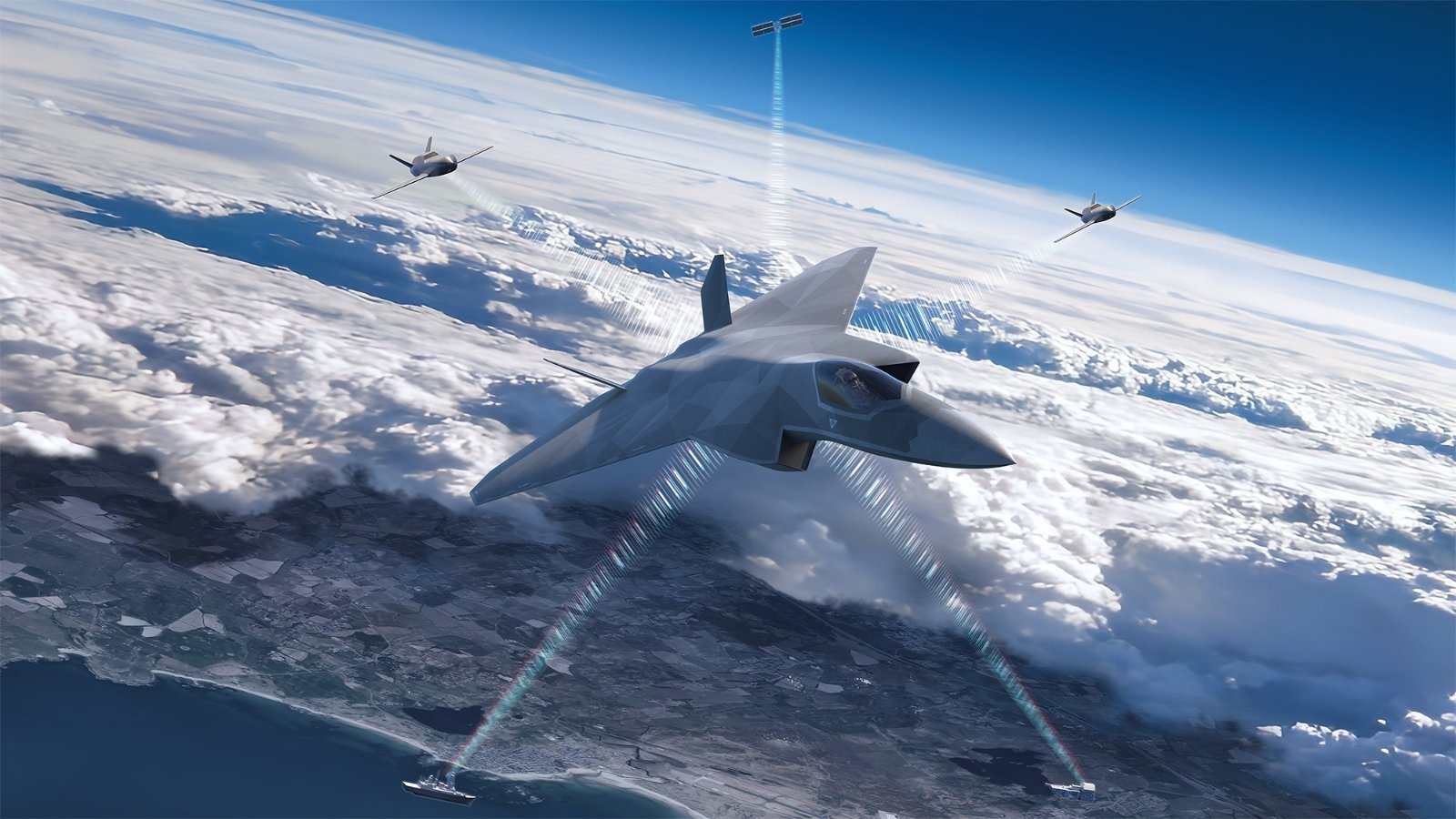
WASHINGTON / PALMDALE : More than a decade before “Unidentified Anomalous Phenomena (UAP)” entered the mainstream political vocabulary, Lockheed Martin was already describing aircraft that no longer behaved like aircraft at all. In plain sight, through patents, DARPA briefings, and academic partnerships, the world’s largest defense contractor outlined technologies that blurred the line between machine and organism. Eleven years later, as military pilots and radar operators report objects that accelerate without inertia, maneuver without wings, and coordinate without radio chatter, the uncomfortable question is no longer whether such performance is possible — but how long it has already been operational.
If this was the public-facing edge of American aerospace research in the mid-2010s, analysts are now asking what lies beyond the curtain of classified “black programs.”
A Technological Trail Hidden in Plain Sight
Between 2012 and 2016, Lockheed Martin’s Skunk Works, working alongside DARPA and the U.S. Air Force Research Laboratory, published and patented research into morphing aircraft structures, structural energy storage, adaptive skins, and autonomous cooperative systems. None of this work was speculative science fiction. It was incremental, peer-reviewed engineering, often presented openly at aerospace conferences.
What remained largely invisible was how these research streams were designed to converge.
Carbon nanotube (CNT)-reinforced composites promised aircraft skins that could sense stress, temperature, and electromagnetic energy while simultaneously storing electrical power. Shape-memory alloys (SMAs) and electroactive polymers offered structures capable of bending and twisting without hinges or hydraulics. In parallel, artificial intelligence research focused on distributed autonomy, enabling multiple vehicles to function as a single adaptive system rather than isolated platforms.
Individually, each advance was revolutionary. Together, they pointed to aircraft that were no longer rigid machines, but reconfigurable systems capable of real-time adaptation.
When the Skin Becomes the Aircraft
At the core of this transformation lies advanced materials science.
Carbon nanotubes — cylindrical carbon structures thousands of times thinner than a human hair — possess exceptional tensile strength, electrical conductivity, and electromagnetic properties. By embedding CNT networks directly into composite airframes, engineers eliminated the traditional separation between structure, wiring, sensors, and power storage.
In these designs, the aircraft skin itself becomes a load-bearing structure, a distributed sensor array, and a structural battery. Electrical energy is stored across the surface of the vehicle rather than in centralized fuel tanks or battery packs. Power flows through the airframe itself, reducing weight and enabling near-instant energy transfer to propulsion and control systems.
The implications are profound. Without bulky engines, fuel systems, or mechanical control linkages, aircraft can be smaller, lighter, and far more energy-efficient. Just as critically, the absence of concentrated heat sources dramatically reduces infrared signatures, complicating detection by traditional tracking systems.
Shape Without Surfaces
One of the most striking features reported in recent encounters is the absence of visible wings, flaps, or rudders — a detail that aligns closely with morphing aircraft research initiated more than fifteen years ago.
Instead of moving parts, these vehicles alter their shape by reconfiguring their internal material structure.
Shape-memory alloys contract or expand when electrically stimulated. Electroactive polymers flex and stiffen in response to voltage. Embedded beneath a seamless composite skin, these materials allow the entire airframe to warp smoothly, altering lift, drag, and direction without external articulation.
To human observers, such motion appears unnatural. There is no banking turn, no roll, no visible aerodynamic transition. The object simply changes direction. From an engineering perspective, the forces are distributed across the entire structure, enabling extreme maneuvers that would tear conventional metal aircraft apart.
Intelligence Without Pilots
Equally disruptive is the shift from piloted aircraft to distributed autonomous systems.
Lockheed Martin’s research into heterogeneous swarms envisioned groups of vehicles — air, sea, and ground — operating as a single cognitive entity. Each platform contributes sensing, processing, and decision-making capacity to the collective system.
Rather than relying on continuous radio transmissions, these swarms use short-range, low-probability-of-intercept communication and onboard AI models trained to predict the behavior of neighboring units. Information propagates through the network almost instantaneously, enabling coordinated action without centralized control.
To radar operators or fighter pilots, such formations can appear to split, merge, and react as though controlled by a single mind. What looks like impossible coordination is, in reality, distributed artificial intelligence operating faster than human perception.
The Black Convergence
Defense analysts increasingly believe that today’s most puzzling sightings result not from a single breakthrough, but from the convergence of multiple mature technologies.
Structural batteries remove traditional endurance limits. Morphing skins eliminate aerodynamic constraints. Swarm intelligence provides omnipresent situational awareness.
Combined, these systems produce a platform that does not fly in the conventional sense. It pulses energy rather than throttling engines. It changes shape rather than deflecting control surfaces. It coordinates silently rather than communicating audibly. Radar cross-sections fluctuate. Infrared signatures fade. Visual profiles shift with viewing angle.
“These systems don’t violate physics,” says Dr. Elena Kovac, an aerospace systems analyst familiar with classified and unclassified programs. “They violate expectations. We’re still looking for airplanes. These aren’t airplanes anymore.”
A Quiet Global Competition
The United States is widely regarded as the leader in this domain, with Lockheed Martin Skunk Works and DARPA at the center of development. Notably, several high-profile UAP encounters occurred near U.S. Navy training and testing ranges, fueling speculation that at least some sightings involve American black-program assets.
China has invested aggressively in graphene, carbon nanotube manufacturing, and AI-driven swarm warfare, framing its approach as “intelligentized conflict.” Chinese military literature openly discusses distributed autonomous systems designed to overwhelm technologically superior forces through coordination rather than firepower.
Russia, though economically constrained, remains strong in advanced metallurgy and hypersonic materials, particularly alloys capable of surviving extreme thermal and structural stress. Analysts remain skeptical, however, of Moscow’s ability to integrate these technologies at scale.
Other nations — including the United Kingdom, Japan, and France — are pursuing elements of adaptive materials, autonomous systems, and next-generation airframes, often through multinational research programs.
Rethinking the “Unidentified”
As governments debate transparency and disclosure, a growing number of experts argue that many “unidentified” sightings may reflect technological surprise rather than extraterrestrial origin. Programs conceived in the early 2010s may now be operational, their capabilities so far removed from legacy aircraft that they defy casual classification.
What once appeared impossible may simply be unfamiliar.
When an aircraft is its own sensor, its own battery, its own computer, and part of a larger thinking system, it stops behaving like a vehicle and starts behaving like an adaptive organism. In the skies above test ranges and coastlines, the future may already be flying — misidentified not because it is alien, but because it arrived earlier, and far more advanced, than anyone expected.
——— End of Article ———