Washington : Lockheed Martin has completed the first successful multi-aircraft flight demonstration of its Sniper Networked Targeting Pod (NTP), validating real-time targeting data exchange between two F-16 Fighting Falcon fighter jets and a ground station. The test represents a significant step in enabling digitally connected air operations using existing combat aircraft.
According to the company, the demonstration showed that trusted targeting data can now be shared in seconds rather than minutes, supporting simultaneous intelligence, surveillance, reconnaissance and strike activities. The flight test confirms that the Sniper system has transitioned from a standalone precision sensor to an active networking and data-distribution node within the battlespace.
Transition from Standalone Sensor to Network Node
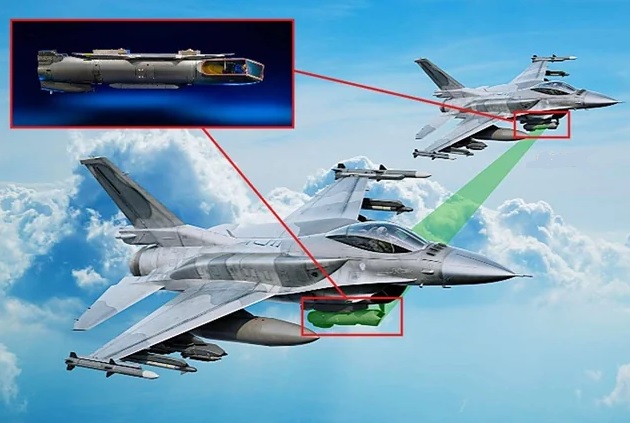
The Sniper NTP is an upgraded variant of the Sniper Advanced Targeting Pod, retaining the same external form factor while integrating extensive internal hardware and software enhancements. These upgrades are enabled through a Hybrid Base Station architecture, allowing advanced communications and processing functions without structural modification to the host aircraft.
During the January 30 flight, the system demonstrated secure, bidirectional data sharing between two airborne F-16s and a ground element, including imagery, target tracks and weapon-quality coordinates transmitted in real time.
Networking and Data Processing Capabilities
A core enhancement of the Sniper NTP is the addition of secure mobile ad hoc network (MANET) radios and encrypted datalinks. These allow participating aircraft to form a decentralized mesh network, automatically re-routing data if a communications path is degraded or disrupted.
The pod also incorporates increased onboard processing power, enabling edge computing functions. This allows sensor data processing and filtering to occur directly on the aircraft, reducing dependence on external relay systems and shortening decision timelines during operations.
Sensor Performance and Targeting Functions
The Sniper NTP retains the full sensor suite of the Sniper family, including high-definition mid-wave infrared (FLIR) sensors, a stabilized electro-optical TV camera, and a dual-mode laser designator and rangefinder. These sensors provide long-range detection and identification and generate precision coordinates suitable for GPS-guided and laser-guided munitions.
By combining these sensors with real-time networking, the system enables cooperative targeting, allowing one aircraft to maintain persistent surveillance while another aircraft conducts the weapon release based on shared data.
Impact on Kill Chain Timing
The demonstration focused on reducing latency across the kill chain, from target detection to engagement. Traditionally sequential processes can now occur in parallel, with airborne crews and ground controllers accessing a single, synchronized tactical picture.
This shared situational awareness supports faster coordination, improved target validation, and reduced risk of misidentification, particularly in complex or congested airspace.
Modernization of Existing Fighter Fleets
The Sniper NTP is designed as a fleet modernization solution for fourth-generation aircraft, particularly the F-16, without requiring extensive avionics redesigns or new aircraft procurement. Its plug-and-play architecture allows operators to add networked combat capability through an external pod already familiar to maintenance and aircrew personnel.
With more than 1,650 Sniper pods currently in global service, the networked upgrade provides a scalable pathway for air forces to maintain digital interoperability with evolving operational standards.
Integration with Fifth-Generation Platforms
The system is intended to operate alongside fifth-generation aircraft, including the F-35 Lightning II. In integrated operations, an F-35 can use its advanced sensors to detect and classify targets, then transmit precise targeting data through the Sniper NTP to an F-16, which can execute the strike using stand-off weapons.
This approach combines advanced sensing with the larger weapons payloads of existing fighter fleets, extending operational effectiveness without new airframe development.
——— End of Article ———