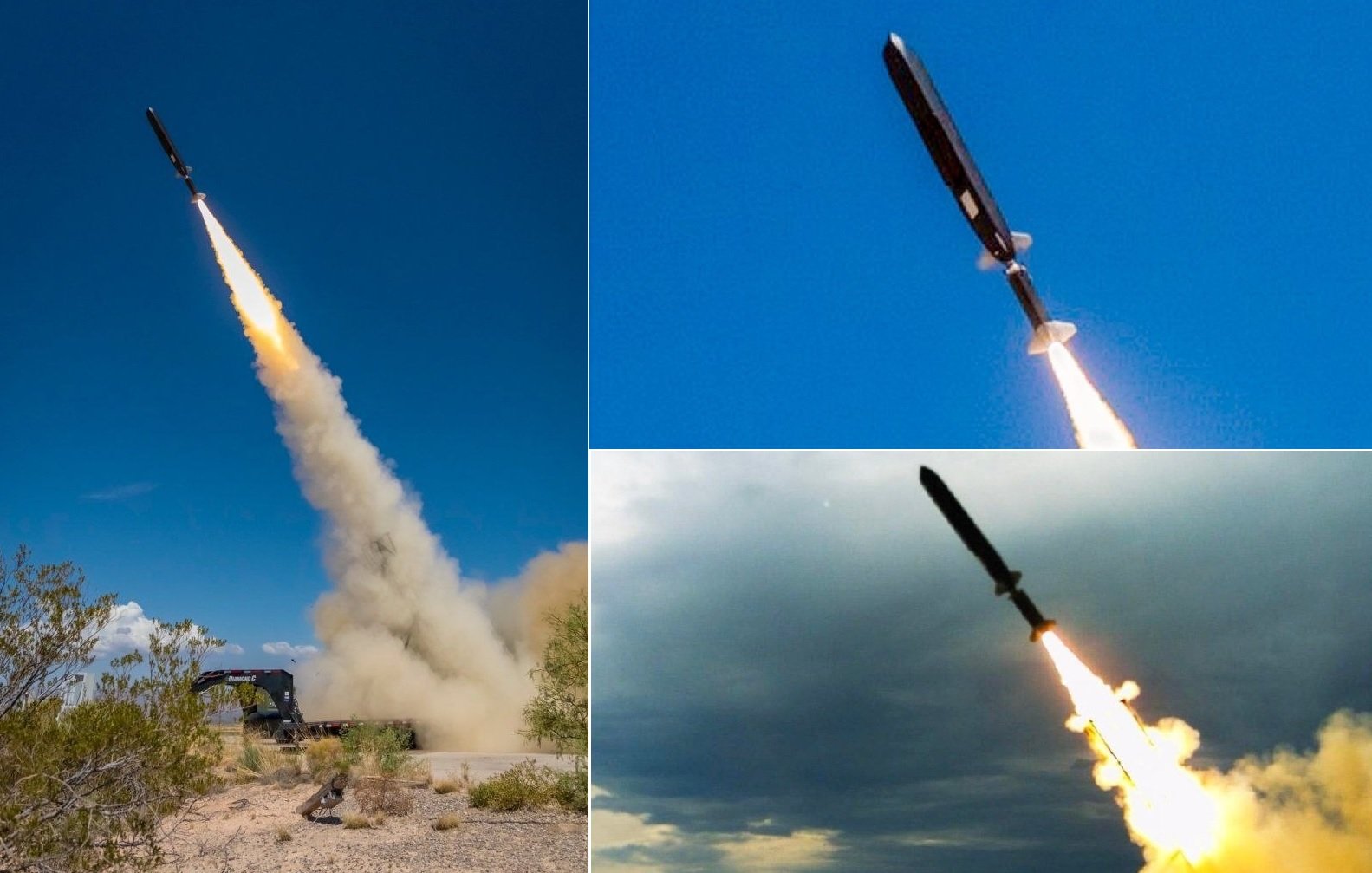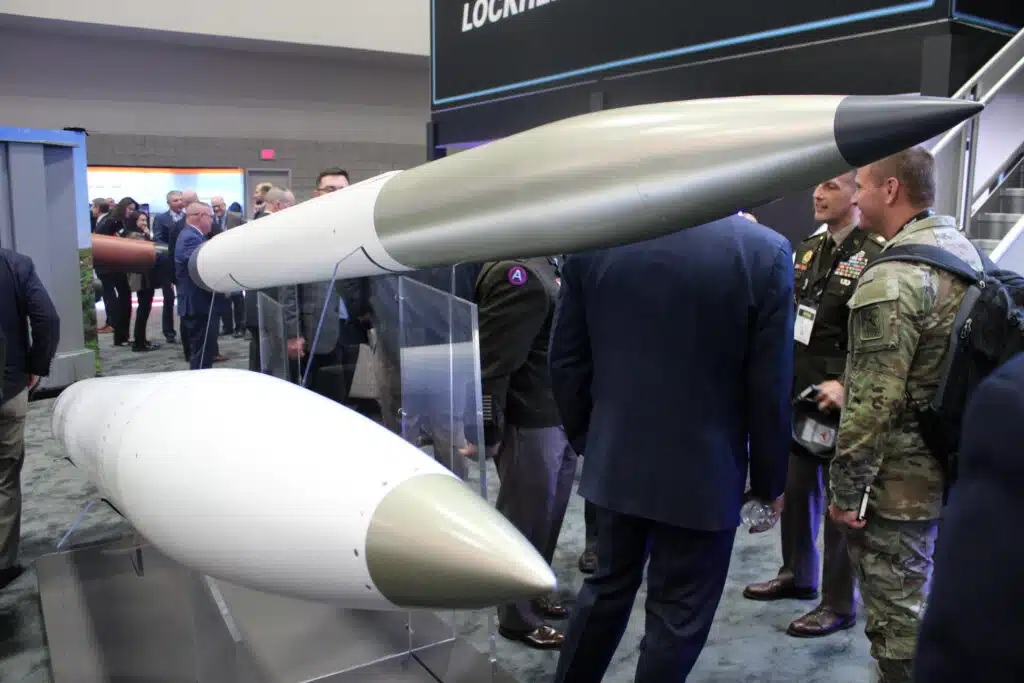
Lockheed Martin is advancing its Precision Strike Missile (PrSM) family, unveiling a prototype of the Increment‑4 variant and beginning a flight-test program that will continue through 2026 and 2027. The company is also testing the Increment‑2 anti-ship variant and exploring a ship-launched PrSM capability from Mk 41 Vertical Launch System (VLS) cells on U.S. Navy surface ships.
The Increment‑4 PrSM prototype was displayed publicly for the first time at AUSA 2025, with initial flight tests scheduled for 2026. Additional tests are planned through 2027 as the design matures and evaluations continue. Alongside Increment‑4, Lockheed Martin is preparing to test the Land-Based Anti-Ship Missile (LBASM), a variant equipped with a multi-mode electro-optical/infrared (EO/IR) seeker, against moving targets in early 2026.
Scott Prochniak, Principal for Strategy & Business Development at Lockheed Martin Missiles & Fire Control, described the performance of Increment‑4, explaining that the missile has a dual-mode motor capable of extreme offset launches and a range requirement of approximately 800 kilometers. He noted that the missile does not need to fly in a straight line to reach its target, providing flexibility in operational scenarios. Paula Hartley, Vice President and General Manager for Tactical Missiles, confirmed that several subcomponent tests have already been conducted to prepare for the 2026 demonstration flight.
The PrSM family includes multiple increments. Increment 1 is the baseline land-attack missile, while Increment 2 is the anti-ship variant equipped with a terminal seeker. Lockheed Martin plans to reuse the Increment‑2 seeker on Increment‑4 to maintain cost efficiency and commonality across the missile family. The LBASM variant adds a multi-mode EO/IR seeker to the standard ballistic airframe to engage moving maritime targets. The Increment‑4 design integrates a dual-mode motor and terminal seeker to strike targets at long ranges beyond 800 kilometers.
The propulsion system of Increment‑4 enables extended range without discarding boosters, allowing for safe launches over land, water, or friendly forces. The missile’s terminal seeker, shared with the LBASM and similar to Lockheed’s LRASM seeker, provides moving-target engagement capabilities, which is essential for anti-ship missions and relocatable land targets.
Increment‑4 is primarily focused on launches from HIMARS platforms, but discussions with the U.S. Navy regarding Mk 41 VLS integration are ongoing, which could extend its capability to surface combatants. Lockheed Martin currently produces about 120 PrSMs per year in a largely automated facility next to the ATACMS production line, with plans to scale production to 400 missiles annually before 2030. The same production line will accommodate Increment‑4 because of shared components and electronics.
The testing timeline includes Increment‑4 display and subcomponent tests in 2025, LBASM flight testing in early 2026, the first Increment‑4 flight test in 2026 to demonstrate long-range performance, and continued Increment‑4 testing through 2027.
If the Increment‑4 and anti-ship variants meet performance expectations, they will provide U.S. forces with long-range precision strike and moving-target engagement capabilities. The ship-launched option could extend these capabilities to surface combatants, improving flexibility for operational planning. The commonality of seekers and electronics across the PrSM family also reduces costs and simplifies logistics, supporting faster deployment of these systems.
Lockheed Martin’s PrSM family is thus positioned to include anti-ship, long-range maneuvering, and ship-launched variants, supporting future long-range precision strike requirements with a combination of shared components, extended range, and flexible launch options.
——— End of Article ———