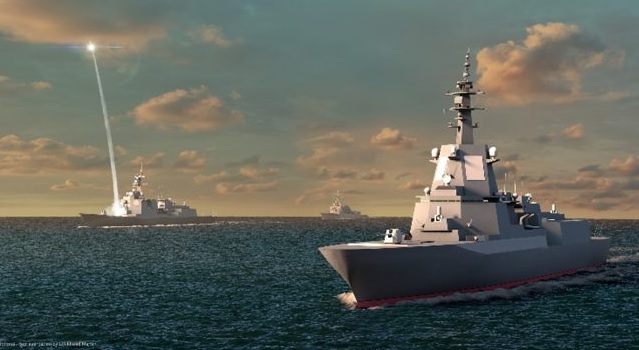
MOORESTOWN, N.J. — March 23, 2026 : Lockheed Martin, in coordination with the U.S. Department of Defense, the Missile Defense Agency (MDA), and Japan’s Ministry of Defense (JMOD), has completed the first live target tracking exercise using the AN/SPY-7(V)1 radar as part of Japan’s Aegis System Equipped Vessel (ASEV) program.
The exercise was conducted under the Japan Flight Test Experiment Aegis Weapon System (JFTX)-01 framework on March 17 and 19, 2026, off the east coast of the United States. It involved two separate live ballistic target launches and represents a key validation step for Japan’s next-generation sea-based missile defense capability.
Live Target Tracking and System Validation
During the trials, the SPY-7 radar, integrated with the Aegis Weapon System in an operational configuration, demonstrated full-spectrum functionality across the engagement sequence.
The system successfully performed long-range search and detection of incoming targets, maintained continuous tracking, and accurately classified ballistic threats. It also demonstrated discrimination capability, distinguishing real targets from background clutter or potential decoys, before completing the sequence with simulated engagement events.
These results confirm the operational maturity of the integrated SPY-7 Aegis System and validate its readiness for deployment in a maritime ballistic missile defense role.
The radar unit used during the exercise will be delivered to Japan and installed on the first ASEV platform, meaning the tested hardware will transition directly from evaluation to operational deployment.
SPY-7 Radar and Aegis Integration
The AN/SPY-7(V)1 is an S-band active electronically scanned array (AESA) radar developed by Lockheed Martin. It is derived from the Missile Defense Agency’s Long Range Discrimination Radar and is designed to address complex and evolving ballistic missile threats.
The system enables simultaneous tracking and engagement of multiple targets and is fully integrated with the Aegis combat system. Its software-defined architecture allows for updates and adaptability as threat environments evolve.
Japan’s Ministry of Defense has now completed initial detection and tracking trials under the ASEV program, including both simulated and live missile scenarios. The results confirm the radar’s ability to support a 360-degree, sea-based ballistic missile defense capability.
Industrial Delivery and Integration Process
Lockheed Martin delivered the first ASEV shipset of four SPY-7 radar antennas to Japan in June 2025, followed by a second shipset delivered on March 12, 2026. Each shipset undergoes full system integration and testing at the company’s Production and Test Center in Moorestown prior to shipment.
This integration approach is intended to reduce technical risk and support adherence to the planned delivery schedule. The system tested during JFTX-01 will now proceed through final data analysis before being packaged for transfer to Japan.
ASEV Platform and Capabilities
Japan plans to field two ASEV ships as part of its maritime missile defense architecture. The vessels are expected to measure approximately 190 meters in length with a displacement of around 12,000 tons, making them larger than the existing Maya-class destroyers.
Each ship is expected to be equipped with 128 Mk. 41 Vertical Launch System (VLS) cells, capable of deploying interceptors such as the SM-3 Block IIIA and SM-6. This configuration is intended to provide layered defense against ballistic and advanced aerial threats.
The ASEV program was developed following the cancellation of Japan’s land-based Aegis Ashore system and represents a shift toward mobile, sea-based missile defense.
Operational and Strategic Context
The test campaign was led by the Missile Defense Agency in coordination with the Japan Maritime Self-Defense Force. It provides Japan with operational data on both the current Aegis baseline and the new SPY-7 configuration under realistic conditions.
According to Lockheed Martin, the successful exercise demonstrates the system’s readiness to detect, track, and engage threats while supporting rapid integration timelines in cooperation with U.S. and Japanese defense institutions.
The program forms part of Japan’s broader effort to strengthen its missile defense posture in response to evolving regional threats. In addition to Japan, the SPY-7 radar is also being developed for other international programs, including Canada’s River-class destroyers and Spain’s F-110 frigates.
Program Timeline
Japan’s Ministry of Defense plans to commission the two ASEV ships in fiscal years 2027 and 2028. Following delivery of the radar systems, the vessels will undergo additional land-based integration and at-sea testing before entering operational service.
No additional test schedules or detailed performance metrics beyond confirmed detection, tracking, and discrimination capabilities have been released.
——— End of Article ———