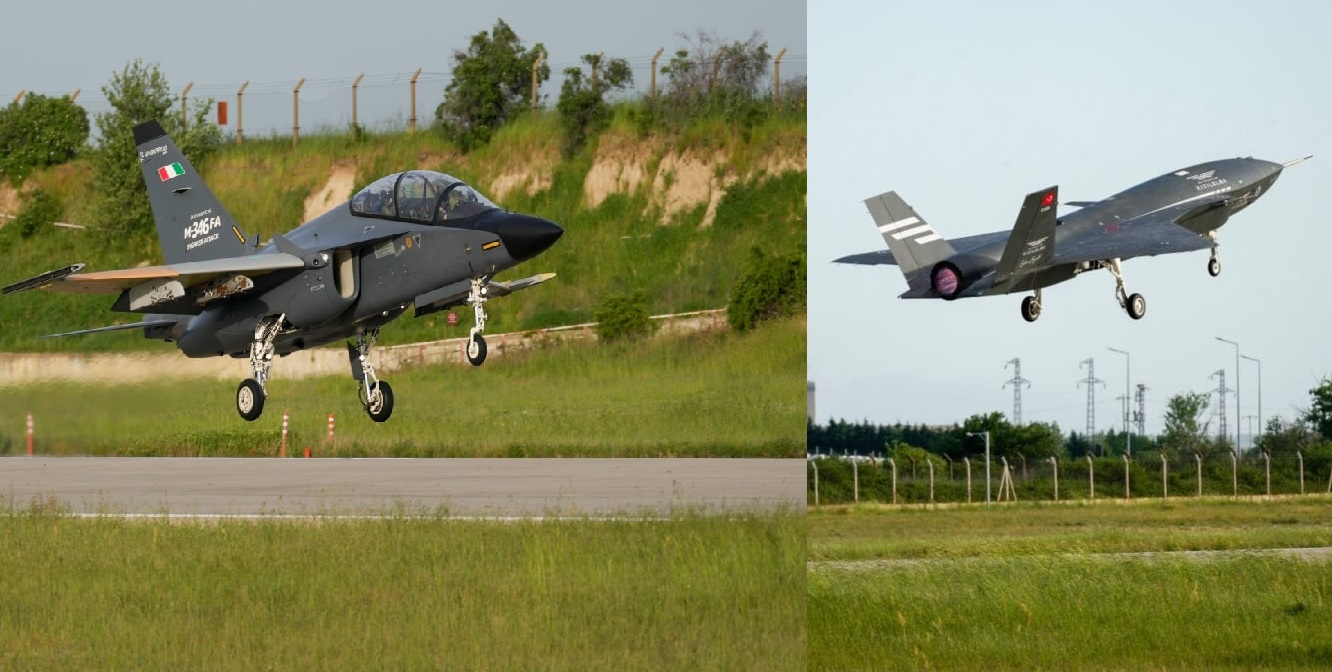
Rome/Istanbul, — June 22, 2026 : Italian defense company Leonardo and Turkish drone manufacturer Baykar have successfully completed the first phase of live flight testing under the K-SWARM programme, a joint initiative focused on developing Crewed/UnCrewed Teaming (CUC-T) and interoperability between manned combat aircraft and autonomous unmanned aerial systems.
The flight campaign was conducted in May 2026 at Baykar’s flight and test center in Çorlu, Türkiye, marking the programme’s transition from simulator-based validation to live flight operations.
First Live Flight Campaign
The tests involved three aircraft: a Leonardo-owned M-346 Fighter Attack (FA) aircraft acting as the command platform, a Bayraktar KIZILELMA uncrewed combat aircraft, and an Italian Air Force T-346A serving as a chase aircraft for mission monitoring and data collection.
The campaign began with KIZILELMA performing an autonomous taxi and take-off before using Baykar’s Smart Fleet Autonomy algorithms to locate and rejoin the M-346 in flight. After the formation was established, pilots aboard the M-346 assumed tactical control of the uncrewed aircraft through a newly integrated avionics suite and dedicated crewed-uncrewed computing system.
During the flights, the M-346 crew directed a series of manoeuvres including position changes, separations and rejoins. KIZILELMA successfully executed each command autonomously while maintaining formation integrity and responding accurately to pilot instructions.
Technology Integration
The programme combines Leonardo’s expertise in avionics, flight control systems and cybersecurity with Baykar’s autonomous flight technologies.
Flight tactics, procedures and algorithms were developed by Leonardo’s Avionic and Flight Control Innovation Labs and PC2LAB in Turin, Italy. These systems were validated using an M-346 Full Mission Simulator in Venegono before live testing began.
Baykar integrated its Smart Fleet Autonomy software into the crewed-uncrewed teaming architecture, enabling autonomous behaviour and coordinated operations during the trials.
Secure communications between the M-346 and KIZILELMA were supported by an advanced radio-frequency data exchange architecture. Leonardo’s GCC Tactical Platform provided real-time monitoring and cybersecurity protection throughout the missions.
Programme Objectives
K-SWARM is designed to advance crewed-uncrewed teaming and swarm operations by allowing airborne crews to direct autonomous combat aircraft during missions. The concept aims to reduce pilot workload, improve mission coordination and enhance the effectiveness of multi-aircraft operations.
The trials demonstrated the ability of a crewed aircraft to command and coordinate a fighter-class unmanned platform in real flight conditions, validating key technologies required for future collaborative combat operations.
Next Phase
Data collected during the campaign is now being analyzed to support future development stages. Leonardo and Baykar plan to conduct additional flight tests in the coming months featuring increased operational complexity, enhanced situational awareness requirements and expanded collaborative mission functions.
The programme also supports the broader cooperation between the two companies through their LBA Systems joint venture, which focuses on advanced unmanned technologies, autonomous systems and crewed-uncrewed teaming capabilities.
The successful completion of the first live testing phase establishes a foundation for further development of technologies intended to support future air combat and multi-domain operations.
——— End of Article ———