In a landmark moment for India’s aerospace ambitions, LAT Aerospace, the country’s most talked-about aviation startup, has officially unveiled the scale model of India’s first hybrid-electric Short Take-Off and Landing (STOL) aircraft, while simultaneously inaugurating its 50,000-square-foot R&D headquarters in Gurugram.
The dual milestone marks LAT’s emergence from stealth mode into full public view — blending cutting-edge hybrid propulsion, indigenous research facilities, and a bold vision to reshape how smaller Indian cities connect by air.
From Food Delivery to Flight Design
Founded in January 2025 by Zomato CEO Deepinder Goyal and former Zomato COO Surobhi Das, LAT Aerospace represents a radical pivot from food logistics to flight logistics. The idea, born from late-night discussions during Zomato’s expansion years, was simple yet revolutionary: to build “buses in the sky” — short-range, hybrid-electric aircraft that could connect Tier-2 and Tier-3 cities using ultra-compact “air-stops” instead of large airports.
Unlike air taxis or luxury electric aircraft concepts in the West, LAT’s aircraft are designed for affordable, high-frequency regional travel, capable of operating from airstrips barely 300–600 meters long.
Das, who now leads LAT as its operational head, described the startup’s progress in a recent LinkedIn post that generated widespread buzz across the aerospace community.
“We’ve been heads-down building the kind of company India’s aerospace ecosystem hasn’t seen before,” she wrote. “From designing our own hybrid powertrain to simulating STOL aerodynamics — this is hands-on engineering, ground-up.”
The Aircraft: Eight Hybrid Engines, 1,500 km Range, and Short-Field Mastery
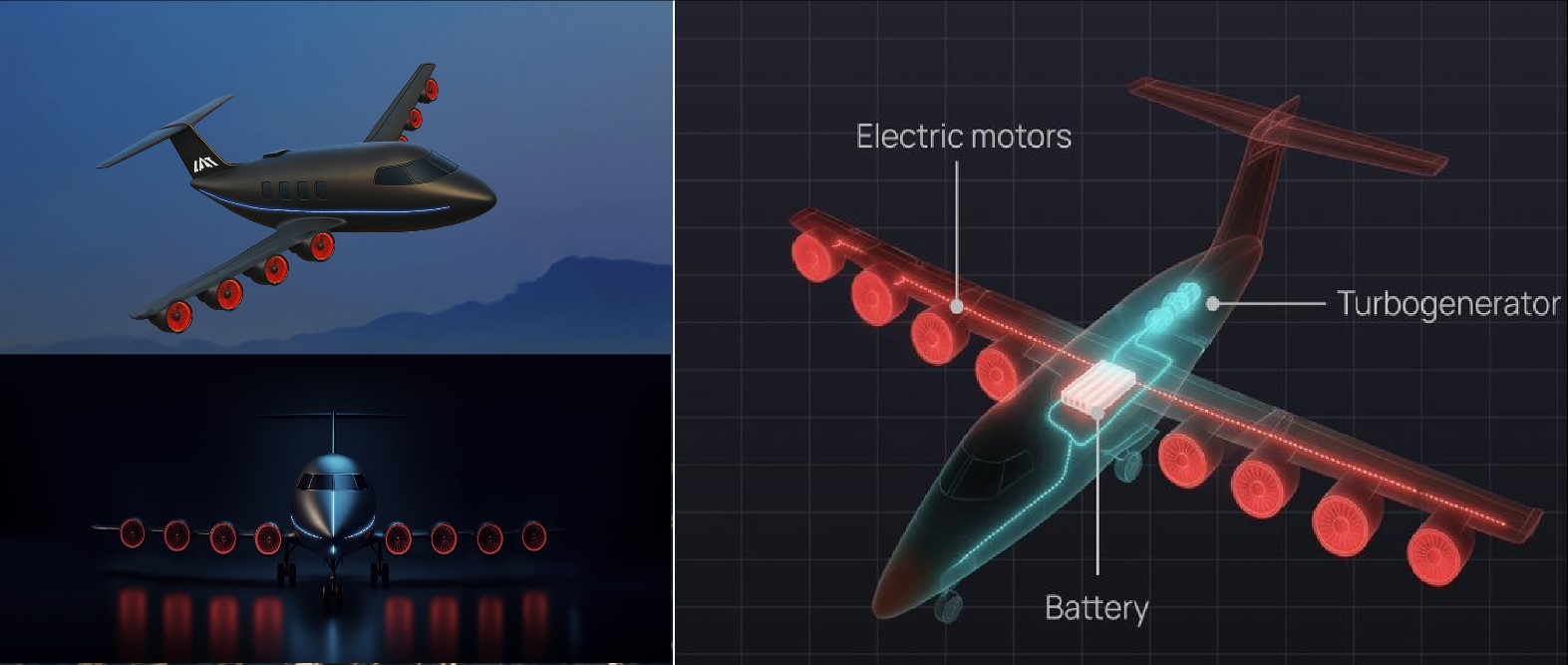
The scale model, recently showcased at LAT’s new facility, depicts a sleek high-wing aircraft powered by eight distributed hybrid-electric engines mounted along the wings. Each motor contributes to lift, thrust, and redundancy, allowing safer low-speed flight and extremely short take-offs.
This Distributed Electric Propulsion (DEP) setup is inspired by emerging global designs but is being fully developed in India. The system integrates battery-powered electric motors with a lightweight gas turbine generator, which recharges batteries in-flight and provides power during cruise — delivering both efficiency and endurance.
The result: a hybrid aircraft targeting a range of up to 1,500 km, roughly double that of many current regional turboprops, but with up to 40% lower operating emissions and noise.
Advanced In-House R&D: India’s First Startup Wind Tunnel
The true showpiece of LAT’s new Gurugram base is its custom-built wind tunnel — a rarity in India’s private aerospace sector. The subsonic wind tunnel will be used to simulate airflow around prototype airframes and refine aerodynamic efficiency for STOL operations.
The new R&D complex also houses:
-
A Powertrain Lab to test hybrid-electric propulsion units,
-
Hardware-in-the-Loop Simulation (HILS) rigs for real-time system validation, and
-
Custom Monte Carlo simulation software to model hybrid flight dynamics under thousands of conditions.
“We’re optimizing for ultra-short take-off and landing — under 300 meters,” Das noted. “We’re cutting grams of weight, building our own simulators, and designing physics models from scratch.”
This hands-on approach differentiates LAT from India’s traditional aerospace firms, which often depend on external laboratories or partnerships for aerodynamic testing.
Indigenous Power: A “Made-in-India” Turbine
Co-founder Deepinder Goyal, who remains in a non-executive but visionary role, has teased another key project — a homegrown gas turbine engine designed specifically for hybrid-electric aircraft.
In a recent statement, Goyal called it “a lightweight, efficient, and flight-ready engine designed and built in India,” emphasizing the company’s focus on indigenization. This would make LAT the first Indian private entity to pursue both airframe and propulsion system development simultaneously.
LAT Aerospace Milestones
| Milestone | Date | Highlight |
|---|---|---|
| Founding & Seed Round | January 2025 | Goyal-Das duo launches LAT with $20M; targets 8–24 seater STOL hybrids. |
| Vision Reveal | July 2025 | Concept unveiled: “Buses in the sky” with up to 1,500 km range; focus on gas turbine integration. |
| R&D HQ Inauguration | November 2025 | 50,000 sq ft Gurugram facility opens; includes powertrain lab, HILS, and proprietary wind tunnel. |
| Tech Demonstrator Tease | Q4 2025 | First demonstrator under design; STOL optimization and weight reduction in focus. |
| Funding Horizon | 2026 | Targeting an additional $50M to scale R&D and expand engineering hires in Delhi NCR and Bengaluru. |
Toward India’s First Hybrid Flight
With its distributed eight-engine concept, 1,500 km range target, and STOL performance, LAT Aerospace could fundamentally redefine regional aviation. The company plans to move from wind tunnel testing to prototype assembly by 2027, with taxi trials in 2028 and first flight tests by 2029.
If successful, LAT will place India alongside the United States and Europe in the race for certified hybrid-electric aircraft — but with a distinctive focus on affordability and accessibility for developing economies.
A New Chapter for Indian Aviation
What began as a conversation between two tech entrepreneurs has evolved into a genuine aerospace revolution in the making. LAT Aerospace’s hybrid-electric aircraft program — powered by eight engines, born from a 50,000-square-foot innovation hub, and aimed squarely at India’s regional skies — may soon turn the dream of “buses in the sky” into a tangible reality.
With its fusion of engineering, sustainability, and vision, LAT Aerospace isn’t just building an aircraft — it’s building a new frontier for Indian aviation.
——— End of Article ———