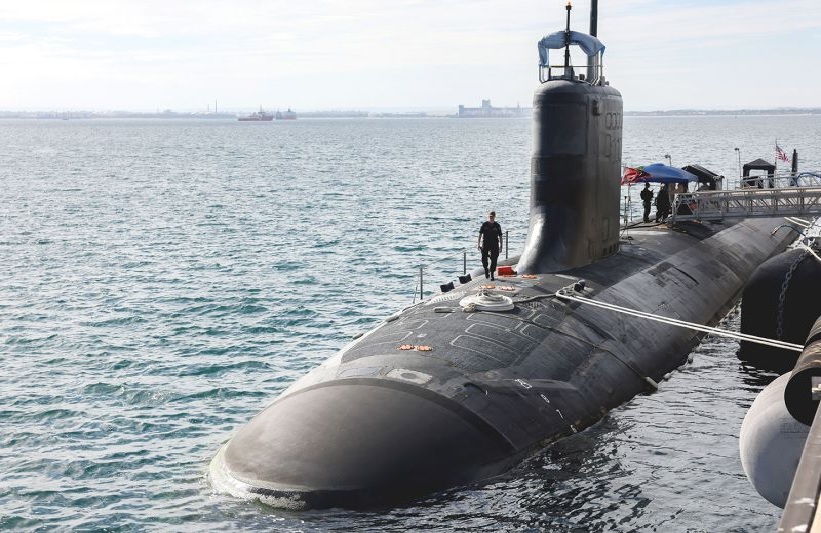
CAMDEN, N.J., Feb. 25, 2026 : L3Harris Technologies has received its largest-ever full-rate production contract for submarine communications systems from General Dynamics Electric Boat, securing delivery of 26 integrated communications shipsets for the U.S. Navy’s Virginia-class attack submarines and Columbia-class ballistic missile submarines.
The award, announced on February 18, 2026, sustains a standardized production pipeline through 2033. Financial terms of the agreement were not disclosed.
Contract Scope and Strategic Context
The follow-on contract supports modernization of undersea command-and-control systems as anti-submarine warfare networks and maritime surveillance capabilities become more advanced globally. In addition to production for U.S. Navy platforms, the agreement includes options that could extend support to future Columbia-class submarines and allied navies.
The inclusion of potential allied support is significant amid expanded submarine cooperation frameworks such as the AUKUS partnership, under which Australia is expected to acquire Virginia-class submarines.
L3Harris will supply fully integrated communications shipsets designed to maintain low observability while ensuring reliable connectivity for intelligence updates, coordinated strike operations, and time-sensitive tasking. The systems are intended to provide a standardized communications baseline across both submarine classes.
“The ability for submarines to operate undetected is vital to the U.S. Navy’s strategic advantage,” said Nino DiCosmo, President of Maritime, Space and Mission Systems at L3Harris. “With decades of experience in submarine technology and in partnership with General Dynamics Electric Boat, L3Harris will deliver highly reliable, undetectable communications systems to enhance operational effectiveness.”
Communications Architecture and Capabilities
The production configuration centers on L3Harris’ MarCom IP-Integrated Communications Core, built on an open-architecture framework. The system integrates legacy shipboard communications technologies, including POTS, ISDN and VoIP, with modern Internet Protocol networks. It performs switching, conferencing, call processing and external systems interfacing within a non-blocking architecture.
The MarCom system features modular and ruggedized packaging designed to withstand internal damage, ensuring communications continuity during combat conditions. Its radio-agnostic design allows compatibility with multiple transmission systems without requiring structural changes to the core architecture.
Complementing the hardware core is the Symphony automation layer. Symphony enables unmanned radio room operations by allowing operators to activate pre-planned communications configurations through a browser-style interface. The system automates switch and router connections, baseband routing, cryptographic management and radio-frequency distribution.
Symphony also incorporates automated failure detection and emission control functions, allowing submarines to transition between communication profiles while minimizing radio-frequency exposure and operator workload.
Crew-level interaction is conducted through the K2 tactical terminal. The K2 supports simultaneous access to multiple secure circuits and integrates both tactical voice networks, such as intercoms and alarms, and IP-based data systems. The architecture uses SRTP protocols and AES-256 encryption and maintains separation between secure (“red”) and unsecure (“black”) networks through a dual-homed, failover-capable configuration.
Integration Across Two Submarine Classes
The 26 shipsets will be integrated into two core components of U.S. undersea operations.
The Virginia-class (SSN) consists of nuclear-powered fast-attack submarines designed for anti-submarine warfare, land-attack missions, intelligence collection and special operations in both littoral and open-ocean environments. The class incorporates photonics masts instead of traditional optical periscopes and features a reconfigurable torpedo room with a lockout trunk for special operations forces.
Block III variants introduced the Large Aperture Bow array to enhance passive acoustic detection. Block V boats include the Virginia Payload Module (VPM), which adds four large-diameter payload tubes. Each tube can carry seven Tomahawk cruise missiles, increasing strike capacity by 28 additional missiles per submarine.
The Columbia-class (SSBN), currently under development by General Dynamics Electric Boat in partnership with Huntington Ingalls Industries’ Newport News Shipbuilding, will replace the aging Ohio-class ballistic missile submarines. The Columbia class is designed to serve as the Navy’s sea-based nuclear deterrent into the 2080s.
The submarines will incorporate electric-drive propulsion and carry 16 Trident II D5 (Life Extension) ballistic missiles. The U.S. Navy has established a requirement for the lead Columbia-class submarine to be patrol-ready no later than October 2030. For the class’s strategic mission, secure and reliable reception of authenticated directives without compromising stealth is a core operational requirement.
Production and Industrial Impact
The full-rate production award formalizes a standardized communications baseline across two active submarine production lines and ensures continuity of capability through the next decade. By aligning Virginia-class and Columbia-class communications systems under a common architecture, the Navy and its prime contractors are establishing interoperability, automation and emission-control as baseline requirements rather than incremental upgrades.
The contract expands L3Harris’ long-standing role in U.S. Navy submarine programs, which have included communications and imaging systems for the Ohio-class and Los Angeles-class submarines. Headquartered in Melbourne, Florida, L3Harris Technologies provides integrated communications and mission systems across multiple defense platforms.
With production locked through 2033, the agreement supports sustained modernization of U.S. undersea command-and-control infrastructure as the Navy fields its next-generation strategic deterrent while continuing Virginia-class construction.
——— End of Article ———