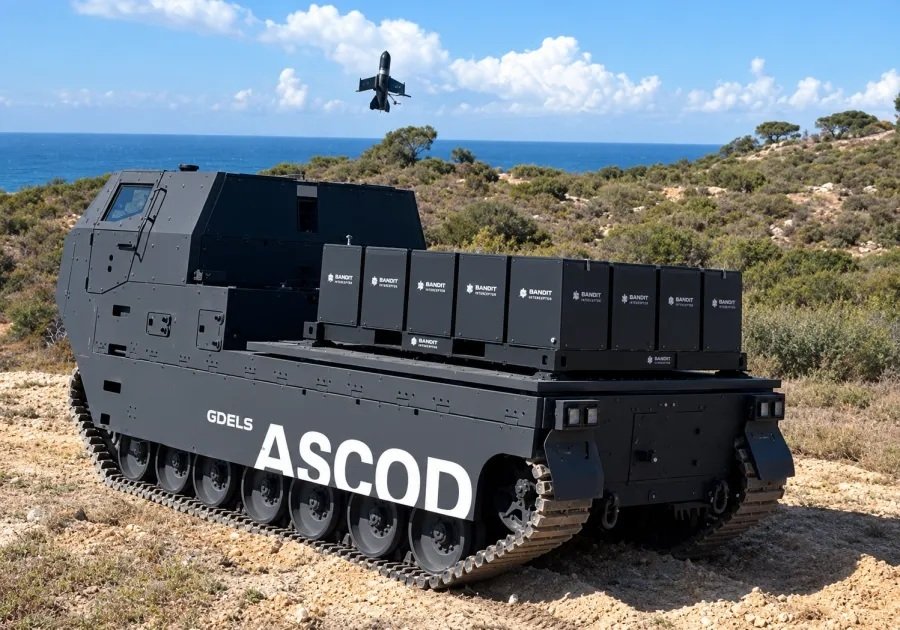
POLAND : L3Harris Technologies conducted a live-fire demonstration of its Vehicle-Agnostic Modular Palletized ISR Rocket Equipment (VAMPIRE) counter-drone system at a military facility in Poland, marking the first launch of the Thales Belgium FZ275 70 mm semi-active laser-guided rocket from the FZ605 launcher integrated onto the platform.
According to company officials, the test resulted in the successful engagement and destruction of multiple ground targets. The firing forms part of an ongoing integration campaign to broaden the range of precision-guided munitions compatible with the VAMPIRE platform for counter-unmanned aerial systems (C-UAS) and ground-attack roles. L3Harris stated that the integration aligns with European operational requirements, including border security efforts and objectives outlined under Europe’s Readiness 2030 framework.
System Configuration and Deployment
VAMPIRE is a portable, self-contained precision-strike system designed for rapid deployment across a range of vehicle platforms. It can be mounted on vehicles equipped with a flat cargo surface and installed in approximately two hours by a single operator using standard tools. The system incorporates its own independent power supply, removing the requirement for a 24-volt alternator connection from the host vehicle.
The palletized configuration allows spare 70 mm rockets to be stored onboard, while reload operations can be completed in under two minutes. Since 2023, the system has supported European combat operations.
In January 2023, the U.S. Department of Defense awarded L3Harris a $40 million contract for 14 VAMPIRE systems under the Ukraine Security Assistance Initiative. An additional contract was issued in June 2025 to support expanded European operations.
Before integrating the FZ275, VAMPIRE employed 70 mm rockets from the Advanced Precision Kill Weapon System (APKWS) family. When fitted with an L3Harris proximity fuze, APKWS rockets are capable of engaging aerial targets at distances of up to 6 kilometers while retaining ground-attack capability. The system’s onboard laser designator enables autonomous target engagement or the designation of targets for other networked platforms in distributed operations.
Sensor and Mission Systems Integration
The Poland demonstration incorporated the Widow Mission Management System and the Wescam MX-10D electro-optical/infrared (EO/IR) stabilized targeting system.
Mounted on a telescopic mast, the Wescam MX-10D allows operators to remain under cover during targeting operations. The system features a four-axis stabilized gimbal delivering high-definition daylight and thermal imaging, continuous zoom capability, and short-wave infrared (SWIR) functionality, including See-Spot capability. It also includes an eye-safe laser rangefinder, optional laser designation, image blending, haze penetration features, and an inertial measurement unit (IMU) for target geolocation.
The Widow Mission Management System is compliant with Forward Area Air Defense Command and Control (FAAD C2) standards. Its modular plug-in architecture supports integration of additional sensors, effectors, moving maps, and radio management systems. L3Harris reports delivery of more than 8,000 Wescam MX-Series systems to nearly 90 countries, integrated across over 280 types of vehicles and vessels.
Thales Belgium FZ275 Rocket Specifications
The FZ275 laser-guided rocket, produced by Thales Belgium—formerly Forges de Zeebrugge—since 2017, is a 2.75-inch (70 mm) semi-active laser-guided munition.
The rocket measures 1.8 meters in length, has a 70 mm diameter, and weighs 12.7 kilograms. It carries a 4.1-kilogram high-explosive warhead containing approximately 1 kilogram of Composition B explosive. The warhead uses an impact base fuze and a pre-fragmented casing.
The FZ275 provides a lethal radius of 9 meters and is capable of penetrating 6 millimeters of ST37-2 steel. It uses a semi-active laser seeker compatible with STANAG 3733 or user-defined codes and is steered by four folding canards. The operational range extends from 1.5 to 7 kilometers.
The rocket has a circular error probability (CEP) of less than 1 meter at a range of 6 kilometers and can engage targets moving at speeds of up to 60 kilometers per hour.
Production volumes have increased to meet demand, with 700 units manufactured in 2024, 3,500 units in 2025, and projected output of 10,000 units in 2026.
Global integration initiatives include certification with the Arnold Defense Land-LGR4 Fletcher launcher in January 2022, a June 2024 memorandum of understanding with Poland’s WB Electronics and AREX for integration into remote weapon systems, and a February 2023 production agreement with Bharat Dynamics Limited (India). In November 2024, an agreement established joint production in Ukraine, introducing the FZ123 warhead variant optimized for C-UAS missions through dispersion of steel balls to increase engagement probability against small drones.
Expanded Variants and Artificial Intelligence Integration
In October 2025, L3Harris expanded the VAMPIRE product line into six variants designed to address kinetic, non-kinetic, and electronic warfare missions across land, maritime, airborne, containerized, and fixed-site applications.
The Stalker XR variant is configured for land operations with expanded munition storage and extended weapon options. Black Wake adapts the system for maritime platforms, including crewed or uncrewed surface vessels such as the 41-foot MAST-13. Dead Wing integrates VAMPIRE components onto aircraft platforms. CASKET provides a containerized anti-drone configuration for rapid deployment. BAT is designed for fixed-site defense and incorporates automatic weapons and non-kinetic capabilities. Killcode is configured for electronic warfare operations, replacing kinetic munitions with jamming systems.
L3Harris also incorporated artificial intelligence (AI) and machine learning (ML) functions demonstrated in 2025 in collaboration with Shield AI. These enhancements are intended to improve detection and engagement performance against small or partially obscured unmanned aerial systems and are integrated with the expanded effector options demonstrated during the Poland test.
The February 12 demonstration represents the continued integration and expansion of the VAMPIRE counter-drone system within European and allied defense operational frameworks.
——— End of Article ———