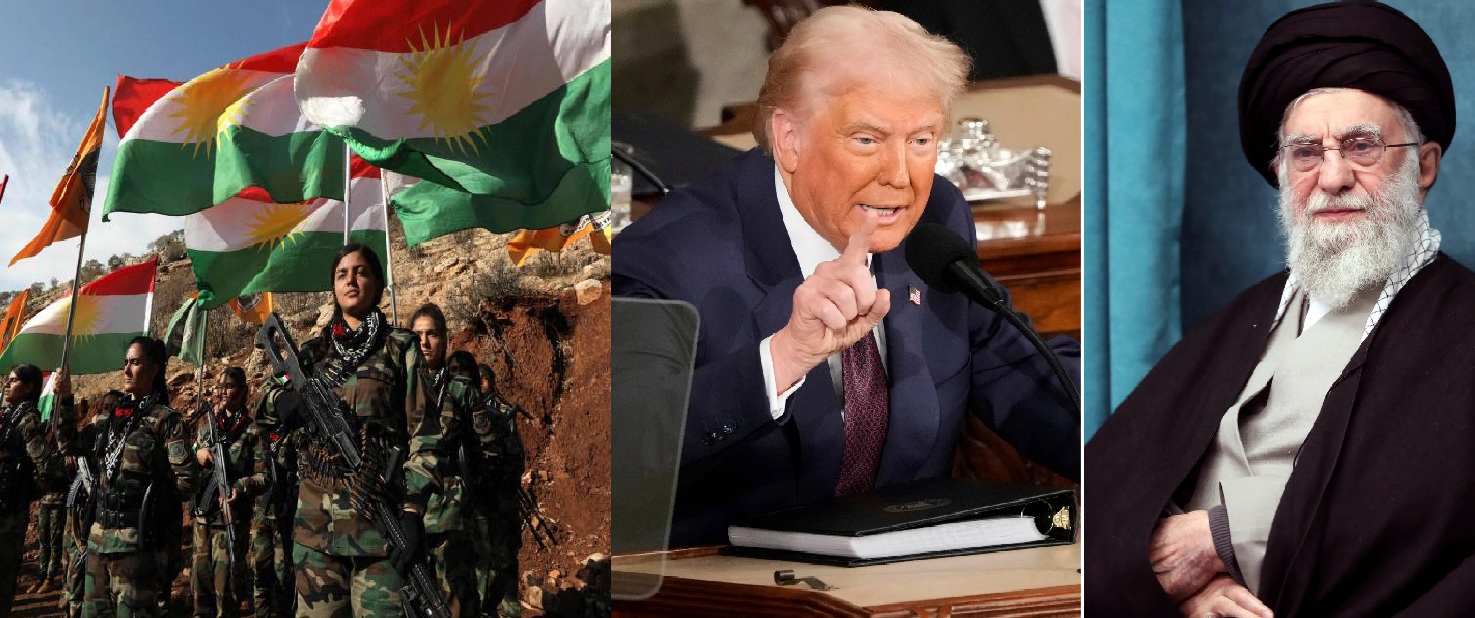
Washington / Erbil : Iran’s Kurdish opposition has postponed plans for an armed incursion into Iranian territory following statements by U.S. President Donald Trump indicating a preference for a “peaceful” overthrow of Iran’s ruling clerical establishment. The shift comes amid signs of a possible de-escalation after weeks of deadly unrest that shook the Islamic Republic and drew sharp warnings from Washington.
The pause was confirmed in an interview with CBS News by leaders of the Democratic Party of Iranian Kurdistan (PDKI), an exiled Kurdish group that has long trained for the possibility of confronting Tehran by force. Fighters from the group are currently based in the mountains of northern Iraq, roughly 30 miles from the Iranian border, where many — including women — say they remain ready to act if circumstances change.
Trump’s Remarks and a Shift in Tone
President Trump said this week that, according to what he described as “reliable sources,” the killing of protesters in Iran was “stopping” and that there was allegedly “no plan for executions” following the brutal suppression of nearly two weeks of mass demonstrations. He added that the situation appeared to be showing early signs of de-escalation.
The comments marked a notable change in tone from Washington. In the early days of the unrest, Trump repeatedly warned that the United States could intervene to protect protesters and, as recently as Tuesday, threatened “very harsh measures” if executions of demonstrators went ahead. Kurdish leaders said the latest remarks suggested the White House was stepping back from the prospect of immediate military involvement.
Protests, Crackdown, and Conflicting Claims
The protests, which erupted over political repression and economic grievances, quickly spread across major Iranian cities. Iranian authorities moved decisively to crush the demonstrations, deploying security forces linked to the Ayatollah regime — a system of governance created after the 1979 Islamic Revolution that places ultimate power in the hands of senior Shiite clerics.
While Tehran has downplayed casualties, sources inside Iran cited by CBS News claim the crackdown may have killed more than 12,000 people, with the true figure potentially far higher. Independent verification has been difficult due to media restrictions and internet shutdowns.
Kurdish Hopes and Caution
Sairan Gharoli, a commander within the Iranian Kurdish movement, said the scale of the protests revived hopes that the deeply entrenched system established after 1979 could finally be challenged. But he cautioned that popular anger alone would not be enough.
“Without real international support, including political and practical backing, the regime has shown time and again that it can survive mass protests,” Gharoli said.
That caution was echoed by Mustafa Hijri, the veteran leader of the PDKI, who has lived in exile for more than four decades. Hijri noted that Iran’s authorities have repeatedly crushed previous waves of unrest and warned that the current uprising could follow the same trajectory.
Calls for Targeted U.S. Action
Despite the decision to delay armed action, Hijri openly expressed hope for U.S. involvement. He said that targeted strikes against the infrastructure of the forces firing on protesters, as well as against what he described as “judicial” institutions serving the regime, could fundamentally alter the balance of power.
Such statements underscore the delicate position of the Kurdish opposition, which is banned inside Iran as a terrorist organization but has long presented itself internationally as a democratic alternative to clerical rule.
Who Are the Kurds and Why the Tension?
The Kurds are a distinct ethnic group numbering around 30 million across the Middle East, with significant populations in Turkey, Iraq, Syria, and Iran. In Iran, Kurds make up roughly 10% of the population and are concentrated in the northwest.
Tensions between Iran’s Kurdish population and the Ayatollah regime date back decades. Kurdish parties opposed the centralization of power after the 1979 revolution and demanded autonomy, cultural rights, and political representation. Tehran responded with military campaigns and tight security control, leaving deep mistrust on both sides.
Hijri said the strategic goal of the Kurdish opposition is not secession but the creation of a democratic Iran in which Kurds and other ethnic minorities can live under equal laws. Central to those demands are the right to educate children in their native languages and the formal recognition of minority rights by the state.
Waiting for the Next Signal
For now, Kurdish fighters in northern Iraq remain on standby, watching closely for signs of whether international pressure particularly from the United States will intensify or fade. Trump’s suggestion that violence inside Iran may be easing has bought Tehran time, but opposition figures say it has also delayed a decisive moment they have been preparing for over decades.
Whether the protests ultimately lead to reform, repression, or a deeper crisis may depend less on the streets of Tehran than on decisions taken in Washington and on whether the world is willing to move beyond words in confronting the Ayatollah regime.
——— End of Article ———