SAN DIEGO — Kratos Defense & Security Solutions has received a U.S. Army contract to develop, manufacture and test an enhanced infrared seeker for the FGM-148 Javelin anti-tank guided missile.
The contract, awarded on August 6 by the U.S. Army Combat Capabilities Development Command (DEVCOM) C5ISR Center, focuses on replacing obsolete components in the Javelin's existing guidance section and developing a production-ready seeker for continued long-term use.
Kratos will conduct development and manufacturing at its Advanced Manufacturing Center in Birmingham, Alabama. The completed seeker will then undergo testing at U.S. Army government facilities.
New seeker to address aging components
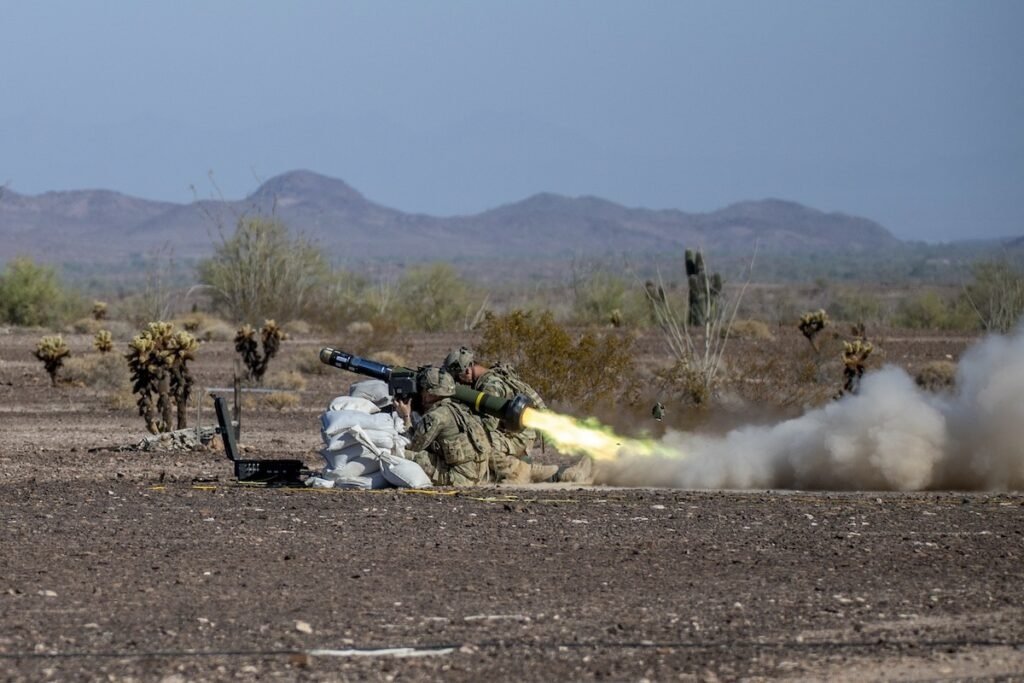
The Javelin's infrared seeker is responsible for detecting and tracking the target after launch. Its fire-and-forget capability allows the operator to lock onto a target before firing, after which the missile tracks the target independently.
The new Kratos seeker is intended primarily to address obsolescence in the current guidance section. Some older semiconductor, detector and manufacturing technologies used in military systems can become unavailable as suppliers discontinue older product lines.
The contract therefore focuses on providing a production-ready replacement that can be manufactured and supported for the Javelin's continued service.
Overall development, production and support of the Javelin system remain with the Lockheed Martin-RTX Javelin Joint Venture. Lockheed Martin currently supplies the existing seeker, while Raytheon is responsible for the Command Launch Unit, related guidance electronics and system software. Kratos will develop the next-generation seeker.
Javelin modernization continues
The seeker program follows the U.S. Army's introduction of the Lightweight Command Launch Unit (LWCLU).
The first LWCLUs were delivered to the Army on May 26, 2026. The new unit is 25 percent lighter and 30 percent smaller than the legacy Block 1 Command Launch Unit and provides roughly twice the target detection and recognition range. It is compatible with current, past and future Javelin missile variants.
Raytheon has invested $22 million to modernize its Tucson, Arizona, production facility to support higher LWCLU production rates.
The Javelin missile production line is also being expanded. Lockheed Martin is increasing annual production capacity to 3,960 missiles by late 2026, compared with the previous capacity of 2,400 missiles per year. The expansion includes additional tooling, testing equipment and supply-chain capacity.
Long-term Javelin production
The Javelin entered U.S. service in 1996 and replaced the wire-guided M47 Dragon. Full-rate production began in 1994, and more than 50,000 missiles had been delivered by 2021.
The system is expected to remain in U.S. service through at least 2050. Its combination of a portable launcher, imaging infrared seeker and fire-and-forget guidance allows infantry units to engage armored targets without maintaining guidance after launch.
The Javelin has also been widely supplied to Ukraine since Russia's full-scale invasion in 2022. Those transfers increased the requirement for additional U.S. production and subsequent replenishment of U.S. inventories.
The Kratos contract adds a new element to the broader Javelin modernization effort. While the LWCLU addresses the weapon's launch and target-acquisition equipment and Lockheed Martin expands missile production, Kratos will replace the aging seeker technology inside the missile.
The new seeker is intended to keep the Javelin's guidance system supportable and suitable for continued production as the U.S. Army maintains the weapon for long-term service.
——— End of Article ———