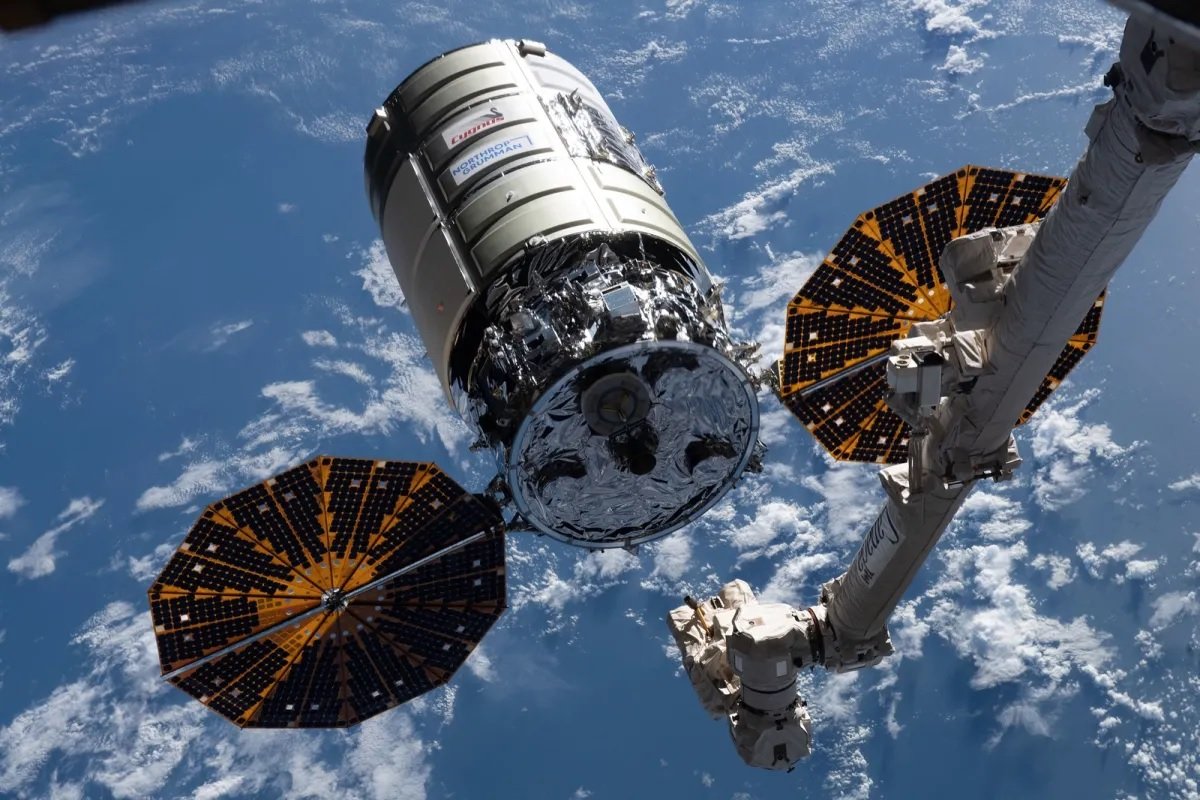
CAPE CANAVERAL, FLORIDA — Northrop Grumman’s Cygnus XL cargo spacecraft has raised the orbit of the International Space Station (ISS) ahead of the planned arrival of NASA’s SpaceX Crew-13 mission.
The uncrewed spacecraft, which remains berthed to the station’s Unity module, fired its gimbaled delta-velocity engine for 18 minutes on September 25. The maneuver increased the ISS orbital altitude by about 1.5 miles at apogee, the highest point of its orbit, and about 0.8 miles at perigee, the lowest point.
Following the maneuver, the station was placed into an orbit measuring approximately 265.5 by 256.8 miles above Earth.
Cygnus XL Performs ISS Reboost
The Cygnus XL was attached to the Earth-facing port of the ISS Unity module when its engines were fired. The spacecraft’s thrust moved the combined station and cargo vehicle, allowing Cygnus XL to perform the orbital reboost.
The maneuver serves two purposes: countering the gradual loss of station altitude caused by atmospheric drag in low Earth orbit and adjusting the ISS orbit for upcoming spacecraft traffic.
Using a visiting spacecraft for reboosts also allows the station to reduce its reliance on its own onboard propellant for some orbital maintenance activities.
The Cygnus spacecraft has previously performed similar maneuvers. The same Cygnus XL conducted another reboost on August 27, 2026, with an engine burn lasting 20 minutes and 43 seconds. That maneuver adjusted the station for the arrival of the Progress 96 cargo spacecraft.
Cygnus XL Delivered More Than 11,000 Pounds of Cargo
The Cygnus XL arrived at the ISS on April 13, 2026, as part of NASA’s Northrop Grumman Commercial Resupply Services-24 (CRS-24) mission.
The spacecraft launched two days earlier aboard a SpaceX Falcon 9 rocket from Space Launch Complex 40 at Cape Canaveral Space Force Station, Florida.
Named S.S. Steven R. Nagel, the spacecraft delivered more than 11,000 pounds of scientific research, hardware, experiments, crew supplies and other cargo to the orbital laboratory.
Beyond its cargo-delivery role, the expanded Cygnus XL is capable of performing orbital reboost operations while berthed to the ISS. This provides another option for maintaining the station’s orbit during its mission.
Reboost Supports Crew-13 Arrival
The latest maneuver also adjusted the ISS orbital phasing for the upcoming SpaceX Crew-13 mission.
Crew-13 is currently targeted to launch no earlier than October 1, 2026, aboard a Crew Dragon spacecraft launched by a Falcon 9 rocket from Space Launch Complex 40 in Florida.
The four-person Crew-13 crew consists of:
- Jessica Watkins (NASA) — Commander
- Luke Delaney (NASA) — Pilot
- Joshua Kutryk (Canadian Space Agency) — Mission Specialist
- Sergey Teteryatnikov (Roscosmos) — Mission Specialist
After arriving at the ISS, the crew will join Expedition 75.
Cygnus XL Scheduled to Leave ISS in October
The Cygnus XL is scheduled to remain attached to the ISS until October. After the Crew-13 mission arrives, the station crew will load the spacecraft with disposal materials.
The spacecraft will then be unberthed from the ISS using the station’s robotic arm. It will subsequently be placed on a trajectory for destructive reentry into Earth’s atmosphere, where it will burn up.
The September 25 reboost demonstrates the additional role of Cygnus XL in ISS operations beyond cargo delivery, allowing the spacecraft to contribute to station orbit maintenance while it remains attached to the orbital laboratory.
——— End of Article ———