KYIV, UKRAINE — Ukrainian developers of the MAUL unmanned ground vehicle (UGV) say that direct feedback from frontline medics and soldiers has driven the platform’s most important improvements, rather than artificial intelligence.
MAUL is a remotely controlled or partly autonomous vehicle designed to evacuate wounded soldiers from areas where Russian drones, mines and artillery make conventional medical evacuation dangerous. Kostyantyn Hushcha, chief executive of AIDronesUA, said battlefield users provide feedback that can quickly lead to design changes, particularly in vehicle movement, casualty protection, system arrangement and field repair.
“These details may look less impressive than a new AI feature, but they are what determine whether an evacuation can actually be completed,” Hushcha said. AIDronesUA is continuing to examine AI and greater autonomy, but says new technology must improve reliability, patient safety and evacuation performance.
MAUL Specifications and Combat Use
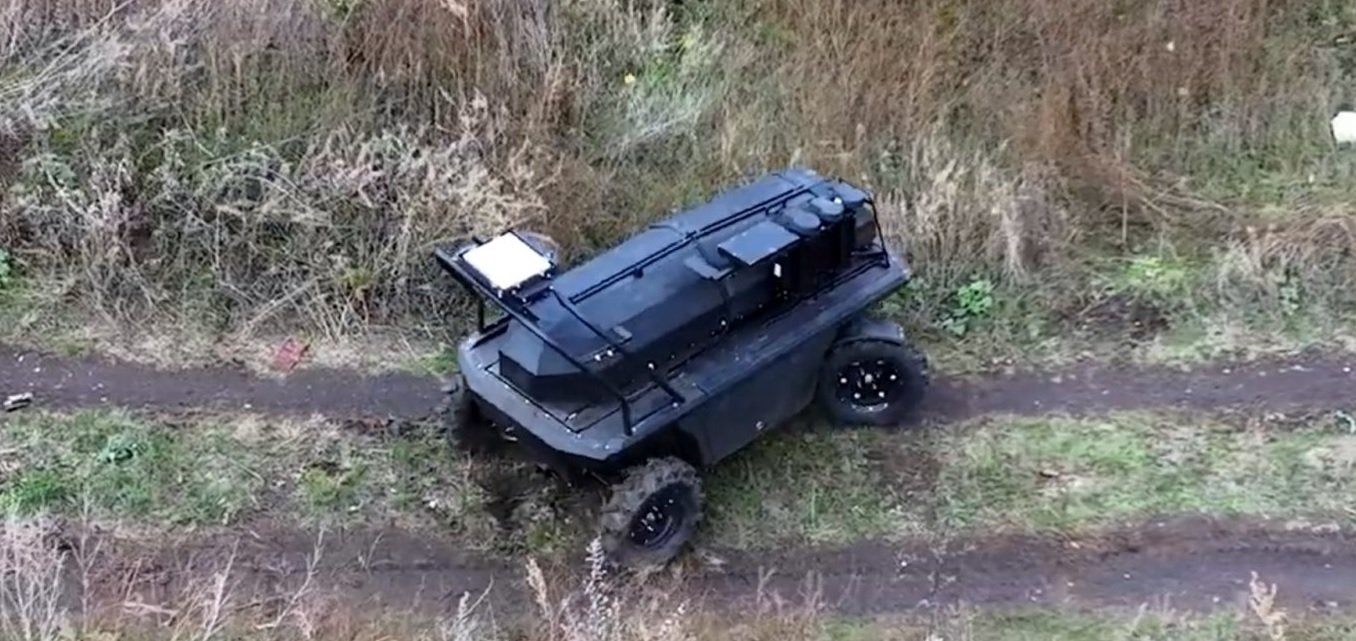
The four-wheel-drive MAUL uses an internal-combustion engine and carries a wounded soldier inside an armored capsule secured with three straps. An internal camera allows operators to monitor the casualty.
The vehicle is about 2.3 meters long, 1.45 meters wide and 0.62 meters high, with 200 mm of ground clearance. It has an operating weight of about 420 kg, a gross weight of 620 kg and a payload capacity of up to 200 kg. It uses airless metal wheels designed for difficult terrain and mine resistance.
The 1st Separate Medical Battalion reports a maximum road speed of 70 km/h. Reported range figures include up to 110 km on roads and 100 km off-road, with a tactical operating radius of about 50 km. Continuous operation can last up to five hours, while standby time can reach 48 hours. The vehicle has multiple communication links, daylight and infrared cameras, and can also be used for logistics and remote weapon stations.
MAUL was originally developed by Ukraine’s 1st Separate Medical Battalion. Ukrainian manufacturer DevDroid later obtained a license to produce it, with early units costing about $19,000. Recent versions have been reported at $22,600 to $33,900, depending on configuration.
In November 2025, the 1st Medical Battalion used MAUL to rescue a wounded soldier who had spent 33 days behind Russian lines. The six-hour mission covered about 64 km. The vehicle drove over an anti-personnel mine that damaged a wheel and was later hit by a Russian drone, but it completed the evacuation and delivered the soldier to Ukrainian medical personnel. Six earlier attempts using other systems had failed.
The unit has also reported additional MAUL evacuation missions, including six evacuations in one day in early 2026 by two vehicles that together covered about 300 km. Company and unit statements have reported roughly 100 or more evacuation missions and more than 150 people evacuated.
Production Expands to Sweden
At Eurosatory 2026 in June, AIDronesUA signed a strategic partnership memorandum with Swedish autonomous-systems company NJORD Technology to establish MAUL production in Sweden. The project targets production of 400 to 500 vehicles annually, primarily for Ukraine’s armed forces.
The Swedish facility is intended to provide a production location outside the range of certain Russian strike drones. AIDronesUA remains responsible for development and battlefield-driven upgrades, while NJORD is providing manufacturing and engineering support.
Ukrainian combat medics have also taken MAUL to Sweden to demonstrate the system to the Swedish Armed Forces’ Life Guards. It was the platform’s first deployment outside Ukraine and allowed Swedish personnel to examine its use in casualty evacuation.
In August 2026, AIDronesUA also signed an agreement with U.S.-based Empery Digital Inc. to explore a strategic investment, with due diligence underway.
AIDronesUA says MAUL continues to be refined mainly through direct feedback from the personnel using it in frontline evacuation missions, while AI and autonomous functions remain areas under development.
——— End of Article ———