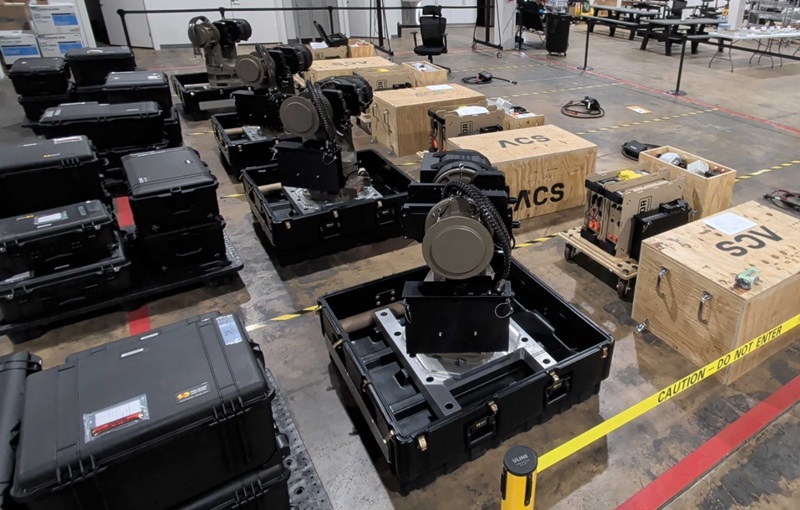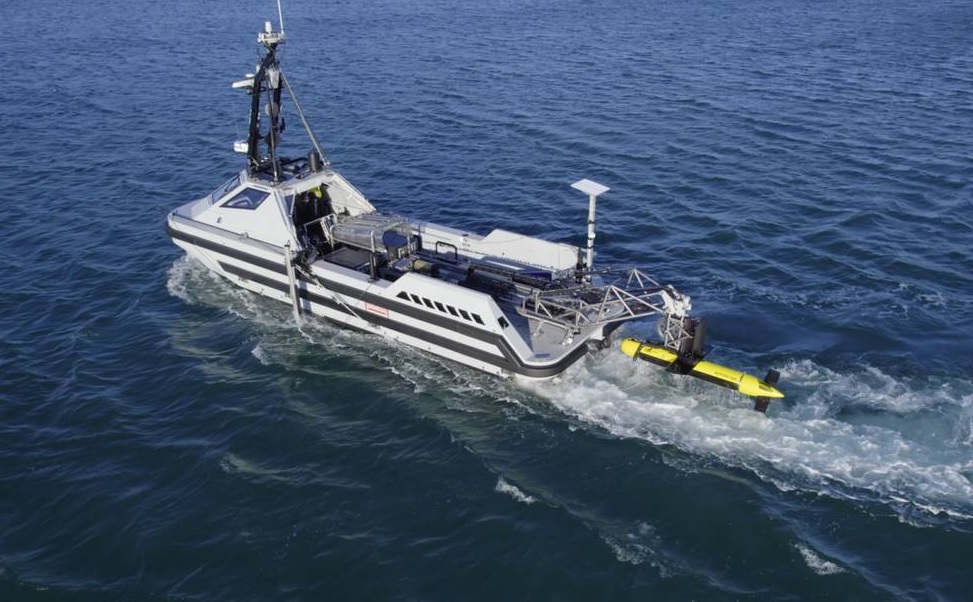
ISTANBUL, Türkiye — April 7, 2026 : Canada-based Kraken Robotics Inc. has announced the successful integration and live demonstration of its KATFISH towed synthetic aperture sonar (SAS) system alongside an autonomous launch and recovery system (LARS) deployed from SEFINE Shipyard’s RD-22 unmanned surface vessel (USV). The joint demonstration was conducted in coordination with SEFINE SISAM (Strategic Unmanned Systems Research Center) during the first quarter of 2026 off the coast of Istanbul.
The demonstration was attended by representatives from multiple navies and government organizations and focused on operational scenarios involving the rapid detection and classification of mine-like objects, as well as the inspection of critical underwater infrastructure.
Operational Performance and Capabilities
During the trials, the KATFISH system produced synthetic aperture sonar imagery at a constant resolution of 3 centimeters by 3 centimeters, covering a survey range of up to 200 meters per side. The system operates at speeds between 4 and 10 knots, with survey altitudes ranging from 5 to 30 meters, and is rated for depths of up to 300 meters.
In addition to high-resolution sonar imagery, the system also delivers bathymetric data at a resolution of 25 centimeters by 25 centimeters. All collected data was streamed in real time to an onshore command center, where operators utilized SEFINE SISAM’s mission planning software to detect and classify underwater contacts during the operation.
Autonomous Deployment System
A key component of the demonstration was the USV-compatible autonomous launch and recovery system (LARS). Designed specifically for smaller unmanned surface vessels, the LARS features an all-titanium construction that reduces overall weight while maintaining a low magnetic signature—an important factor in mine countermeasure (MCM) missions.
The system enables the safe deployment and retrieval of the towed sonar without direct human intervention, allowing the host vessel to conduct operations in hazardous environments without onboard crew involvement.
Industry Perspective
Bernard Mills, Executive Vice President of Defence at Kraken Robotics, highlighted the operational relevance of the system in current maritime security conditions.
He stated that the protection of maritime transit routes and underwater infrastructure has become increasingly important, and noted that autonomous mine countermeasure capabilities such as KATFISH allow naval forces to efficiently detect and classify mine-like threats. He added that the integration of Kraken’s sonar systems with SEFINE’s multi-role USVs enables faster deployment of advanced technologies while improving operational efficiency in complex maritime environments.
Previous Demonstration and System Validation
The Türkiye deployment follows an earlier integration conducted in November 2025, when Kraken Robotics partnered with TKMS ATLAS UK to demonstrate the same KATFISH and USV LARS configuration aboard an 11-meter ARCIMS USV operated by the UK Royal Navy.
That demonstration took place off the coast of Portland, United Kingdom, for NATO representatives. The system was fully integrated in under two weeks and maintained operational performance in sea state 3 conditions. The trial also confirmed the system’s air-deployable capability as a 300-meter depth-rated autonomous towed survey package.
Modular Design and Cross-Platform Integration
According to Kraken Robotics, successive demonstrations on different unmanned surface vessel platforms validate the modular architecture and cross-platform compatibility of the KATFISH system and its associated launch and recovery equipment.
The integration of high-resolution synthetic aperture sonar with autonomous USVs provides naval forces with scalable capabilities for seabed mapping, mine detection, and infrastructure inspection. The system is designed to deliver performance levels typically associated with larger crewed vessels while being deployable from smaller unmanned platforms.
——— End of Article ———