Tokyo, Japan – Japan’s major defence contractors, Mitsubishi Heavy Industries (MHI) and Kawasaki Heavy Industries, are developing missile-shaped and aircraft-type unmanned combat drones designed to operate alongside manned fighter jets. The concepts focus on low-cost production, rapid deployment and manned-unmanned teaming for future air operations.
Mitsubishi Develops ARMDC-20X Missile Drone
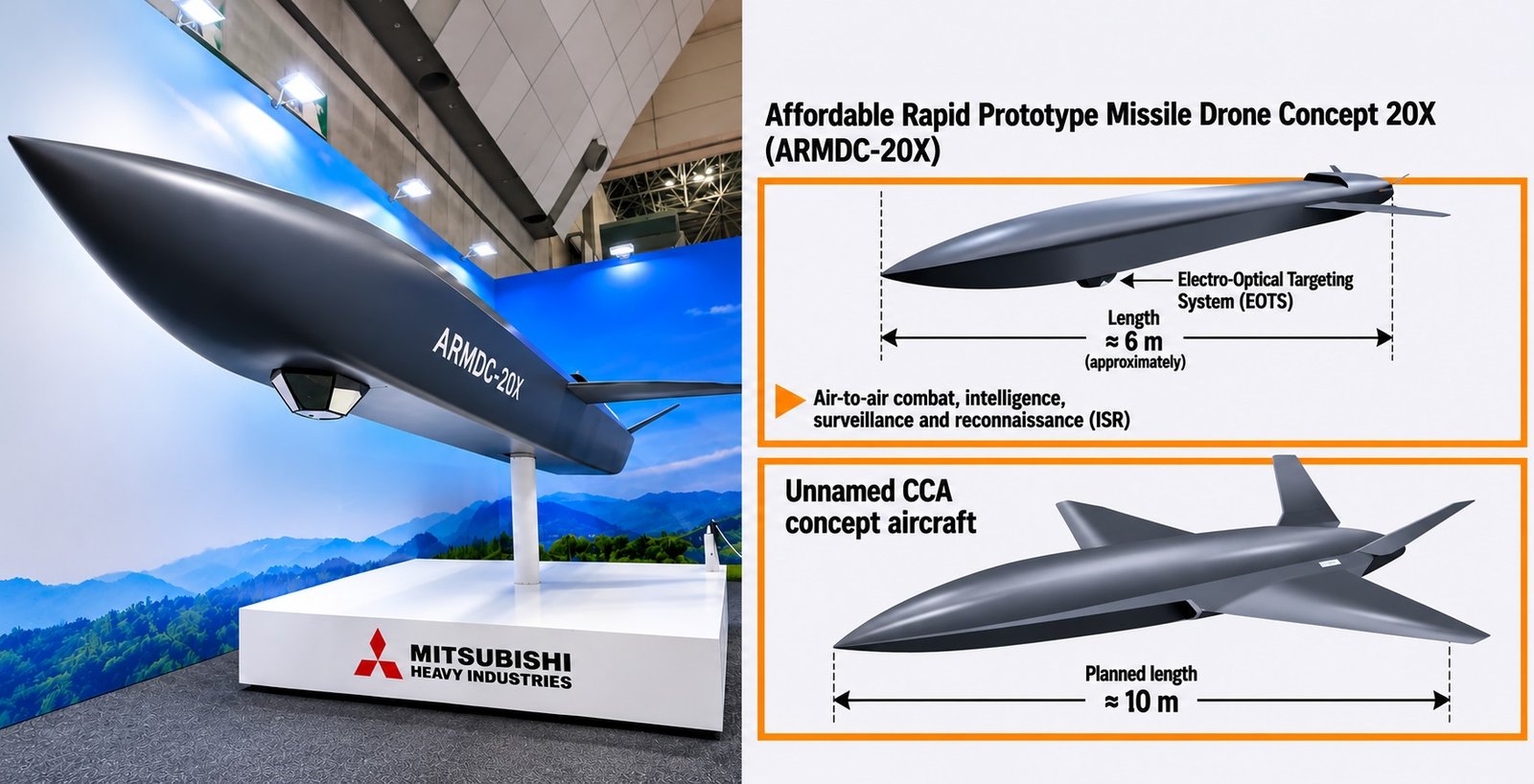
At the Japan International Aerospace Exhibition 2024 in Tokyo, Mitsubishi Heavy Industries presented two collaborative combat aircraft concepts. One of them, named ARMDC-20X (Affordable Rapid Prototype Missile Drone Concept 20X), features a slender, missile-like design and measures nearly 6 metres in length.
Its displayed model featured an electro-optical targeting system beneath the nose and an engine intake on its upper surface. The drone is intended mainly for intelligence, surveillance and reconnaissance (ISR) missions, detecting and identifying threats before sharing information with crewed aircraft. It is designed as an affordable, attritable platform that can be produced in larger numbers.
Mitsubishi also presented a larger, approximately 10-metre-long tactical combat UAV with a conventional aircraft-like design and twin tails. Unlike the ARMDC-20X, this platform is intended to be reusable, operate from runways and carry internal weapons for attack missions.
Both concepts are being developed with artificial intelligence to support coordinated operations with manned fighters. They are also intended to support Japan’s future Global Combat Air Programme (GCAP) fighter, developed jointly with the United Kingdom and Italy, which is targeted to enter service in 2035.
Kawasaki Develops Two Collaborative Drone Designs
Kawasaki Heavy Industries is also studying two designs under its Collaborative Support Aircraft (CSA) programme, as confirmed by company officials in March 2026.
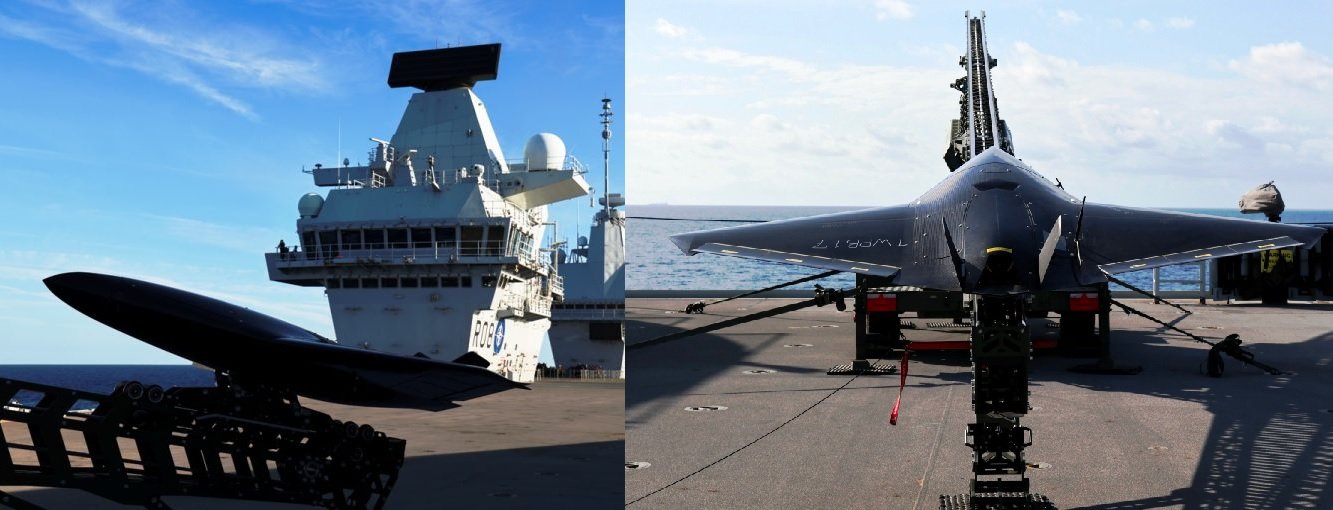
The first is a missile-shaped drone measuring approximately 4–5 metres, designed for rapid production and launch from ground-based or naval platforms without requiring a runway. Kawasaki is also examining the possibility of launching these drones from airborne platforms, including its C-2 transport aircraft.
The second design features a more conventional aircraft configuration. Kawasaki intends both platforms to support missions such as electronic warfare, intelligence, surveillance and reconnaissance (ISR).
The company is also considering modular designs and open architecture to support different mission requirements. Artificial intelligence is expected to enable autonomous operations and reduce the workload on human operators. These drones are intended to operate alongside Japan Air Self-Defense Force aircraft, including future GCAP fighters and existing platforms such as the P-1 maritime patrol aircraft.
Japan Focuses on Affordable Unmanned Combat Aircraft
Both companies are pursuing a similar approach: developing relatively inexpensive unmanned platforms that can be manufactured quickly and deployed in larger numbers.
Missile-like designs could offer greater launch flexibility, allowing drones to operate without depending entirely on conventional runways. They could also undertake high-risk missions, provide additional sensing capabilities and support crewed aircraft during combat operations.
The programmes remain at the conceptual and development stage. Their development reflects Japan’s growing focus on collaborative combat aircraft as part of its future air power strategy.
——— End of Article ———