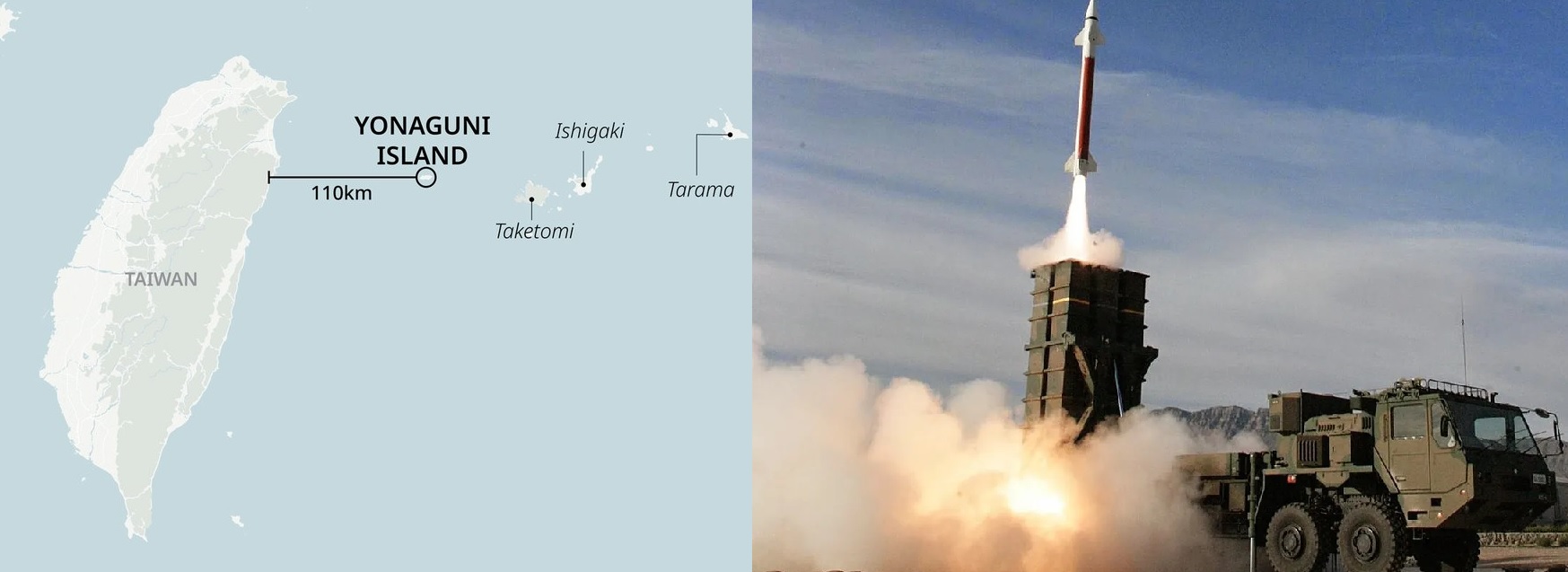
Japan has confirmed plans to deploy medium-range surface-to-air missiles on Yonaguni Island, a tiny outpost just about 110 km from Taiwan, in a move aimed at strengthening air defence and deterring an increasingly assertive China. The deployment is part of a wider missile and force build-up along Japan’s southwestern island chain facing the East China Sea and Taiwan Strait.
A New Missile Unit on Japan’s Western Edge
According to Japanese defence officials, the new unit on Yonaguni will field medium-range surface-to-air missiles (SAMs), widely understood by analysts to be variants of the Type 03 Chū-SAM or its improved version, already in service with the Japan Ground Self-Defense Force (JGSDF).
Yonaguni, the westernmost inhabited island of Japan, has long been seen as a frontline observation post. A small JGSDF coastal surveillance unit was established there in 2016; now, the island is being hardened into a full-fledged air-defence node that can help shield Japanese territory and sea lanes around Taiwan.
Japanese Defence Minister statements, reported by outlets citing Bloomberg and domestic media, frame the move as essential to reducing the risk of an armed attack on Japan and countering the “most severe security environment” since World War II, rather than as an escalation.
Missile Specifications: Type 03 Medium-Range Surface-to-Air Missile
The Type 03 medium-range surface-to-air missile (Chū-SAM) is Japan’s primary mobile area air-defence system for the Ground Self-Defense Force. Key specifications include:
-
Type: Mobile, truck-mounted surface-to-air missile system
-
Range: Approximately 50 km or more (some sources suggest up to around 60–100 km for improved variants)
-
Engagement altitude: Up to about 10 km
-
Speed: Around Mach 2.5
-
Missile dimensions: About 4.9 metres in length and 320 mm in diameter, with a mass around 570 kg
-
Warhead: Approx. 73 kg high-explosive fragmentation warhead with proximity fuze
-
Guidance: Inertial guidance with mid-course command updates, plus an active radar homing seeker in the terminal phase
-
Sensors & fire control: The system uses a sophisticated active electronically scanned array (AESA) radar, capable of tracking up to roughly 100 targets and engaging about 12 simultaneously, including fighter jets, helicopters and cruise missiles
The newer Chū-SAM Kai (improved Type 03) further enhances range, networking and the ability to counter advanced cruise missiles and some short-range ballistic or hypersonic threats, and is being progressively fielded across Japan.
Deployed on Yonaguni, such a system would form a dense air-defence umbrella over key sea lanes between Taiwan and the Ryukyu islands, complicating any hostile attempt to use aircraft or cruise missiles in a Taiwan contingency.
Yonaguni’s Strategic Position Near Taiwan
Yonaguni Island sits on the western edge of the Nansei (Ryukyu) island chain, facing both the East China Sea and the Pacific. It is closer to Taiwan than to Okinawa’s main island, and lies near routes used by Chinese warships and aircraft transiting toward the western Pacific.
The deployment on Yonaguni will tie into a lattice of new bases across the chain:
-
Surface-to-air missile units have already been established or planned on Amami Oshima, Miyako and Ishigaki islands.
-
Anti-ship missile batteries, including truck-mounted Type 12 surface-to-ship missiles, are positioned to cover key straits like Miyako, through which Chinese naval task forces routinely pass.
-
U.S. forces have also conducted logistics drills to Yonaguni and are building their own “missile Marine” posture in nearby islands, further integrating the island into allied planning for a Taiwan emergency.
Together, these steps are designed to create an anti-access / area-denial (A2/AD) barrier stretching from Kyushu down toward Taiwan, constraining Chinese air and naval manoeuvre in any crisis.
Part of Japan’s Wider Missile and Defence Buildup
The Yonaguni deployment is one element of a broader Japanese rearmament that began in earnest with Tokyo’s 2022 national security and defence strategies, which explicitly describe China as Japan’s “greatest strategic challenge.” Tokyo plans to lift defence spending to about 2% of GDP by 2027, roughly doubling the traditional 1% ceiling.
Central to this shift is a focus on long-range strike and coastal defence missiles:
-
The upgraded Type 12 surface-to-ship missile is being modified from a roughly 200 km weapon to a 900–1,200 km range standoff missile, with improved stealth shaping and in-flight retargeting via satellite links.
-
Japan is developing Hyper Velocity Gliding Projectiles (HVGPs) – hypersonic glider weapons intended to hold Chinese ships and bases at risk at long distances.
-
Tokyo has agreed to purchase U.S. Tomahawk cruise missiles and accelerate domestic missile deployments, including the upgraded Type 12 at bases in Kyushu, ahead of schedule.
In this context, the Yonaguni SAM unit is a defensive yet highly visible symbol: it protects Japanese territory and forces, but also signals that Japan is willing to share more of the front-line burden in any Taiwan-related crisis.
China’s Criticism and Taiwan’s Quiet Support
Beijing has sharply criticized Tokyo’s stance on Taiwan and its expanding missile network. Chinese officials and state media have labelled Japan’s moves “destabilizing” and accused Tokyo of “interfering” in China’s internal affairs.
After Japanese leaders suggested that an attack on Taiwan could threaten Japan’s own survival and justify intervention, the Chinese Consul General in Osaka posted a now-deleted threat on social media about “cutting off the head that sticks its nose into everything,” prompting a diplomatic stir. Chinese ministries later urged their citizens to reconsider travel and study plans in Japan.
Taiwan, by contrast, has generally welcomed Japan’s tougher posture, seeing the Ryukyu missile belt – including Yonaguni – as a crucial backstop against a People’s Liberation Army (PLA) attempt to encircle or blockade the island. Taiwanese officials and analysts have framed Japan’s actions as part of a broader network of democracies – including the United States and Australia – seeking to complicate any Chinese military move against Taiwan.
Local Tensions on a Militarizing Island
On Yonaguni, reactions are mixed. The island has traditionally relied on tourism, fishing and small-scale agriculture, and many residents worry that intensified militarization could turn their home into a frontline battlefield in a great-power conflict. Reports describe how radar stations, military housing and expanded port facilities have transformed parts of the island’s landscape, even as some locals welcome the economic benefits of base construction and troop presence.
Safety concerns were heightened after past incidents, such as aircraft accidents during exercises in the broader Okinawa region, which reminded residents of the risks of living next to high-tempo military operations. Memories of World War II’s Battle of Okinawa also feed fears that, in a future conflict, remote islands like Yonaguni could again bear the brunt of fighting.
A Clear Signal to Beijing – and Washington
For Tokyo, placing medium-range SAMs on Yonaguni Island sends multiple signals:
-
To China, that Japanese airspace and sea approaches near Taiwan will be defended by modern, networked missile systems.
-
To Taiwan, that Japan is serious about its oft-stated resolve to treat a Taiwan emergency as a direct security concern.
-
To the United States, that Japan is investing heavily in its own frontline deterrent, complementing U.S. forces and easing allied planning for any Taiwan scenario.
As missile launchers roll onto Yonaguni’s windswept hills, the island’s dual identity – serene tourist destination and potential flashpoint in an East Asian war – has never been more stark. The deployment of Type 03 medium-range missiles there underlines how the Taiwan question is remaking Japan’s defence posture and reshaping the strategic map of the western Pacific.
——— End of Article ———