MANILA, February 11 : Japan has formally transferred five coastal surveillance radar systems to the Philippines under its Official Security Assistance (OSA) program for Fiscal Year 2023, reinforcing Manila’s maritime monitoring capabilities amid continuing tensions in the South China Sea.
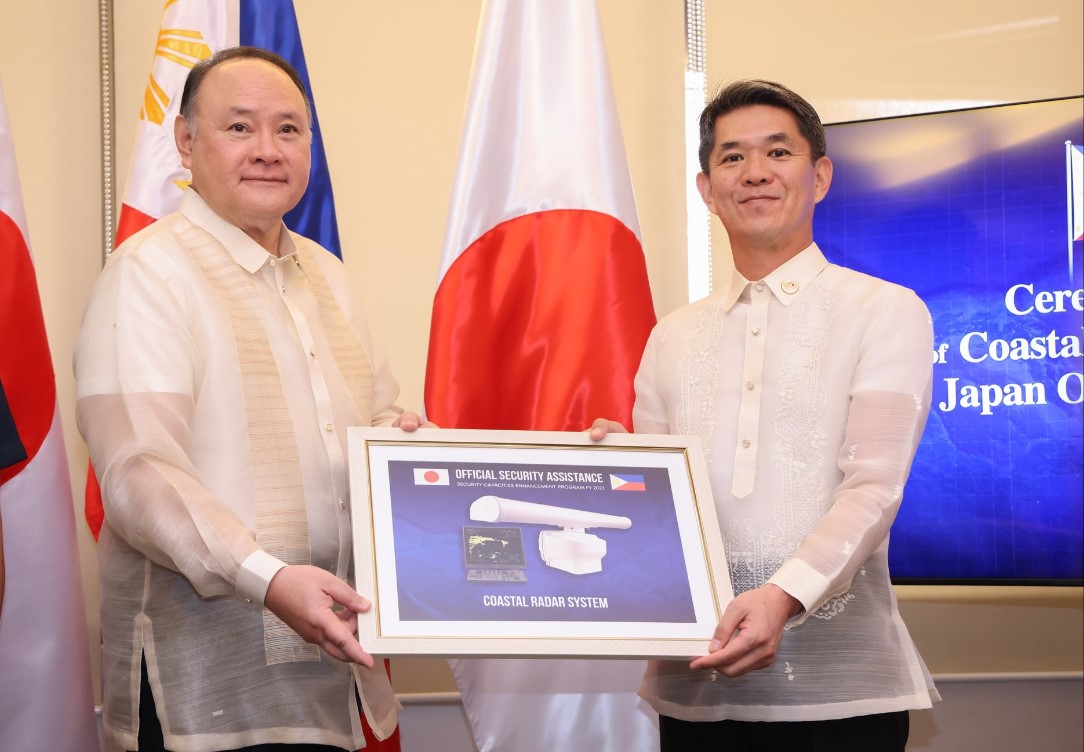
The handover ceremony took place at the headquarters of the Department of National Defense in Camp Aguinaldo, where Japanese Ambassador Kazuya Endo formally delivered the equipment to Philippine defense officials. The radar systems constitute the first completed project under Japan’s OSA framework for the Philippines.
Equipment and Funding Details
The assistance package is valued at JPY 600 million, equivalent to approximately PHP 228 million. It includes five fixed coastal radar units, mobile surveillance and monitoring equipment, and secure communications systems. The assets will be operated by the Philippine Navy.
According to Japanese officials, the radar systems are intended to strengthen the Philippines’ maritime domain awareness, enabling improved monitoring of activities within its exclusive economic zone (EEZ) and key sea lanes. The systems are expected to enhance tracking, identification, and information-sharing capabilities once fully deployed and integrated into naval operations.
Ambassador Endo stated during the ceremony that the South China Sea remains a critical maritime corridor for international trade and energy supplies, emphasizing that stability and openness in these waters are directly linked to regional and global security. He noted that strengthening the Philippines’ maritime domain awareness contributes to both national defense and regional stability.
Philippine Response
Philippine Defense Secretary Gilberto Teodoro Jr. accepted the donation on behalf of the government. In his remarks, Teodoro described Japan’s bilateral engagement as consistent and values-based, contrasting it with what he characterized as transactional approaches by other countries in the region.
Although he did not directly name any country, the remarks came amid continued confrontations between Philippine vessels and Chinese coast guard and maritime militia ships in contested areas of the South China Sea. Manila has repeatedly protested what it describes as dangerous maneuvers near disputed shoals and features within its EEZ.
Official Security Assistance Framework
The Philippines is currently the primary recipient of Japan’s OSA program and the only country to receive assistance for three consecutive fiscal years.
Under the framework:
Fiscal Year 2023: Delivery of five coastal radar systems valued at JPY 600 million.
Fiscal Year 2024: Allocation of JPY 900 million for the procurement of rigid-hulled inflatable boats (RHIBs).
Fiscal Year 2025: Funding designated for the construction of support facilities and related infrastructure for the RHIBs.
Japan introduced the OSA program to provide defense-related equipment and infrastructure support to partner countries, complementing its long-standing development assistance initiatives.
Expanding Defense Cooperation
The radar transfer forms part of broader defense cooperation between Tokyo and Manila. In January, the two countries signed the Acquisition and Cross-Servicing Agreement (ACSA), allowing the exchange of supplies and services during joint exercises and operations without additional taxation or administrative barriers.
The ACSA supports implementation of the Reciprocal Access Agreement (RAA), signed in 2024. The RAA streamlines procedures for the deployment of troops for joint training, humanitarian assistance, and disaster response missions, enhancing interoperability and logistical coordination between the armed forces of both countries.
Both Japan and the Philippines maintain close security ties with the United States, and the recent agreements are part of ongoing efforts to deepen trilateral and regional defense cooperation.
With the transfer of the radar systems completed, Philippine authorities are expected to proceed with installation and operational integration to expand coastal monitoring coverage in strategic maritime areas.
——— End of Article ———