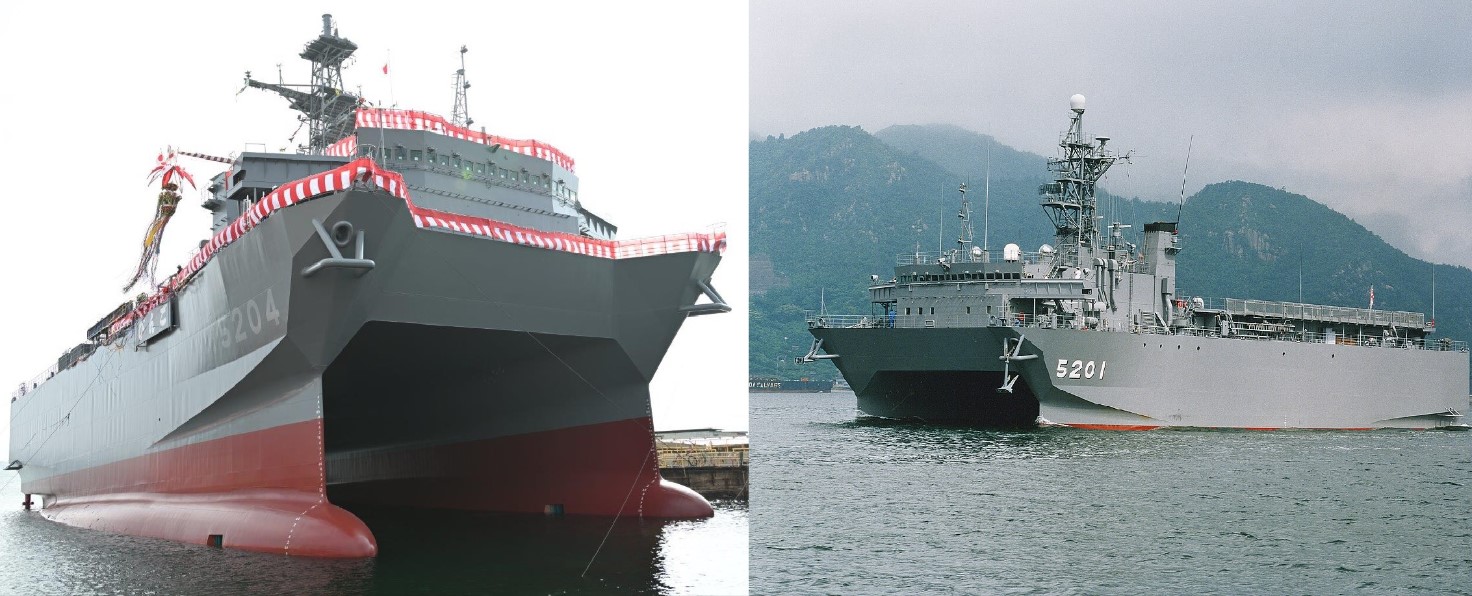
KURE, Japan — March 7, 2026 : The Japan Maritime Self-Defense Force (JMSDF) formally commissioned the ocean surveillance ship JS Bingo (AOS 5204) on March 6, expanding Japan’s dedicated underwater acoustic intelligence fleet. The induction ceremony took place at Kure Naval Base in Hiroshima Prefecture, where the vessel was assigned to the 1st Ocean Surveillance Division, the JMSDF’s specialized unit responsible for operating ocean surveillance ships.
The ship was delivered earlier the same day by Mitsubishi Heavy Industries Maritime Systems following a handover ceremony at the company’s shipyard in Tamano City, Okayama Prefecture. With the commissioning of JS Bingo, the JMSDF now operates four vessels in the Hibiki-class of auxiliary ocean surveillance ships.
The addition of the vessel increases Japan’s capacity to conduct long-duration acoustic monitoring missions and strengthens the country’s underwater intelligence collection network in surrounding seas.
Background of the Hibiki-Class Fleet
JS Bingo is the fourth ship in the Hibiki class. The earlier vessels are:
-
JS Hibiki (AOS 5201) — commissioned in 1991
-
JS Harima (AOS 5202) — commissioned in 1992
-
JS Aki (AOS 5203) — commissioned in 2021
Ships of the class are named after coastal sea regions known as “nada.” The newest vessel is named after Bingo-nada, a section of water located in the central Seto Inland Sea.
The Hibiki-class ships were originally developed during the late Cold War period as dedicated platforms for collecting underwater acoustic intelligence. Their primary role is to detect, record, and classify the acoustic signatures of submarines and surface vessels operating in nearby waters.
The procurement contract for JS Bingo was awarded in March 2023, with construction costing approximately 19.6 billion yen (about $124 million). The vessel was laid down in March 2024 and launched on February 17, 2025 before completing outfitting and sea trials ahead of commissioning.
Ship Design and SWATH Hull Configuration
JS Bingo has a standard displacement of approximately 2,900 tons, similar to JS Aki and about 50 tons heavier than the first two ships of the class due to modern design updates introduced roughly three decades after the original vessels entered service. Full load displacement is estimated at around 3,800 tons.
The ship measures 67.0 meters in length, 29.9 meters in beam, and 15.3 meters in height, with a draft of 7.5 meters.
One of the defining features of the Hibiki-class design is the Small Waterplane Area Twin Hull (SWATH) configuration. This semi-submerged catamaran arrangement uses two torpedo-shaped hulls positioned below the water surface, connected to the upper structure through narrow struts.
Because most of the vessel’s buoyant volume remains below the waterline, wave impacts on the ship are significantly reduced. The configuration provides high stability even in rough sea conditions, which is essential for collecting sensitive underwater acoustic measurements.
Propulsion and Operational Characteristics
JS Bingo is powered by four diesel engines driving two propulsion motors connected to two shaft lines. The propulsion system produces approximately 3,000 shaft horsepower, enabling a maximum speed of 11 knots.
The ship carries a crew complement of 40 personnel and is designed for extended monitoring missions at sea. The vessel can remain deployed for up to 90 days and has an operational range of approximately 3,800 nautical miles at a cruising speed of 10 knots.
The ship also features a flight deck capable of supporting helicopter operations, providing additional flexibility for logistics and operational support missions.
SURTASS Acoustic Surveillance System
The core mission system aboard JS Bingo is the Surveillance Towed Array Sensor System (SURTASS), a long towed sonar array deployed from the stern of the vessel. JS Bingo and the previously commissioned JS Aki are equipped with an upgraded version of the SURTASS system compared with the equipment installed on the first two Hibiki-class ships.
The system consists of a low-frequency array of hydrophones designed to detect underwater acoustic emissions over long distances. The array can be configured in two main modes depending on operational conditions:
-
Deep-water configuration: a single 1,800-meter towed array
-
Littoral configuration: a twin-line array with two 800-meter cables
While being towed behind the ship, the array collects underwater sound data from submarines and other vessels. Operators analyze these signals to identify and catalogue distinctive acoustic signatures, often referred to as acoustic “fingerprints.” The information is transmitted through the JMSDF operational network to analysis centers and anti-submarine warfare (ASW) units, including facilities based at Yokosuka Naval Base.
Operational Role and Strategic Context
Ocean surveillance ships act as long-duration acoustic monitoring platforms, collecting data on submarine activity and other underwater movements in surrounding waters. The introduction of a fourth vessel expands the number of available platforms capable of deploying long-range sonar arrays.
The additional surveillance capacity supports Japan’s maritime monitoring efforts amid changes in the regional undersea environment, including the expansion of submarine fleets in nearby regions and the introduction of new submarine classes by regional navies.
Rotational Crew System in the 1st Ocean Surveillance Division
The 1st Ocean Surveillance Division, which operates the Hibiki-class ships, introduced a rotational crewing system in 2017, becoming the first JMSDF unit to adopt such a model. Instead of assigning a fixed crew to each vessel, multiple crews rotate among ships in order to maximize operational availability and increase time spent at sea.
Before the arrival of JS Bingo, the division operated three ships with four rotating crews. Following the commissioning of the new vessel, the unit has transitioned to a five-crew structure supporting four ships, enabling more continuous deployment cycles and sustained acoustic monitoring operations.
The division operates under the Oceanography Anti-Submarine Warfare Support Command, headquartered at Yokosuka Naval Base in Kanagawa Prefecture, south of Tokyo.
JS Bingo (AOS 5204) Key Specifications
Class: Hibiki-class ocean surveillance ship
Standard displacement: ~2,900 tons
Full load displacement: ~3,800 tons
Length: 67.0 meters
Beam: 29.9 meters
Height: 15.3 meters
Draft: 7.5 meters
Propulsion:
-
4 diesel engines
-
2 propulsion motors
-
2 shaft lines
-
3,000 shaft horsepower
Maximum speed: 11 knots
Range: 3,800 nautical miles at 10 knots
Endurance: Up to 90 days at sea
Crew: 40 personnel
Aviation facilities: Helicopter flight deck
Primary equipment: 1 × Surveillance Towed Array Sensor System (SURTASS)
The commissioning of JS Bingo increases the Japan Maritime Self-Defense Force’s dedicated ocean surveillance fleet to four ships, expanding its capacity to collect and analyze underwater acoustic data across the surrounding maritime region.
——— End of Article ———