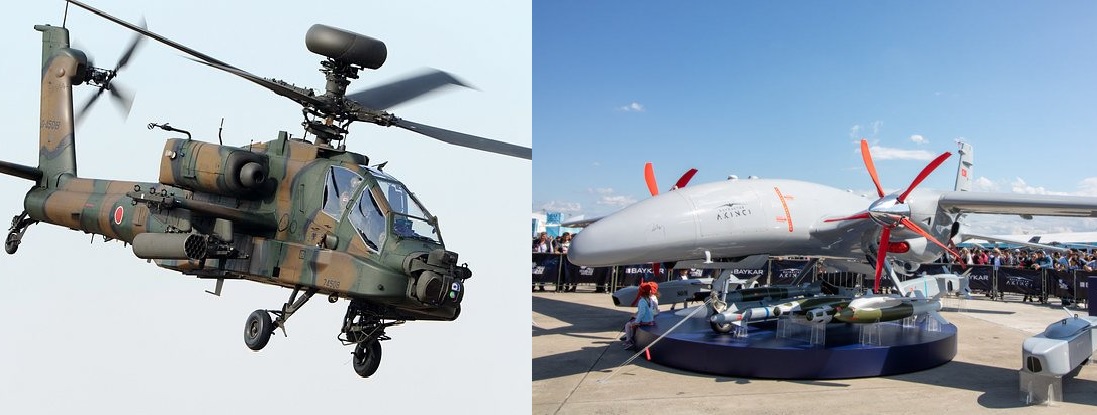
TOKYO, — April 12, 2026 : Japan has formally allocated ¥11.1 billion (approximately $69.7 million) in its fiscal year 2026 defense budget for the procurement of five wide-area unmanned aerial vehicles (UAVs) for the Ground Self-Defense Force (GSDF), marking a key step in the country’s transition from manned attack helicopters to unmanned systems. The budget was enacted on April 7, 2026, as part of a broader restructuring of Japan’s defense posture.
The wide-area UAVs are intended to support long-range detection of surface vessels, intelligence collection, and battlefield coordination, including directing firepower. Budget documents published by the Ministry of Defense specify that the procurement is not restricted to unarmed configurations, indicating a high likelihood that the selected platforms will include strike and electronic warfare capabilities.
The ¥11.1 billion allocation forms part of a larger investment strategy under which Japan is committing more than ¥100 billion (approximately $670 million) in fiscal year 2026 toward the accelerated deployment of unmanned systems. Defense officials have emphasized a “quantity over quality” approach to rapidly expand drone inventories, particularly to enhance surveillance and deterrence across remote and strategically sensitive regions such as the Ryukyu Islands.
Policy Framework and Transition Timeline
The procurement is rooted in the Defense Buildup Program, approved by the Japanese cabinet in December 2022. The program mandates the phased retirement of the GSDF’s AH-1S Cobra anti-tank helicopters and AH-64D Apache combat helicopters, transferring their reconnaissance and strike roles to unmanned platforms. This transition is intended to reduce operational costs and personnel risk while maintaining combat effectiveness.
Under current planning, the GSDF aims to establish a dedicated multi-purpose unmanned aircraft unit by approximately fiscal year 2032. To support this timeline, the Ministry of Defense initiated a Request for Information (RFI) process, issuing the first RFI in March 2025 and a second on January 30, 2026. The submission deadline for the second RFI closed on March 12, 2026, and the ministry is currently reviewing industry responses to determine the final platform selection.
The administration of Prime Minister Sanae Takaichi has also announced plans to revise Japan’s three core security documents—the National Security Strategy, National Defense Strategy, and Defense Buildup Program—before the end of 2026. Drone-centric warfare has been identified as a central focus of this review, with the potential to expand procurement targets further.
Tested Platforms: Bayraktar TB2S and Heron Mk II
Two UAV systems have completed formal testing and evaluation by Japan’s defense establishment and are considered leading candidates for procurement.
The Bayraktar TB2S, developed by Turkish company Baykar, is an upgraded version of the widely deployed TB2 platform. It is equipped with satellite communications for beyond-line-of-sight operations, enabling coverage across Japan’s extensive maritime areas. Powered by a 100-horsepower Rotax 912 engine, the TB2S has an endurance of approximately 27 hours. It features four underwing hardpoints capable of carrying up to 150 kilograms of laser-guided munitions. The estimated unit cost is approximately ¥700 million (about $5 million). The GSDF Central Accounting Unit conducted a procurement survey for the platform in August 2023, and testing was completed during fiscal year 2025. In August 2025, Defense Minister Gen Nakatani visited Baykar’s facilities in Turkey, indicating continued interest. Japan is also monitoring further developments of the platform, including higher-altitude variants such as the TB-2T.
The Heron Mk II, produced by Israel Aerospace Industries, offers extended endurance and advanced surveillance capabilities. It is powered by a 141-horsepower Rotax 915 iS engine and can remain airborne for up to 45 hours, with a maximum speed of 278 kilometers per hour. The platform integrates radar and electro-optical sensors capable of wide-area surveillance without entering foreign airspace, aligning with Japan’s operational and legal requirements. The Heron Mk II was tested at Shirahama Airport in Wakayama Prefecture, with Kawasaki Heavy Industries serving as the domestic handling partner, potentially positioning the company for local production or maintenance roles. Testing was completed during fiscal year 2024. The estimated unit cost is approximately ¥1.5 billion (around $10 million).
Additional Industrial Options
In addition to the two tested systems, Japan is evaluating other domestic and international options. In December 2023, the Acquisition, Technology & Logistics Agency (ATLA) awarded a ¥660 million contract to SUBARU for a concept-demonstration study of a vertical-takeoff-and-landing (VTOL) multi-purpose UAV. The study was delivered in February 2025. SUBARU has prior experience in unmanned systems, having produced the GSDF’s FFOS and FFRS observation platforms, and is considered a potential domestic alternative.
Another candidate is the Gray Eagle 25M, a modernized variant of the MQ-1C developed by General Atomics. The platform is powered by a 200-horsepower heavy-fuel engine and offers endurance exceeding 40 hours. It incorporates a Modular Open Systems Approach (MOSA) architecture, allowing rapid integration of sensors and electronic warfare payloads. The Gray Eagle 25M completed its first flight in December 2023 and is currently being delivered to U.S. Army National Guard units. Japan is also separately investing ¥41.5 billion in MQ-9B SeaGuardian UAVs from General Atomics for maritime surveillance missions.
Broader Defense Budget Context
The UAV procurement is part of Japan’s fiscal year 2026 defense budget totaling a record ¥9.04 trillion. Within this framework, approximately ¥100.1 billion has been allocated for the development of the Synchronized, Hybrid, Integrated and Enhanced Littoral Defense (SHIELD) system by fiscal year 2027. The SHIELD initiative integrates UAVs, unmanned surface vessels, and unmanned underwater systems to strengthen coastal defense capabilities.
Institutionally, the GSDF is scheduled to establish a dedicated department for unmanned systems by the end of April 2026. The unit, expected to consist of 10 to 20 personnel, will focus on drone operations and the integration of artificial intelligence technologies for automation.
Transition to Implementation Phase
With funding now formally appropriated and five UAVs authorized, Japan’s Ministry of Defense is moving from evaluation and planning into the procurement phase. The review of responses to the January 2026 RFI is ongoing and will inform the final platform selection.
The wide-area UAV acquisition represents the first confirmed funding step in Japan’s broader effort to replace manned attack and reconnaissance helicopters with unmanned systems. The transition is expected to reshape GSDF aviation structure over the coming decade, with full operational integration targeted by the early 2030s.
——— End of Article ———