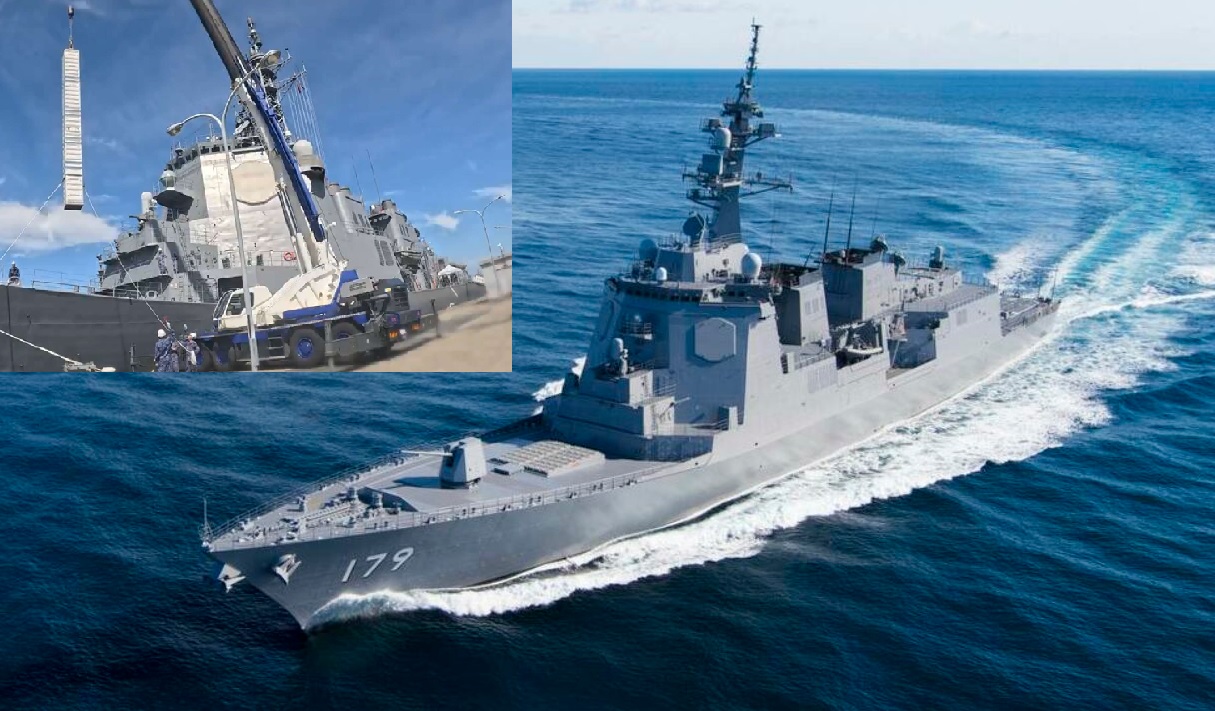
TOKYO / SAN DIEGO — March 27, 2026: Japan has completed a major upgrade to one of its frontline naval assets, with the Japan Maritime Self-Defense Force (MSDF) confirming that the Aegis-guided missile destroyer JS Chokai (DDG-176) is now capable of launching U.S.-made Tomahawk cruise missiles. The modification, carried out at a U.S. naval facility in San Diego, was overseen by Japan’s Acquisition, Technology & Logistics Agency (ATLA) and marks a significant development in Tokyo’s evolving defense posture.
The upgrade makes Chokai the first Japanese warship configured to employ the Tomahawk Land Attack Missile (TLAM), introducing a long-range precision strike capability that extends beyond Japan’s traditional defensive framework. Officials say the enhancement is intended to strengthen deterrence by enabling the targeting of distant, hardened facilities such as missile launch sites, air bases, logistics infrastructure, and command nodes across Northeast Asia.
Strategic Context and Policy Framework
Japan’s Defense Minister Shinjiro Koizumi described the deployment as a necessary response to the rapidly changing regional security environment. He pointed to continued ballistic missile development by North Korea, including maneuverable systems with extended range, as well as China’s expanding inventory of conventional and precision-strike weapons.
Koizumi emphasized that the capability is designed to complicate adversary planning and reinforce deterrence, remaining within the bounds of Japan’s self-defense-oriented security policy. The introduction of long-range strike options was formally authorized under Japan’s revised National Security Strategy (2022).
In January 2024, Japan signed an agreement with the United States to procure up to 400 Tomahawk missiles, including both Block IV and Block V variants, in a deal valued at approximately $2.35 billion. The integration aboard Chokai represents the first operational step in deploying these systems across the fleet.
A ceremony marking the completion of the refit was held in San Diego, attended by Vice Adm. Yoshihiro Goka of the MSDF Fleet Escort Force and Vice Adm. John Wade, commander of the U.S. Third Fleet.
Platform Overview: Kongo-Class Destroyer
Commissioned as part of Japan’s first generation of Aegis-equipped destroyers, Chokai is a Kongo-class vessel designed for multi-mission operations and extended deployments.
The ship displaces approximately 7,500 tons (standard) and up to 9,500 tons (full load). Measuring 161 meters in length with a beam of 21 meters, it is powered by four Ishikawajima-Harima/General Electric LM2500-30 gas turbines driving two shafts. This propulsion system generates roughly 100,000 shaft horsepower, enabling speeds of up to 30 knots.
With an operational range of about 4,500 nautical miles at 20 knots and a crew of around 300 personnel, the vessel is optimized for sustained operations across the Western Pacific.
Combat Systems and Sensors
The destroyer’s combat capability is built around the Aegis Combat System, centered on the AN/SPY-1D phased-array radar. This system allows simultaneous tracking of multiple airborne and ballistic threats at long range.
Additional sensors include the OPS-28 surface search radar for maritime surveillance and the OQS-102 bow-mounted sonar for anti-submarine warfare. Electronic warfare protection is provided by the NOLQ-2 intercept and jamming system, which disrupts radar-guided threats.
The ship also operates one SH-60K helicopter equipped for anti-submarine and surveillance missions using dipping sonar, sonobuoys, and data-link capabilities.
Armament and Layered Defense
Chokai retains a comprehensive weapons suite supporting air, surface, and subsurface warfare. Its armament includes a 127 mm Oto Melara naval gun for surface engagements and naval gunfire support, as well as eight RGM-84 Harpoon anti-ship missiles capable of striking targets beyond 120 kilometers.
For close-in defense, the vessel is equipped with two 20 mm Phalanx Close-In Weapon Systems (CIWS), designed to intercept incoming missiles at short range. Anti-submarine capabilities are supported by two HOS-302 triple torpedo launchers deploying Mark 46 or Type 73 lightweight torpedoes.
At the core of the destroyer’s firepower is the 90-cell Mk-41 Vertical Launch System (VLS), a modular launcher capable of deploying a range of munitions. Prior to the upgrade, this included SM-2MR surface-to-air missiles, SM-3 ballistic missile interceptors, RIM-162 Evolved Sea Sparrow Missiles (ESSM), and RUM-139 anti-submarine rockets.
Tomahawk Integration and Capabilities
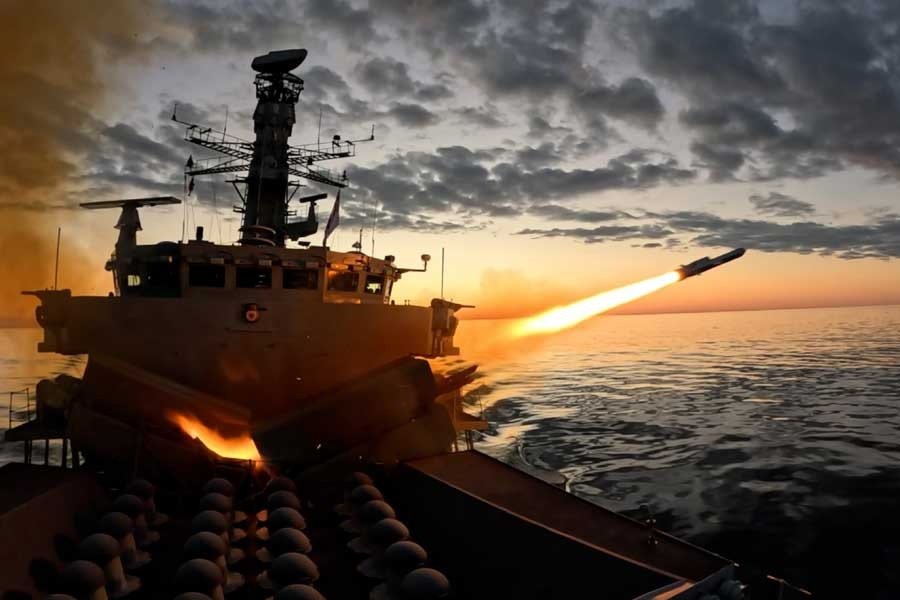
The addition of Tomahawk missiles significantly expands the ship’s operational role. The subsonic cruise missile offers a range of approximately 1,600 kilometers and uses a combination of inertial navigation, terrain contour matching, and satellite guidance to reach its target with high precision.
Its low-altitude flight profile enhances survivability by reducing radar detection in contested environments. Integration into the Mk-41 VLS required no major structural modifications, allowing relatively seamless adaptation.
However, defense planners note certain operational constraints. The Tomahawk is optimized for fixed or slow-moving targets and depends heavily on accurate targeting data provided through intelligence, surveillance, and reconnaissance (ISR) networks. Its subsonic speed also results in longer flight times compared to ballistic systems, which may limit responsiveness in rapidly evolving scenarios.
Testing and Operational Timeline
Despite the successful integration, Chokai is not yet operational in its new configuration. Live-fire testing is scheduled to take place in U.S. waters by the summer of 2026 to validate system performance and crew readiness.
Following testing and certification, the vessel is expected to return to Japan and re-enter active service around September 2026.
Broader Force Modernization Plans
The upgrade is part of a broader Japanese effort to field long-range strike capabilities across its Self-Defense Forces over the coming decade. The MSDF plans to equip all eight of its Aegis destroyers—including Kongo, Atago, and Maya-class vessels—with Tomahawk missiles.
In parallel, Japan is advancing development of an extended-range version of its domestically produced Type-12 surface-to-ship missile. The upgraded system is expected to achieve comparable standoff range and is intended to eventually replace imported cruise missiles, enhancing national autonomy in defense production and sustainment.
The deployment of Tomahawk-equipped destroyers aligns with evolving U.S.-Japan operational concepts focused on distributed maritime operations and networked strike capabilities, integrating naval assets with joint and allied command-and-control systems.
Operational Implications
With the addition of long-range strike capability, Chokai can now engage targets deep inland without approaching hostile coastlines. When integrated with real-time data links and ISR networks, this capability allows coordinated precision strikes against high-value targets.
At the same time, effectiveness depends on secure communications, accurate intelligence, and resilience against electronic warfare. These factors remain central to the operational deployment of cruise missile systems in contested environments.
The upgrade represents a structural shift in Japan’s maritime defense architecture, expanding the role of surface combatants from primarily defensive operations to include long-range precision strike within the framework of national defense policy.
——— End of Article ———