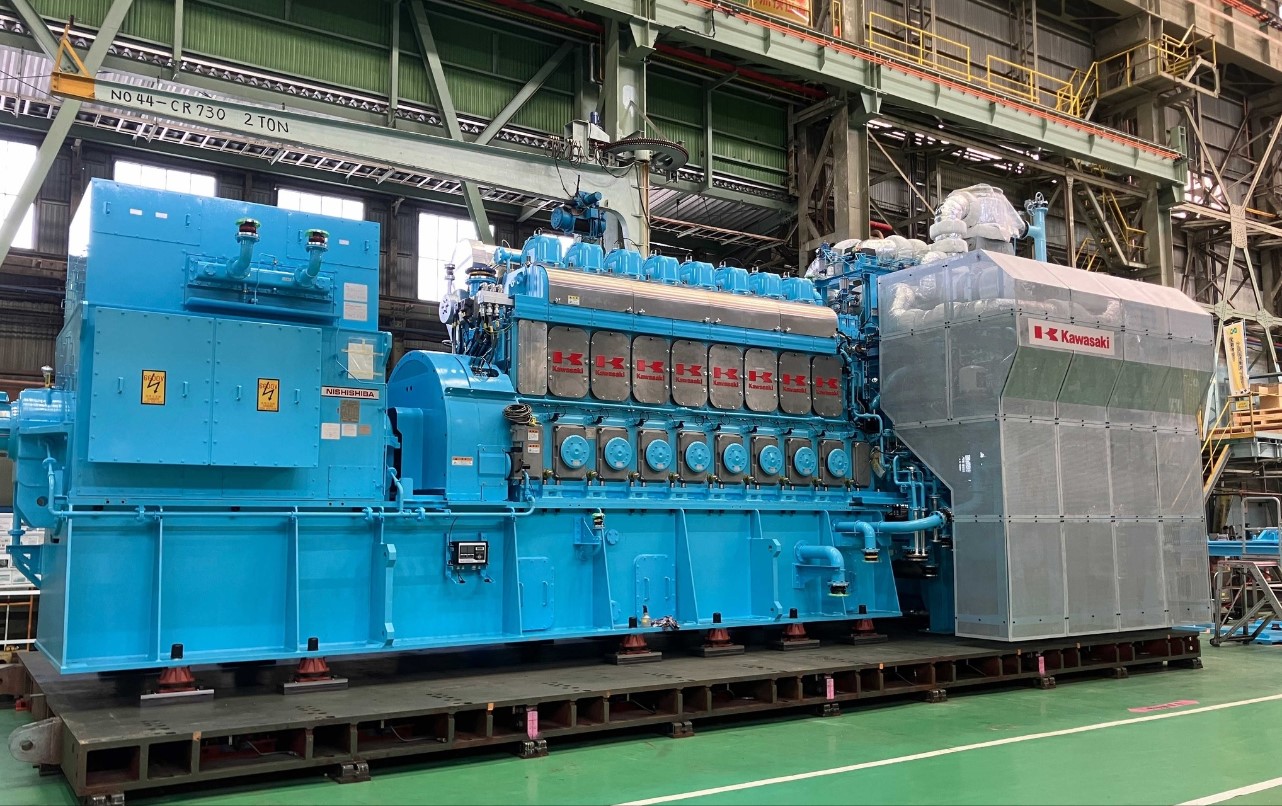
KOBE, JAPAN : Kawasaki Heavy Industries has begun commercial deployment of what it describes as the world’s first large-class gas engine designed to generate electricity by co-firing up to 30% hydrogen with natural gas. The company started accepting commercial orders in late September 2025 following completion of an 11-month operational verification program at its Kobe Works facility.
The newly commercialized model, designated the KG-18-T.HM, is derived from the company’s established Kawasaki Green Gas Engine (KG Series), which has received more than 240 orders since its introduction in 2011. The hydrogen-ready version is positioned as a transitional solution for utilities seeking to reduce carbon emissions while maintaining existing gas-based power infrastructure.
Engine Specifications and Operating Characteristics
The KG-18-T.HM is an 18-cylinder, large-class reciprocating gas engine designed for distributed and medium-scale power generation applications.
The system operates within the 5–8 megawatt (MW) output class. It produces 7,800 kilowatts (kW) at 50Hz (750 rpm) and 7,500 kW at 60Hz (720 rpm), enabling compatibility with both frequency standards used in Japan and international markets.
The engine pre-mixes hydrogen with natural gas or city gas at concentrations of up to 30% by volume. Operators can dynamically adjust the hydrogen blending ratio during operation depending on hydrogen availability. The combustion system is capable of maintaining stable performance at hydrogen concentrations as low as 5%, allowing flexible fuel management based on supply conditions.
Kawasaki has also designed the system for retrofit applications. Existing mono-firing natural gas engines within the KG Series can be upgraded to hydrogen co-firing specifications without replacing the core generator infrastructure. This approach allows operators to transition gradually while utilizing installed assets.
Engineering Modifications for Hydrogen Operation
Hydrogen presents specific engineering challenges compared to natural gas, including higher flame speed, elevated combustion temperatures, and a greater tendency to leak due to its small molecular size. The KG-18-T.HM incorporates structural and safety modifications to address these factors.
To reduce leakage risk, the number of flanged joints in the fuel gas piping system has been minimized, as such joints are common leakage points. Primary and secondary fuel gas valves, along with fuel gas pressure sensors, have been replaced with hydrogen-compatible components designed for the fuel’s physical characteristics.
Flanged joints and the area surrounding the cylinder cover are enclosed and continuously monitored using high-sensitivity hydrogen leak detection systems. The engine also incorporates nitrogen purge mechanisms to inert fuel lines during startup, shutdown, or fault conditions, reducing the risk of unintended ignition.
Power Plant Configuration and Fuel Handling System
Integration of the KG-18-T.HM into a power generation facility requires dedicated hydrogen handling and mixing systems.
The standard configuration includes a hydrogen trailer receiving unit, where compressed hydrogen delivered by transport trailers is unloaded. The hydrogen is then transferred to a dedicated hydrogen mixing unit, which safely blends pure hydrogen with natural gas before delivery to the engine.
A KGG module regulates the pressure of the blended gas to match the engine’s inlet requirements. The gas engine generator is housed within a soundproofed building that contains the engine and auxiliary equipment. An adjacent electrical room contains the control panels for engine and generator operation.
Alignment with Japan’s Hydrogen Strategy
The commercialization of the hydrogen co-firing engine aligns with Japan’s national energy transition strategy. The government has identified hydrogen and ammonia as key fuels for decarbonizing thermal power generation.
Japan has set a target for hydrogen and ammonia to account for 1% of the country’s overall electricity mix by 2030. As part of this effort, authorities aim to introduce 30% hydrogen co-firing across domestic gas-fired power plants by the same year.
To support market adoption, the Japanese parliament passed the Hydrogen Society Promotion Act in May 2024. The legislation established a 15-year contract for difference (CfD) subsidy framework designed to bridge the cost gap between low-carbon hydrogen and conventional fossil fuels. The mechanism is intended to provide revenue stability for operators investing in hydrogen-capable power systems.
The government has outlined phased supply targets, aiming to expand combined hydrogen and ammonia availability to 3 million tonnes annually by 2030, 12 million tonnes by 2040, and 20 million tonnes by 2050.
Cost reduction is also central to the strategy. Japan is targeting a delivered hydrogen price of 30 yen per normal cubic meter (Nm³) by 2030, with a longer-term objective of reducing the cost to 20 yen/Nm³ by 2050 to achieve parity with liquefied natural gas (LNG).
Broader Industrial Development
Kawasaki’s reciprocating engine program forms part of a wider hydrogen power development effort in Japan.
Mitsubishi Power has demonstrated 30% hydrogen co-firing using large-frame gas turbines, including the 1,650°C-class M501JAC turbine, at the Takasago Hydrogen Park. These demonstrations have been connected to the local grid, reflecting parallel development of hydrogen-ready technologies across multiple generation scales.
The KG-18-T.HM represents one segment of Japan’s broader plan to integrate hydrogen into its power sector while maintaining compatibility with existing thermal generation infrastructure.
——— End of Article ———