TOKYO : Japan has confirmed the world’s first successful extraction of rare earth–bearing sediment from the deep ocean floor, marking a major technological milestone that could reshape global supply chains for critical minerals used in advanced manufacturing, clean energy, and defense industries.
The Japanese government said on February 2, 2026, that a state-led research mission retrieved mineral-rich mud from a depth of approximately 6,000 meters beneath the Pacific Ocean, the deepest level at which such materials have ever been recovered. The test was carried out near Minami-Torishima, a remote coral island located about 1,900 kilometers southeast of Tokyo, within Japan’s Exclusive Economic Zone (EEZ).
Officials estimate that seabed deposits in the surrounding area contain more than 16 million tonnes of rare earth oxides, a volume that could supply Japan’s domestic demand for several centuries if commercial extraction proves viable.
First-of-its-Kind Deep-Sea Operation
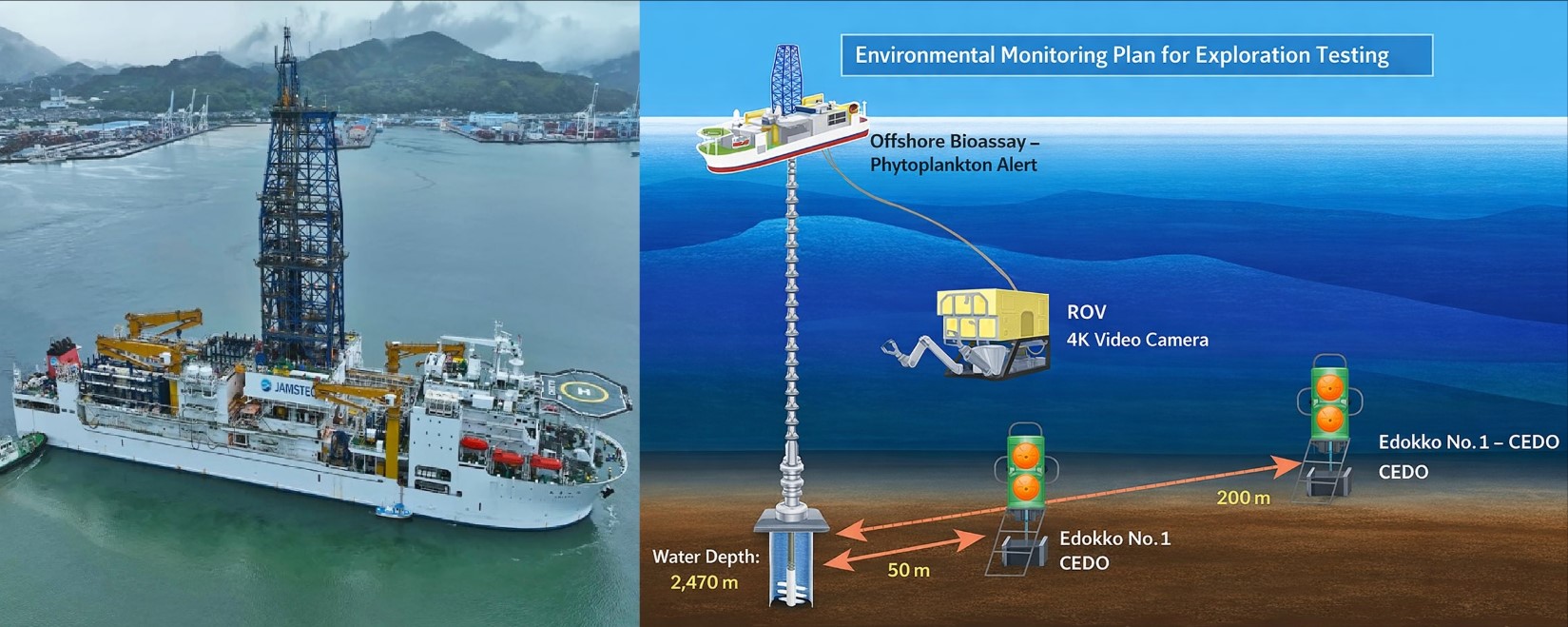
The operation was conducted using the Chikyu, a scientific drilling vessel operated by the Japan Agency for Marine-Earth Science and Technology (JAMSTEC). Originally designed for earthquake and mantle research, the vessel was adapted for deep-sea mineral recovery under conditions that exceed those of conventional offshore drilling.
Engineers deployed nearly six kilometers of reinforced pipe to the seabed using a riser drilling system, a technology typically associated with deep-water oil and gas exploration. At the seafloor, a remotely operated mining unit agitated the sediment, creating a slurry of mud and seawater. High-pressure pumps then transported the mixture vertically through the pipe system to the surface.
According to project engineers, all equipment was engineered to withstand pressures of roughly 600 atmospheres, a technical barrier that has historically limited seabed mining experiments to far shallower depths.
Mineral Content and Industrial Relevance
Initial analysis indicates that the retrieved sediment contains elevated concentrations of rare earth elements (REEs) essential to modern industrial applications. These include neodymium and dysprosium, which are used in permanent magnets for electric vehicle (EV) motors and wind turbine generators, as well as yttrium, terbium, and gadolinium, which play roles in electronics, lasers, superconductors, and defense systems.
Government researchers estimate that each tonne of seabed mud contains approximately two kilograms of extractable rare earth metals. Unlike many terrestrial rare earth ores, the deep-sea sediment is believed to be largely free of radioactive byproducts, potentially simplifying downstream processing and waste management.
Economic Security and Strategic Motivation
The project is closely tied to Japan’s economic security strategy, which prioritizes stable access to materials deemed critical for national industry and defense. Japan currently depends on China for an estimated 60 to 70 percent of its rare earth imports, a reliance that has been viewed as a strategic vulnerability.
The deep-sea extraction test follows renewed trade frictions in early January 2026, when Beijing tightened export controls on several dual-use materials supplied to Japan amid broader regional security disputes. Japanese officials say the latest restrictions accelerated efforts to develop alternative supply sources that are insulated from geopolitical pressure.
Investment and Development Timeline
Since 2018, the Japanese government has invested approximately ¥40 billion (about $260 million) in research and development related to deep-sea rare earth mining. The February 2026 retrieval marks the completion of the program’s proof-of-concept phase.
Throughout the remainder of 2026, the recovered samples will be transported to the Port of Shimizu for detailed chemical and metallurgical analysis to determine mineral density, purity levels, and extraction efficiency. A scaled demonstration phase is scheduled for February 2027, with a target of lifting up to 350 tonnes of sediment per day under sustained operating conditions.
A comprehensive assessment of commercial feasibility, including cost structures, environmental safeguards, and supply chain logistics, is expected to be completed by March 2028.
Environmental and Logistical Considerations
Despite the technical success, the project faces unresolved environmental and logistical challenges. Marine scientists have cautioned that large-scale disturbance of the seabed could generate sediment plumes that may affect deep-sea ecosystems that remain poorly understood. Environmental groups have called for further impact studies before commercial operations proceed.
Logistical complexity is another factor. Minami-Torishima lies far from Japan’s main industrial centers, requiring long-distance maritime transport. To address this, authorities plan to construct a dehydration facility on the island capable of reducing the volume of extracted mud by roughly 80 percent before shipment to refineries on the main islands.
Japanese officials emphasized that no decision on commercial mining has yet been made and that future steps will depend on environmental reviews, economic assessments, and international regulatory developments. However, the government described the successful deep-sea extraction as an important advance toward securing long-term access to strategically important minerals.
——— End of Article ———