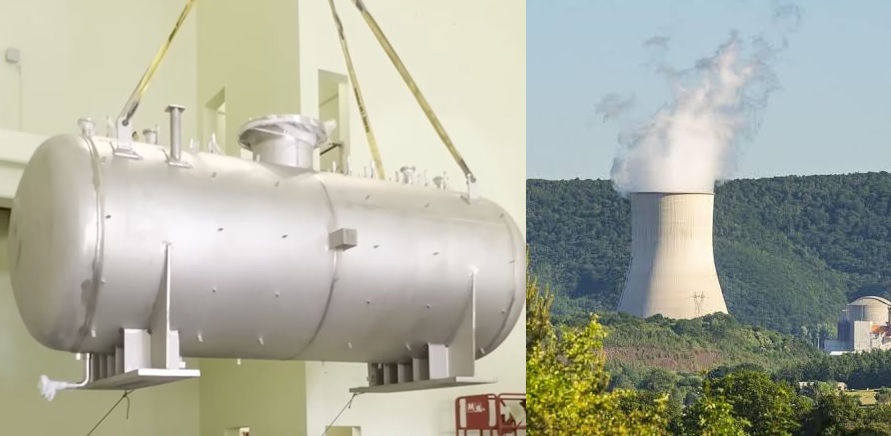
BOLOGNA, Italy — June 21, 2026 : France-headquartered advanced reactor developer Newcleo has completed the installation of the main reactor vessel for its PRECURSOR facility at the ENEA Brasimone Research Centre near Bologna, marking a major milestone in the development of lead-cooled fast reactor (LFR) technology.
The project is designed to demonstrate the operation of a full-scale reactor system and generate electricity without the use of nuclear fuel. Instead, the facility will use electric heaters and molten lead coolant to simulate the thermal behavior of a commercial nuclear reactor, allowing engineers to validate key technologies before introducing radioactive materials.
Main Vessel Installed
The centerpiece of the PRECURSOR facility is a large reactor vessel manufactured by Fucina Italia srl in Piombino, Tuscany, and engineered within the Newcleo group.
The vessel weighs approximately 20 metric tons when empty and reaches around 155 tons once filled with molten lead and internal components. Its dimensions are close to those planned for Newcleo's future commercial lead-cooled reactors, including the company's proposed 200 MWe reactor design.
According to Newcleo, the installation represents one of the largest and most advanced non-nuclear demonstrations of lead-cooled reactor technology currently under development in Europe.
How PRECURSOR Generates Electricity
Unlike conventional nuclear reactors, PRECURSOR does not contain uranium fuel or rely on nuclear fission to produce heat.
Instead, banks of high-powered electric heaters deliver approximately 10 MW of thermal energy into a pool of molten lead. The lead absorbs the heat and circulates through the reactor vessel in the same manner expected in a fueled reactor.
The thermal energy is then transferred to steam generators, producing steam that drives a commercial turbine supplied by Fincantieri. The turbine is capable of generating approximately 2 MW of electricity, with part of the output helping offset the electricity consumed by the heating system.
The facility is intended to demonstrate the complete power conversion chain, from heat production and coolant circulation to steam generation and electricity production.
Supporting Infrastructure
In addition to the main reactor vessel, the PRECURSOR facility includes several specialized systems required for handling molten lead.
These include:
- A melting tank used to liquefy solid lead ingots.
- A storage vessel for holding and conditioning molten lead during startup and maintenance operations.
- A transfer vessel for moving liquid metal between different parts of the facility.
Together, these systems will allow engineers to evaluate operational procedures and long-term performance under realistic conditions.
Testing Program
The facility is scheduled for completion during 2026 and will support a broad testing campaign covering:
- Thermal-hydraulic performance
- Normal operating conditions
- Steam generation
- Electricity production at different power levels
- Operation of the Decay Heat Removal (DHR) system
- Performance of heat exchangers and coolant circulation systems
The overall plant configuration, including the turbine and condenser systems, is designed at approximately one-ninth the scale of the future LFR-AS-30 demonstration reactor.
Why Lead-Cooled Fast Reactors?
Lead-cooled fast reactors (LFRs) are among the advanced Generation IV nuclear technologies being developed to improve safety, efficiency, and fuel utilization.
Unlike conventional water-cooled reactors, LFRs use molten lead as the primary coolant. Because lead has a boiling point above 1,700°C, reactors can operate at atmospheric pressure while maintaining substantial thermal safety margins.
This eliminates the need for the high-pressure cooling systems used in traditional nuclear power plants and reduces the risk of coolant boiling.
Another key advantage is passive safety. Molten lead can circulate naturally as temperatures change, allowing residual heat to be removed without relying entirely on electric pumps or operator intervention during emergency conditions.
Role of ENEA Brasimone
The ENEA Brasimone Research Centre has been involved in lead-cooled reactor research for decades and hosts several experimental facilities dedicated to heavy liquid metal technologies.
Its expertise includes thermal-hydraulics, coolant chemistry, corrosion studies, materials testing, and safety analysis. The collaboration with Newcleo also includes additional experimental infrastructure such as the OTHELLO research loop.
The PRECURSOR project builds on this long-standing research base and provides a bridge between laboratory-scale experiments and commercial reactor deployment.
Development Roadmap
Newcleo plans to use data from PRECURSOR to support the development of its first fueled reactor, the LFR-AS-30, a lead-cooled fast reactor with an electrical output of approximately 30 MWe.
The company aims to bring the reactor online in France around 2031 before moving forward with larger commercial units, including the LFR-AS-200 design.
Newcleo is also expanding its activities internationally. The company recently announced a partnership with California-based reactor developer Oklo and has outlined plans to invest up to $2 billion in advanced fuel fabrication infrastructure in the United States.
The initiative is focused on producing Mixed Oxide (MOX) fuel using recycled nuclear materials, including surplus plutonium and depleted uranium.
Significance for Advanced Nuclear Development
By demonstrating the operation of a full non-nuclear power conversion system before introducing fuel, Newcleo is pursuing a development strategy aimed at reducing technical and licensing risks associated with advanced reactors.
Successful operation of PRECURSOR will provide valuable data on molten lead cooling systems, heat transfer equipment, steam generation, and electricity production at an integrated system level.
As countries continue to seek reliable low-carbon energy sources, the project represents an important step toward the commercialization of lead-cooled fast reactor technology and the broader deployment of next-generation nuclear power systems.
——— End of Article ———