TEL AVIV, Israel — April 15, 2026: Israeli aviation manufacturer AIR has completed the inaugural flight of its production-configured AIR Cargo-Heavy Unmanned Aircraft System (UAS), marking a milestone in the development of autonomous, heavy-lift electric vertical takeoff and landing (eVTOL) platforms. The company confirmed that the flight took place earlier this month, concluding a development cycle of approximately two years that included ground and real-world operational testing.
The aircraft is designed as an autonomous logistics platform capable of transporting medium-weight cargo without requiring a runway. AIR stated that the system has now reached “mission-ready” status, with more than 25 units already ordered and paid for. Deliveries are underway, including systems scheduled for shipment to the United States for certification and operational evaluation.
Platform Overview and Technical Characteristics
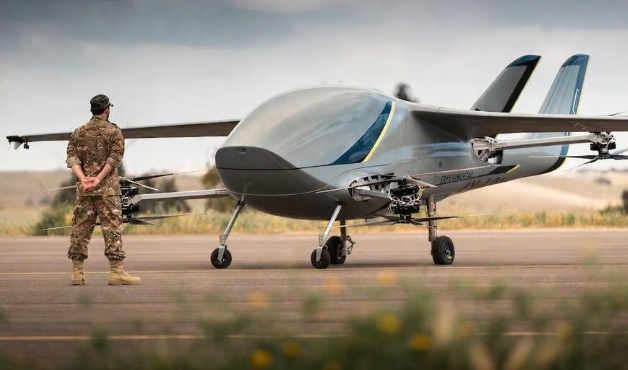
The AIR Cargo-Heavy UAS is categorized as a “Group 4 UAS” under U.S. Department of Defense classifications, placing it among larger unmanned systems capable of sustained operations and significant payload capacity. The platform combines vertical takeoff and landing capability with fixed-wing forward flight to improve range and efficiency.
According to the company, the aircraft has a payload capacity of approximately 250 kilograms (around 550 pounds) and a cargo volume of 70 cubic feet. Its physical dimensions include a wingspan of 7.5 meters (24.6 feet), a length of 6 meters (19.2 feet), and a height of 2.3 meters (7.5 feet).
The system uses electric propulsion and supports direct-current fast charging, reaching 80 percent battery capacity in approximately 30 minutes and full charge in about 60 minutes. The estimated unit cost is around $1 million, significantly lower than that of conventional manned helicopters used for comparable logistics missions.
The aircraft operates autonomously after mission parameters are defined by operators. It relies on onboard flight logic and navigation systems to execute routes without continuous human control. The design does not require prepared runways, enabling deployment from confined terrain and naval vessels.
Development Background and Industrial Base
The cargo platform is derived from technologies developed for AIR’s piloted AIR ONE eVTOL aircraft, a two-seat system with a reported range of approximately 160 kilometers and a top speed of up to 250 kilometers per hour. The cargo variant has been reconfigured as an uncrewed system optimized for payload capacity and logistics roles.
AIR was founded in 2018 by Chen Rosen, Rani Plaut, and Netanel Goldberg. The company has raised approximately $30 million in funding, including a $23 million investment round led by Entrée Capital. It employs around 70 personnel across facilities in Israel and the United States, with production centered in Kfar Yona, Israel, and additional operations in Florida. Manufacturing processes are based on automotive-style production methods intended to support scalable output.
In addition to defense applications, the company states that the platform is designed for dual-use roles, including disaster response and commercial mid-mile logistics. AIR has also reported more than $1 billion in orders for its broader AIR ONE platform, with approximately 3,300 customers on a waiting list. Certification of the piloted variant by the U.S. Federal Aviation Administration is expected later in 2026.
U.S. Military Interest and Evaluation
AIR confirmed that multiple branches of the U.S. military, including the Air Force, Navy, and Marine Corps, have expressed interest in the cargo platform. One defense customer has already purchased a unit for approximately $1 million, and additional systems are being prepared for testing and certification processes in the United States.
The aircraft is being evaluated for logistics missions that currently depend on manned helicopters, particularly ship-to-ship and ship-to-shore resupply operations. These missions include the delivery of equipment, repair tools, medical supplies, and other cargo between naval vessels or from shore bases to deployed units.
Operational Context in Maritime Environments
The system’s development aligns with evolving operational requirements in contested maritime regions, including the Strait of Hormuz and surrounding areas such as the Gulf of Oman. These environments have recently experienced disruptions, including shipping interference and the use of low-cost drones and missile systems to restrict airspace and maritime movement.
According to AIR CEO and co-founder Rani Plaut, existing logistics operations in such regions often rely on crewed helicopters for relatively small payload deliveries. He stated that the new platform is intended to reduce the need to deploy high-value aircraft and personnel for routine resupply tasks.
The autonomous cargo system enables the transport of items such as ship repair components or medical supplies without exposing aircrew to potential threats. In scenarios where an unmanned platform is lost, the financial and operational impact is lower compared to that of a manned helicopter.
Role in Logistics and Cost Structure
The AIR Cargo-Heavy UAS is positioned as a medium-lift, medium-range logistics solution intended to complement, rather than replace, existing aviation assets. By shifting routine resupply missions to autonomous systems, military operators can allocate crewed aircraft to higher-priority roles such as combat operations and search-and-rescue missions.
The company noted that most existing vertical takeoff and landing drones are limited to payloads below 100 pounds and short operational ranges, restricting their utility for sustained logistics. The AIR platform is designed to transport several hundred pounds of cargo over operationally relevant distances, addressing a gap between small drones and large helicopters.
Plaut described the system as a “work platform” rather than a strategic asset, emphasizing its role in routine logistics. The cost structure allows for potential attritable use in contested environments, where the loss of a unit would not involve personnel risk and would represent a comparatively limited financial burden.
——— End of Article ———