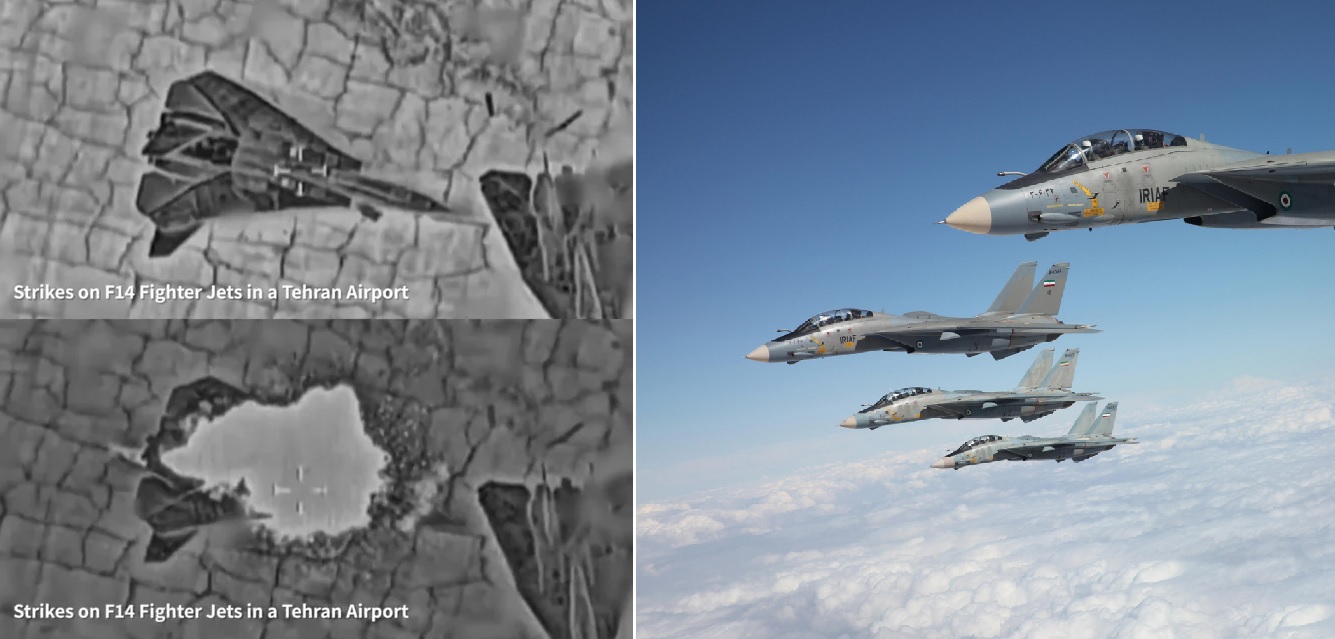
TEL AVIV, — March 8, 2026 : The Israel Defense Forces (IDF) announced that Israeli Air Force strikes have destroyed the remaining fleet of Iranian F-14A Tomcat fighter aircraft at the 8th Tactical Fighter Base located near Isfahan International Airport in central Iran.
In an official statement, the Israeli military said the operation targeted aviation infrastructure and aircraft storage areas at the base, which historically served as the main operating hub for Iran’s F-14 interceptor fleet. According to the IDF, the precision strikes eliminated all F-14 aircraft stationed at the installation, leading Israeli officials to assess that the Iranian Air Force no longer possesses operational Tomcat fighters.
The military did not immediately release video footage or satellite imagery of the strike’s aftermath. Israeli officials stated that visual documentation is being prepared and will be released publicly once it has been processed.
Strike on the 8th Tactical Fighter Base
The targeted installation, known as the 8th Tactical Fighter Base (TFB-8), is located adjacent to Isfahan International Airport and has long served as the central base for Iran’s F-14 fleet. The base hosts several fighter squadrons, including the 81st Tactical Fighter Squadron, 82nd Tactical Fighter Squadron, and 83rd Tactical Fighter Squadron, which historically operated the aircraft in the air-defense interceptor role.
Israeli military officials described the base and the aircraft stationed there as active military assets supporting Iranian air operations. The strike focused specifically on aircraft positioned within the aviation compounds at the base.
The operation forms part of a broader Israeli aerial campaign targeting Iranian military infrastructure that began on February 28, 2026. Israeli authorities have stated that the campaign is based on intelligence assessments identifying key aviation and missile-related facilities.
Just days before the Isfahan operation, Israeli strikes also targeted Mehrabad International Airport in Tehran. In that attack, the IDF reported the destruction of 16 aircraft used by the Islamic Revolutionary Guard Corps (IRGC) Quds Force, along with several detection systems and air-defense assets located at the airport.
Iran’s Remaining F-14 Inventory
Prior to the current conflict, defense assessments estimated that Iran possessed approximately 20 to 25 F-14 Tomcat airframes, although only a portion of them were believed to be fully operational at any given time.
Iran originally acquired the aircraft during the 1970s under the government of Shah Mohammad Reza Pahlavi. At the time, the United States approved the sale of advanced interceptor aircraft to Iran to counter high-altitude reconnaissance flights conducted by Soviet MiG-25 aircraft along Iran’s northern borders.
A total of 79 F-14A Tomcats were ordered, and dozens were delivered before the 1979 Islamic Revolution ended military cooperation between Washington and Tehran. After the revolution and the subsequent U.S. arms embargo, Iran lost access to official spare parts and technical support for the aircraft.
Despite these restrictions, the Iranian Air Force managed to keep a limited number of Tomcats operational for decades. Iranian maintenance crews relied on domestic overhaul programs, reverse-engineered components, and the cannibalization of parts from non-operational aircraft to maintain the fleet.
Operational Role of the Aircraft
Within the Iranian Air Force, the F-14 Tomcat served primarily as a long-range interceptor tasked with air defense and patrol missions. The aircraft’s radar and long-range missile capability historically allowed it to track and engage targets at extended distances, making it one of the most capable air-defense platforms in Iran’s inventory.
Over time, however, the aircraft became increasingly difficult to maintain due to aging airframes and limited access to original components.
The F-14 Tomcat originally entered service with the United States Navy in 1974 and remained in American service until its retirement in 2006. Following its retirement in the United States, Iran remained the only country known to operate the aircraft.
Awaiting Visual Confirmation
Israeli officials have not disclosed the exact number of aircraft destroyed during the strike or the specific munitions used in the operation. The IDF also did not provide information on potential casualties or damage to other infrastructure at the base.
Iranian authorities had not issued an official response to the Israeli claim at the time of publication.
If the destruction of the aircraft is confirmed through forthcoming imagery, the strike would represent the end of operational service for the F-14 Tomcat worldwide and remove Iran’s remaining long-range interceptor platform from its air force inventory.
——— End of Article ———