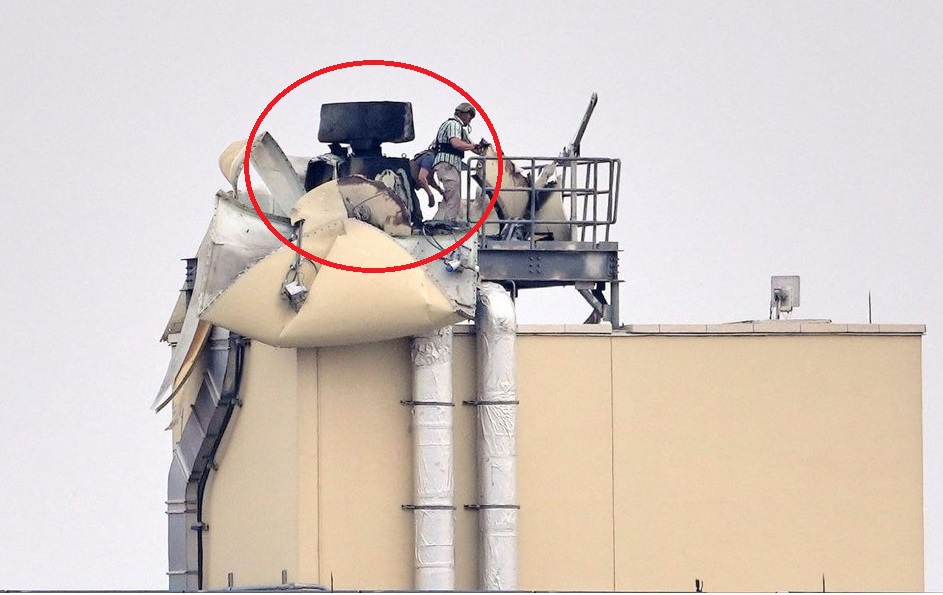
BAGHDAD, IRAQ — March 15, 2026 : A strike involving a one-way attack drone or rocket damaged a key air-defense sensor at the United States Embassy compound in Baghdad, according to images and reports that emerged following the incident on March 14. The attack destroyed a rooftop-mounted Saab Giraffe-1X 3D multi-mission surveillance radar, a system used as part of the embassy’s short-range air-defense and early-warning network.
Footage and photographs circulating after the strike show the burned and twisted remains of the radar installation on the roof of the embassy complex located inside Baghdad’s fortified Green Zone. Debris removal operations were visible in the aftermath as personnel cleared fragments of the damaged radome and associated equipment from the site.
Initial reports from Iraqi security sources and open-source analysts indicate that the attack likely involved a low-cost Iranian-type loitering munition, possibly from the Shahed-136 family, launched by Iran-aligned militia groups. Other reporting suggests that a rocket may also have been involved in the strike. The munition impacted near a helipad area inside the embassy compound and directly struck the radar installation, causing localized fire and rendering the system non-operational. No casualties were reported, and embassy personnel were accounted for following standard protective procedures.
Radar System Destroyed in Strike
The destroyed system was identified as the Saab Giraffe-1X, a compact 3D Active Electronically Scanned Array (AESA) radar designed for short-range air and surface surveillance. The radar operates in the X-band and provides continuous 360-degree monitoring of the surrounding airspace, allowing operators to detect and track aerial threats such as rockets, artillery shells, mortar rounds, and small unmanned aerial systems.
The system has an instrumented detection range of up to approximately 75 kilometres for larger aerial targets, while smaller drones are detected at shorter distances depending on size and altitude. The radar features elevation coverage exceeding 70 degrees, enabling it to track steep ballistic trajectories typical of mortar and rocket fire.
Technical characteristics of the Giraffe-1X include a scan rate of about 60 rotations per minute, allowing rapid updates of the air picture and near-instantaneous detection of fast-moving threats. The radar can simultaneously track more than 100 aerial targets and approximately 200 surface targets, providing situational awareness capability for defensive systems.
Designed as a lightweight and deployable sensor platform, the radar weighs less than 300 kilograms and requires approximately 2.3 kilowatts of power during operation. Its compact size allows it to be mounted on rooftops, towers, or mobile platforms, making it suitable for installations in confined environments such as diplomatic facilities or forward operating bases.
Role in the Embassy’s Air-Defense Network
At the U.S. Embassy in Baghdad, the Giraffe-1X served as part of the compound’s Counter-Rocket, Artillery, and Mortar (C-RAM) defense architecture. In this role, the radar functioned as a primary sense-and-warn sensor, continuously scanning the surrounding area for incoming projectiles or unmanned aircraft.
When a threat is detected, the radar calculates the object’s trajectory, determines its likely point of origin, and estimates the projected impact location. This information is then transmitted to defensive systems within the C-RAM network.
The radar also provides engagement-quality targeting data to interceptor systems, including automated gun-based defense platforms such as the Phalanx close-in weapon system, which can fire bursts of ammunition to intercept rockets, artillery shells, mortars, or drones before they reach protected areas.
Beyond projectile detection, the radar supports counter-unmanned aerial system (C-UAS) operations, identifying and tracking low-flying drones that may approach the compound. It also provides short-range air surveillance to support broader force protection and situational awareness for security personnel.
Reports indicate that a single Giraffe-1X unit was installed on the embassy rooftop to serve as a central sensor node for the compound’s defensive network. The destruction of the rooftop unit temporarily removed a key element of the embassy’s local detection capability.
Impact on Defensive Operations
With the radar destroyed, the C-RAM node linked to the rooftop system is currently non-operational, according to reports from security officials. Replacement of the radar would require the delivery, installation, and calibration of a new unit before the sensor can resume full operational capability.
Large facilities such as the Baghdad embassy typically operate layered defensive systems that may include secondary radar sensors, portable counter-battery systems, and other surveillance technologies deployed within or near the compound.
The embassy compound in Baghdad, one of the largest diplomatic facilities operated by the United States, has faced repeated rocket and drone attacks over the past decade from armed groups aligned with Iran. Defensive upgrades, including C-RAM systems and counter-drone sensors, have been installed over time to protect personnel and infrastructure.
Procurement and Deployment of the Radar
The Giraffe-1X radar system is manufactured by the Swedish defense company Saab and has been adopted by several militaries for air-defense, counter-drone, and battlefield surveillance roles.
The U.S. Army has procured the system for security-cooperation partners, with deliveries scheduled to begin in 2026 under a contract valued at approximately $46 million awarded in the third quarter of 2025. The radar is intended for use in forward-deployed environments and force-protection roles where compact and rapidly deployable surveillance systems are required.
Regional Security Context
The strike occurred amid escalating tensions across the Middle East involving the United States, Israel, and Iran. Iranian officials and media outlets have described ongoing attacks across the region as part of “Operation True Promise 4.”
Despite the damage to the radar installation, there were no reported casualties from the strike on the Baghdad embassy, and operations within the diplomatic compound continued following the incident. Security assessments and repair planning are expected to determine the timeline for restoring the damaged air-defense sensor capability.
——— End of Article ———