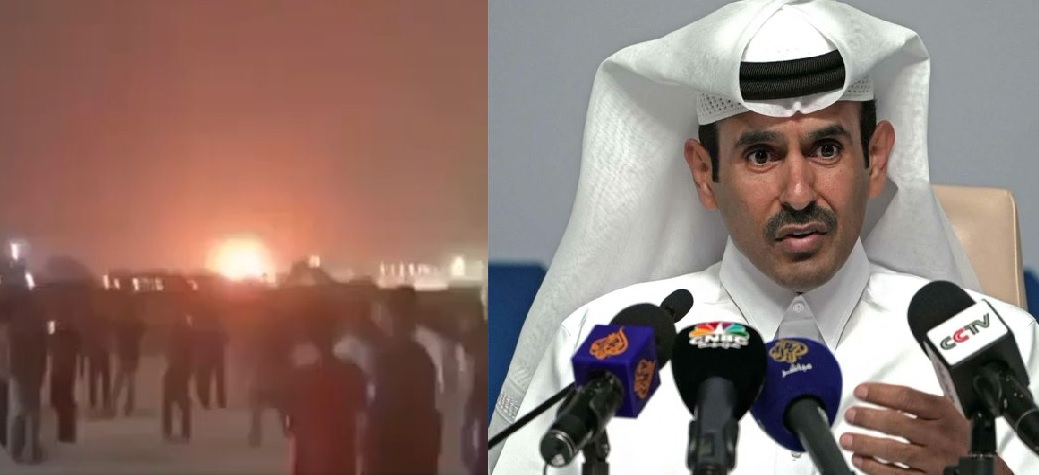
DOHA, Qatar — March 20, 2026 : QatarEnergy has reported an estimated $20 billion annual revenue loss following Iranian missile strikes on its liquefied natural gas (LNG) infrastructure at Ras Laffan Industrial City, disabling approximately 17% of the country’s export capacity.
The strikes, carried out on March 18 and early March 19, targeted critical production facilities at Ras Laffan, the world’s largest LNG processing hub. The damaged assets were part of infrastructure valued at approximately $26 billion, which had entered service only two years earlier.
Saad Sherida Al-Kaabi, who also serves as Qatar’s Minister of State for Energy Affairs, confirmed that the outage would significantly disrupt global energy supplies and force the company to suspend portions of its international delivery commitments.
Strike Details and Regional Context
The attacks are linked to escalating regional tensions, with Iran reportedly targeting Qatari energy infrastructure following Israeli strikes on the South Pars gas field, a major offshore reserve jointly shared by Iran and Qatar.
QatarEnergy confirmed that no casualties were reported and that emergency response teams successfully contained fires resulting from the strikes. However, the physical damage to production infrastructure has resulted in a complete shutdown of affected units, with no immediate timeline for restart.
Al-Kaabi described the incident as unexpected, noting the timing during Ramadan and the involvement of a regional state.
Infrastructure Damage and Production Losses
The missile strikes primarily affected three major production components:
-
LNG Train 4 (QatarEnergy 66%, ExxonMobil 34%)
-
LNG Train 6 (QatarEnergy 70%, ExxonMobil 30%)
-
One train at the Pearl Gas-to-Liquids (GTL) facility, operated by Shell
Together, the two LNG trains account for 12.8 million tonnes per annum (MTPA), representing 17% of Qatar’s total LNG export capacity.
Repair timelines are substantial:
-
LNG trains: estimated 3 to 5 years for full restoration
-
Pearl GTL facility: expected outage of at least one year
The shutdown effectively removes the output of recently commissioned infrastructure, translating directly into the projected $20 billion annual revenue loss.
Broader Impact on Energy Exports
Beyond LNG, the disruption affects multiple associated energy products processed at Ras Laffan:
-
Condensates: down by 18.6 million barrels (24% of exports)
-
Helium: reduced by 14%, impacting global semiconductor and industrial supply chains
-
Liquefied Petroleum Gas (LPG): decreased by 1.281 million tonnes (13%)
-
Naphtha and sulfur: each reduced by approximately 6%
QatarEnergy operates a total of 14 LNG trains, and Ras Laffan typically accounts for nearly 20% of global LNG supply, making the outage significant for international markets.
Contractual Disruptions and Market Effects
QatarEnergy has notified key buyers—including China, South Korea, Italy, and Belgium—of potential force majeure declarations on long-term LNG contracts for up to five years, reflecting the extended repair timeline.
The supply disruption has already influenced global energy markets. Brent crude oil prices rose by more than 10%, briefly exceeding $119 per barrel, while LNG spot prices in Europe and Asia also showed upward movement.
International Response
Donald Trump stated that the United States had no prior involvement in Israeli actions targeting Iran’s energy infrastructure and emphasized that Qatar was not a party to those operations. He warned against further escalation and indicated that the U.S. could respond if additional attacks on Qatari energy assets occur.
Global Supply Gap and Replacement Capacity
The loss of 17% of Qatar’s LNG export capacity creates a substantial supply gap in global markets, particularly affecting Asia and Europe, where Qatar is a primary supplier.
Potential alternative suppliers include:
-
United States: The world’s largest LNG exporter, with flexible export capacity and spot market cargo availability. However, infrastructure utilization is already high, limiting immediate surge capacity.
-
Australia: A major LNG exporter with stable long-term contracts, though limited spare capacity for short-term replacement.
-
Russia: Holds significant LNG potential, but geopolitical constraints and sanctions restrict its ability to fully compensate for the shortfall.
-
Algeria and Nigeria: Can provide incremental volumes, particularly to European markets, though production scalability is limited.
In the near term, analysts expect partial substitution rather than full replacement, with increased reliance on spot LNG markets, pipeline gas, and fuel switching in power generation.
Outlook
The disruption at Ras Laffan represents one of the most significant impacts on global LNG supply in recent years. With repair timelines extending up to five years and limited immediate replacement capacity, the event is expected to contribute to sustained volatility in global energy markets.
QatarEnergy has stated that full operational recovery will depend on both the security environment and the ability to safely initiate repair work. The company continues to assess the extent of damage and has not yet released detailed estimates for reconstruction costs.
——— End of Article ———