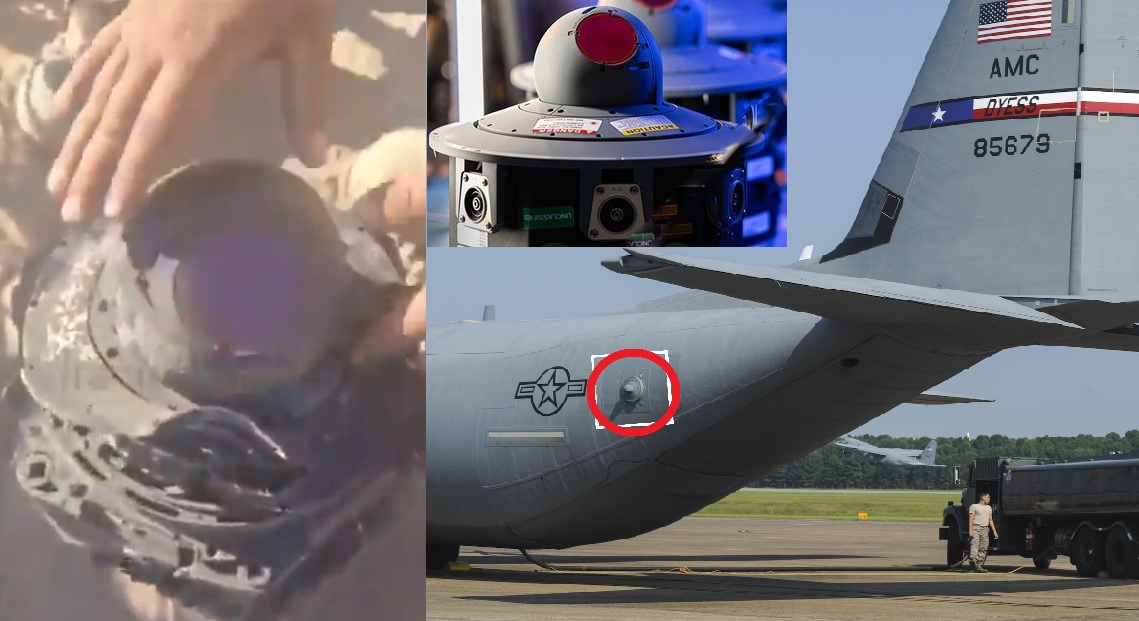
TEHRAN, — April 11, 2026 : Iranian forces have reported the recovery of a U.S.-manufactured AN/AAQ-24 Large Aircraft Infrared Countermeasure (LAIRCM) system following military operations earlier this month in southern Isfahan province. The system, developed by Northrop Grumman, was reportedly retrieved from wreckage linked to U.S. aircraft involved in a combat search-and-rescue mission.
According to statements released by the Islamic Revolutionary Guard Corps (IRGC), the equipment was obtained after the destruction of multiple U.S. platforms, including C-130 military transport aircraft and UH-60 Black Hawk helicopters. The aircraft were deployed as part of an operation to recover crew members from a downed F-15E fighter jet. Iranian sources stated that their forces engaged the aircraft, while U.S. officials have previously indicated that at least one MC-130J aircraft was intentionally destroyed on the ground to prevent sensitive technology from being captured.
The AN/AAQ-24 system, also referred to as a Directional Infrared Countermeasure (DIRCM), is a laser-based defensive suite designed to protect large aircraft from infrared-guided, heat-seeking missiles. It is deployed across a wide range of U.S. military platforms, including the C-130 Hercules, C-17 Globemaster III, CH-47 Chinook, HC-130J and MC-130J special operations aircraft, C-5 Galaxy, KC-135 Stratotanker, and various rotary-wing and tilt-rotor aircraft.
Northrop Grumman manufactures the AN/AAQ-24(V) as a modular and scalable system. It remains the only laser-based DIRCM system currently in production for countering infrared missile threats and has been installed on more than 1,500 aircraft across over 85 different platform types worldwide. The system is in active operational use by U.S. forces and multiple international operators.
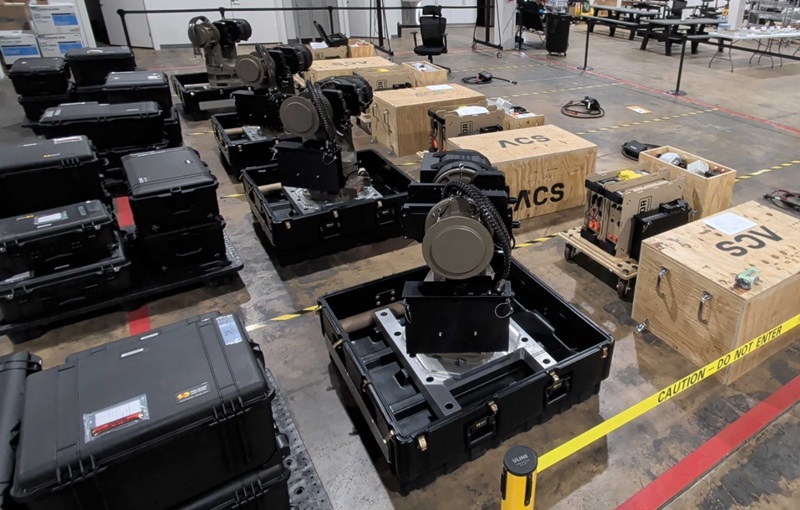
Technically, the AN/AAQ-24(V) consists of several integrated components. These include five to six missile warning system sensors, such as the AN/AAR-54, which utilize two-color infrared detection technology to identify incoming missile launches. The system also incorporates a central processor, a cockpit interface unit—either a control indicator unit (CIU) or control interface replacement unit (CIUR)—and one to three laser transmitter assemblies. These include Guardian Laser Transmitter Assemblies (GLTA) or Small Laser Transmitter Assemblies (SLTA), which provide near-spherical defensive coverage around the aircraft.
The system operates by detecting missile launches in real time across multiple infrared threat bands (Bands I, II, and IV). Once a threat is identified, the system tracks the missile’s seeker head and directs a high-intensity laser beam toward it. This laser disrupts the missile’s guidance system, causing it to lose lock on the aircraft. The process is fully automated and capable of engaging multiple threats simultaneously, including in complex or cluttered environments.
Unlike traditional countermeasure systems that rely on expendable flares, the AN/AAQ-24(V) provides a continuous, non-depleting defensive capability. It functions across all weather conditions and altitudes and includes built-in self-testing mechanisms to support maintenance and operational readiness. The system uses a universal jam waveform and programmable high-capacity cards, allowing for customization of jamming techniques, maintenance protocols, and aircraft-specific configurations.
Power requirements for the system include approximately 377 watts for the processor unit and up to 1,700 watts peak for the laser transmitter during active operation, with around 580 watts required in standby mode. In terms of physical characteristics, the GLTA turret measures approximately 13 inches in diameter and 14 inches in height, with a weight of about 60 pounds. Missile warning sensors are comparatively smaller and lighter.
The AN/AAQ-24(V) forms a key component of U.S. efforts to enhance aircraft survivability against man-portable air-defense systems (MANPADS) and other infrared-guided threats. Continuous upgrades, including Block 30 and Block 35 configurations, are intended to improve detection sensitivity and countermeasure effectiveness against more advanced missile systems.
The reported recovery marks the first known instance of this specific DIRCM technology entering Iranian possession. Analysts note that access to such systems could provide insights into U.S. defensive technologies, including detection algorithms and laser modulation techniques. Potential analysis or reverse engineering may allow the development of counter-countermeasure capabilities designed to reduce the effectiveness of laser-based defenses.
The U.S. Department of Defense has not issued an official statement confirming the status or condition of the recovered equipment. Iranian authorities have also not provided detailed information regarding the operational state of the retrieved components or any ongoing technical evaluation.
The incident underscores the risks associated with deploying advanced defense systems in contested operational environments and may influence future protective measures, including software updates and hardware modifications, across U.S. military aviation fleets.
——— End of Article ———