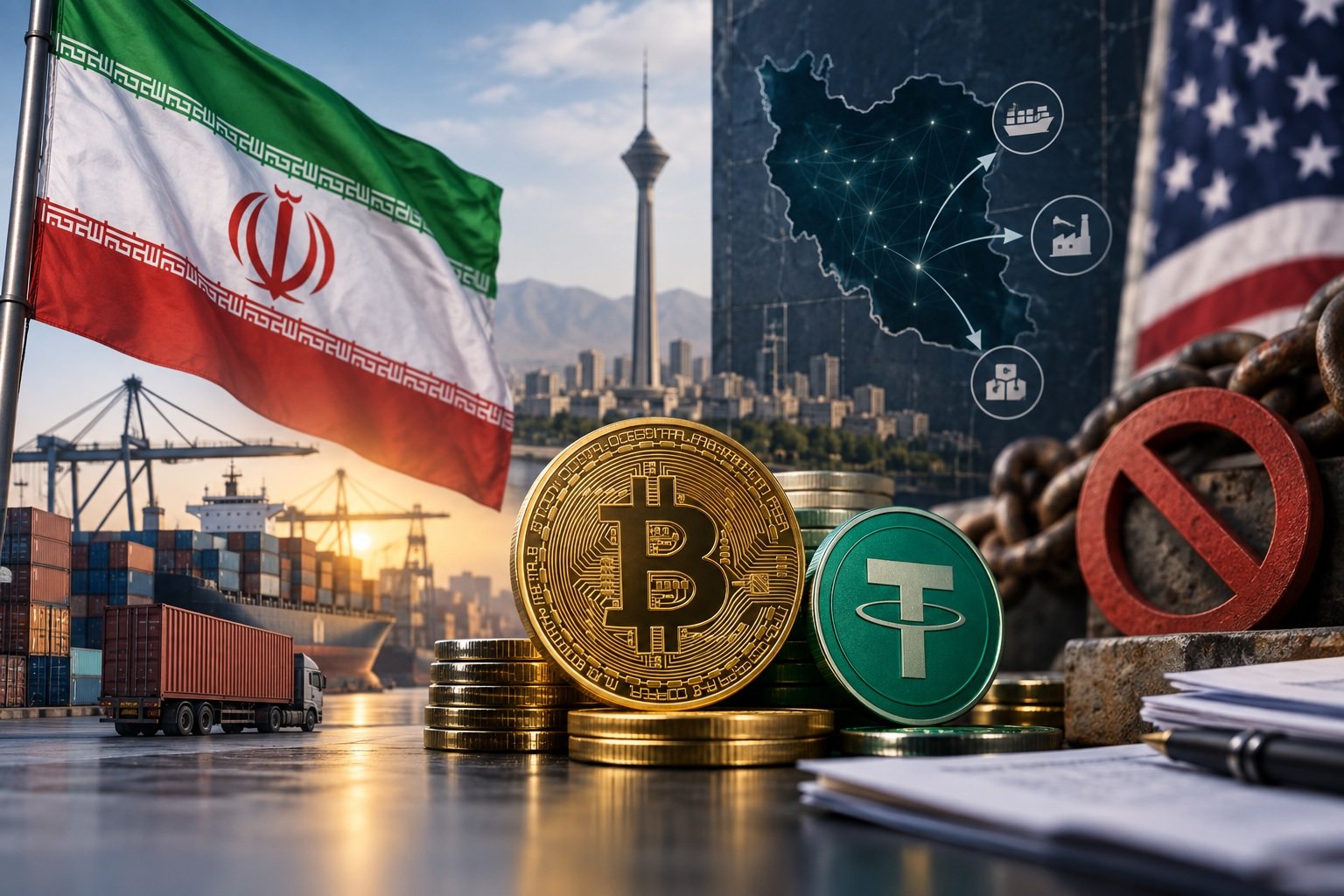
TEHRAN — Iran is increasingly using cryptocurrency to keep international trade moving as U.S. sanctions restrict its access to conventional financial networks.
The Central Bank of Iran has eased foreign-exchange controls, allowing exporters and importers to use Tether (USDT), Bitcoin and domestic cryptocurrency exchanges for cross-border settlements.
Exporters Get More Flexibility
Previously, exporters were required to return a significant portion of their foreign earnings through a government-controlled foreign-exchange platform, often at official rates that were less favorable than open-market rates. This encouraged some businesses to keep funds abroad or outside the formal system.
Under the revised framework, exporters can repatriate funds through Iranian crypto exchanges, convert currencies through the open market and use export proceeds directly to help pay for imports such as industrial raw materials and machinery.
Crypto Activity Reaches Billions
Blockchain analytics firm TRM Labs estimated that nearly $10 billion in cryptocurrency volume moved through Iran in 2025. Chainalysis separately estimated that Iranian wallets received about $7.8 billion during the year.
Tether is the most commonly used cryptocurrency for these transactions, largely because USDT is designed to maintain a value linked to the U.S. dollar. Bitcoin is also used, while domestic exchanges provide the infrastructure for transactions. Much of the Tether activity has used the Tron network.
Iran's major exchanges account for a large share of domestic activity, with Nobitex handling more than 87% of domestic transaction volume in 2025, according to the supplied data.
Central Bank and Bitcoin Mining
Elliptic reported that the Central Bank of Iran acquired at least $507 million in Tether during 2025, based on leaked documents and blockchain analysis. The activity was linked to efforts involving the rial and transactions outside traditional banking channels.
Bitcoin mining provides another source of digital assets. Elliptic previously estimated that Iranian miners accounted for about 4.5% of global Bitcoin mining, based on earlier data. The figure should not be treated as a current 2026 estimate.
Iran has used state-subsidized electricity for mining, effectively converting electricity into Bitcoin that can be transferred or exchanged to obtain value for international transactions. Licensed miners have previously been required to sell their output to the central bank, although mining has also operated outside official channels.
U.S. Sanctions Target Iranian Crypto Networks
The United States has responded by targeting Iranian cryptocurrency networks. The Treasury Department has sanctioned Iranian exchanges including Nobitex, Wallex, Bitpin and Ramzinex, citing their alleged roles in sanctions evasion and transactions involving regime-linked entities.
Tether has also frozen cryptocurrency in wallets identified as connected to Iranian entities. One reported action involved about $344 million, with additional amounts frozen later.
Iran's cryptocurrency system does not replace conventional banking or handle the country's entire trade requirements. However, the combination of relaxed currency controls, domestic exchanges and digital assets gives Iranian businesses another option for moving funds and settling international transactions while traditional financial channels remain restricted.
——— End of Article ———