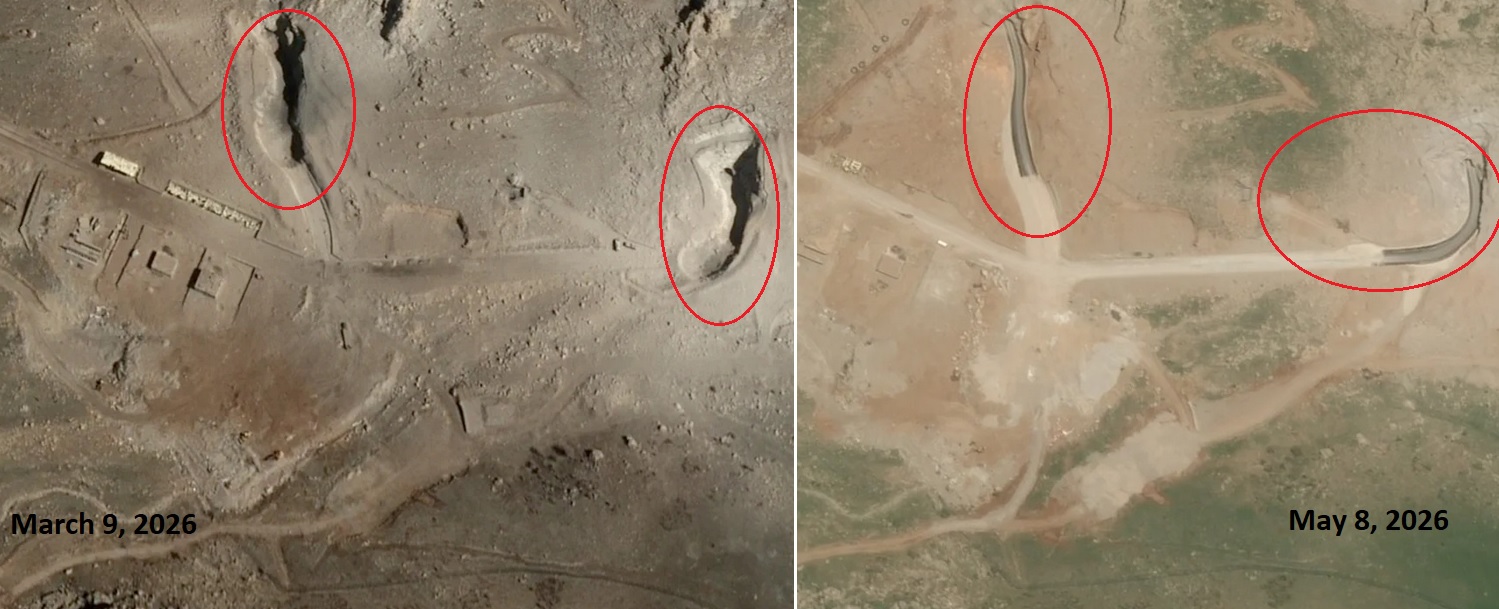
WASHINGTON — May 31, 2026 : Iran has restored access to most of the underground missile facilities targeted during recent strikes by the United States and Israel, according to a CNN analysis of commercial satellite imagery, indicating a faster-than-expected recovery of critical military infrastructure following the conflict.
Satellite imagery reviewed by CNN and provided by Airbus Defence and Space shows that Iran has reopened 50 of 69 tunnel entrances struck at 18 underground missile facilities since a ceasefire was declared more than seven weeks ago. The images suggest Tehran has accelerated efforts to repair access routes, clear debris, and restore access to missile sites damaged during the campaign.
Tunnel Entrances Reopened Across Missile Sites
The recovery work has been visible across multiple underground missile bases, where heavy engineering equipment has been deployed to remove rubble and reopen blocked entrances. Satellite imagery showed bulldozers, excavators, front-end loaders, dump trucks, and debris-clearing vehicles operating near tunnels sealed during bombing.
At a missile base in Dezful, satellite imagery captured on May 12 showed that four of the facility’s five underground entrances had been reopened, leaving only one access point blocked.
Similar activity was documented near Khomein and Isfahan, where trucks were observed clearing debris from tunnel entrances damaged during the strikes. Roads damaged during bombing operations have also largely been repaired, with satellite imagery showing access routes restored to near pre-conflict condition.
The images further indicate that nearly all bomb craters along roads leading to missile facilities have been filled, allowing movement to resume at several military locations. At some bases, additional repair work was visible, suggesting continued efforts to restore operational readiness.
Focus of the US-Israeli Air Campaign
During the conflict, US and Israeli forces concentrated attacks on tunnel entrances, access roads, and supporting infrastructure rather than attempting to destroy underground storage areas directly.
Military planners targeted surface-level infrastructure to trap missile launchers and stockpiles underground by sealing entrances and cutting off access routes. Analysts note that many of Iran’s missile facilities are deeply buried inside granite mountains and protected beneath hundreds of meters of solid rock, making direct destruction through airstrikes significantly more difficult.
Because of this underground design, the military campaign relied heavily on blocking entry points and disrupting operations instead of penetrating fortified storage complexes.
Questions Over Long-Term Effectiveness
The speed of Iran’s recovery has renewed discussion among military analysts over the long-term effectiveness of surface strikes against deeply buried missile infrastructure.
Experts say the strikes disrupted missile operations during the conflict and slowed launch activity but may not have caused major damage to underground arsenals. During the fighting, Iran reportedly continued excavation efforts even as US and Israeli strikes targeted engineering equipment used to reopen blocked access routes.
Despite operating at reduced launch rates, Tehran continued missile launches during the conflict while attempting to restore damaged facilities.
According to assessments cited in the report, Iran is believed to retain approximately 1,000 missiles stored inside underground facilities. Before the conflict, Tehran was estimated to possess around 2,500 medium-range ballistic missiles, with intelligence assessments now suggesting that more than 1,000 remain available.
Experts Say Missile Capability Remains
Sam Lair, a research associate at the James Martin Center for Nonproliferation Studies at the Middlebury Institute of International Studies, told CNN that Iran could continue launching missiles as long as it maintains launchers and trained crews, even if missile production slows.
According to Lair, Iran’s underground missile system was designed to absorb attacks, restore access, and continue operations after strikes. He said the recovery pattern seen in satellite imagery aligns with the operational structure of Iran’s “missile cities.”
Lair also noted that ceasefires generally create opportunities for both sides in a conflict to restore damaged military systems and rebuild operational capacity.
Timur Kadyshev, a senior researcher at the Institute for Peace Research, said Iran had spent decades preparing for a conflict involving attacks on strategic military infrastructure, contributing to the pace of current recovery efforts.
Recovery Faster Than Initial Intelligence Estimates
US intelligence assessments cited in the report suggest Iran’s military recovery is progressing faster than initially expected.
Four sources familiar with intelligence evaluations said Iranian forces had surpassed earlier timelines related to the restoration of missile sites, launchers, and operational infrastructure. One assessment reportedly increased estimates of surviving missile launchers to around two-thirds of pre-conflict levels, partly because the ceasefire period allowed Iran to excavate launchers buried during earlier strikes.
Officials also believe Tehran is replacing missile launchers and rebuilding weapons production capabilities faster than expected, increasing concerns over Iran’s ability to restore military readiness in the near term.
Drone Production Resumes During Ceasefire
In addition to missile recovery efforts, US intelligence agencies reportedly assess that Iran has restarted parts of its drone production network during the ceasefire period that began in early April.
According to the latest estimates, Tehran could restore its drone strike capability within roughly six months, supported by existing technical expertise, manufacturing infrastructure, and continued access to dual-use commercial components.
A March 2026 Atlantic Council report noted that Iran retains established production systems and technical capabilities that could support the rebuilding of missile and drone-related programmes.
Broader Strategic Situation
The ceasefire announced by US President Donald Trump in April paused fighting between Iran, the United States, and Israel, but several broader objectives linked to the military campaign remain unresolved.
Among the stated goals were preventing Iran from acquiring nuclear weapons capability, degrading its missile programme, and weakening broader military infrastructure. However, satellite imagery and intelligence assessments suggest Iran continues to rebuild access to key underground facilities while restoring elements of its missile and drone capabilities.
——— End of Article ———