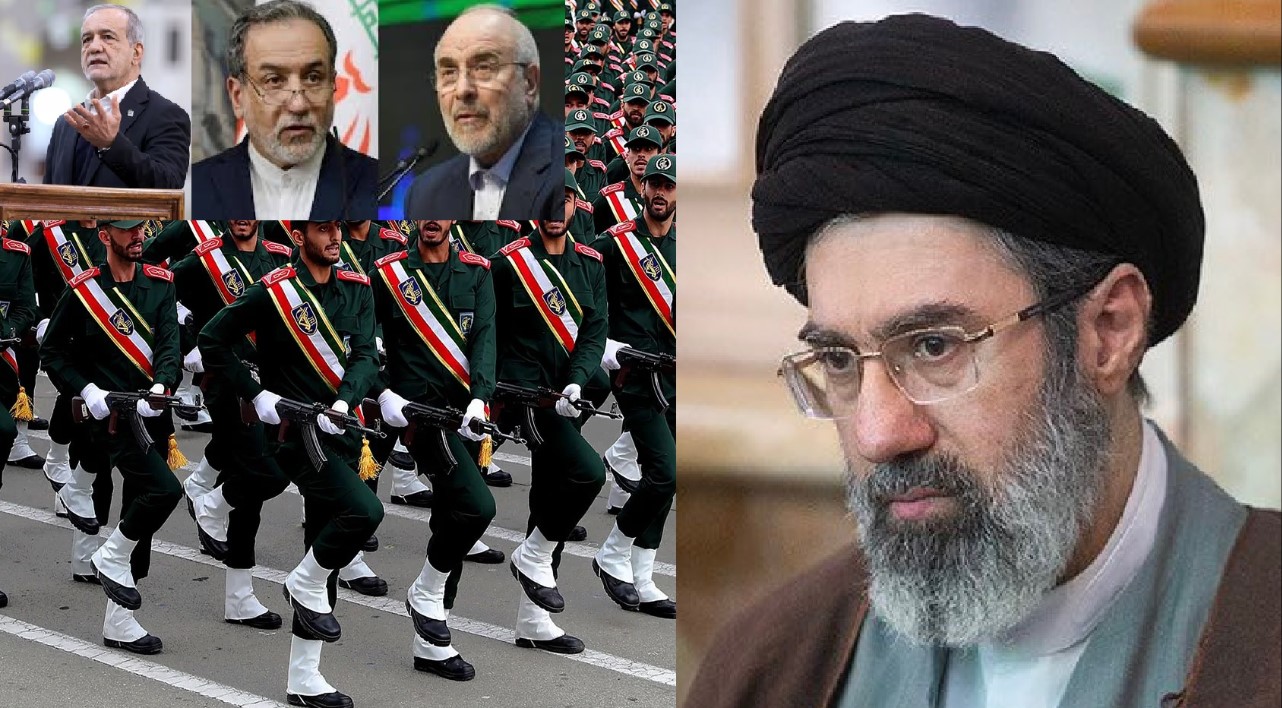
Iran’s political and military structure is undergoing a significant internal shift, as the Islamic Revolutionary Guard Corps (IRGC) has assumed de facto control over key state functions during an ongoing conflict and leadership crisis. The development follows a prolonged absence of Supreme Leader Mojtaba Khamenei and increasing tensions between the military establishment and the civilian administration led by President Masoud Pezeshkian.
Leadership Vacuum and Uncertainty
The current situation stems from the deaths of Ayatollah Ali Khamenei and several senior Iranian officials in US-Israeli strikes at the outset of the conflict. Mojtaba Khamenei, his son, was subsequently appointed Supreme Leader. However, he has not appeared in public since his appointment, and all communications attributed to him have been delivered indirectly through state television, either as written statements or read by presenters.
International assessments and statements from US officials indicate that Mojtaba Khamenei may have sustained severe injuries during the initial strikes. US President Donald Trump and Defense Secretary Pete Hegseth have publicly suggested that he could be critically wounded, possibly disfigured, or in a coma. Iranian authorities have not officially confirmed these claims.
The absence of a visible and functioning Supreme Leader has created a leadership vacuum at the highest level of the Iranian state. This has limited the ability of the civilian government to exercise authority over national decision-making processes.
Emergence of IRGC Military Council
In response to the leadership gap, the IRGC has established a military council composed of senior commanders, which is currently overseeing daily executive decisions. This body is reported to be directing both internal governance and wartime operations.
The IRGC has also implemented a strict security perimeter around Mojtaba Khamenei. This arrangement restricts access to official information and has effectively prevented direct communication between the Supreme Leader’s office and other branches of government. Requests from President Pezeshkian to meet the Supreme Leader have not been granted in recent days.
Civil-Military Tensions Intensify
Tensions between the IRGC leadership and the civilian administration have become increasingly visible. A recent attempt by President Pezeshkian to appoint Hossein Dehghan as intelligence minister was blocked by IRGC commander Ahmad Vahidi. Vahidi, who assumed leadership of the IRGC following the death of his predecessor earlier in the conflict, rejected the proposed appointment.
He stated that, under current wartime conditions, all critical and sensitive government positions must be selected and overseen directly by the IRGC. This approach departs from Iran’s established governance process, which typically requires approval from the Supreme Leader for key appointments.
President Pezeshkian has raised concerns regarding the IRGC’s conduct of the conflict, particularly its actions involving neighboring Gulf countries. He has warned that these policies are contributing to long-term economic strain, as Iran’s financial resources continue to be depleted by sustained military operations. The president has formally requested the restoration of executive authority to the civilian government, but these requests have not been accepted by the IRGC leadership.
Strategic and Economic Implications
The IRGC has expanded its operational control during the conflict, including direct management of the Strait of Hormuz. The waterway is a critical global oil transit route, accounting for approximately one-fifth of the world’s oil shipments.
Iran has imposed restrictions on vessels linked to the United States, Israel, and allied countries, effectively limiting access through the strait. The IRGC Navy has declared full control over the area and has issued warnings regarding unauthorized transit.
Beyond military operations, the IRGC continues to maintain extensive involvement in Iran’s economic sectors, including oil, transportation, banking, and real estate. Its influence in these areas has grown over time and now intersects directly with its expanded role in governance during the conflict.
Diplomatic Context
US President Donald Trump recently stated that discussions aimed at ending the conflict were underway with what he described as “moderate leaders” in Iran. Iranian officials have denied that any such negotiations are taking place.
The current balance of power suggests that the civilian government has limited capacity to independently engage in diplomatic initiatives, as decision-making authority appears concentrated within the IRGC’s military leadership.
Ongoing Situation
No official confirmation has been issued by Iranian authorities regarding the full extent of the reported power shift. However, the IRGC continues to direct key aspects of Iran’s internal governance and military strategy.
The situation reflects a consolidation of authority within the military structure amid unresolved questions about the Supreme Leader’s condition and the role of civilian leadership during the ongoing conflict.
——— End of Article ———