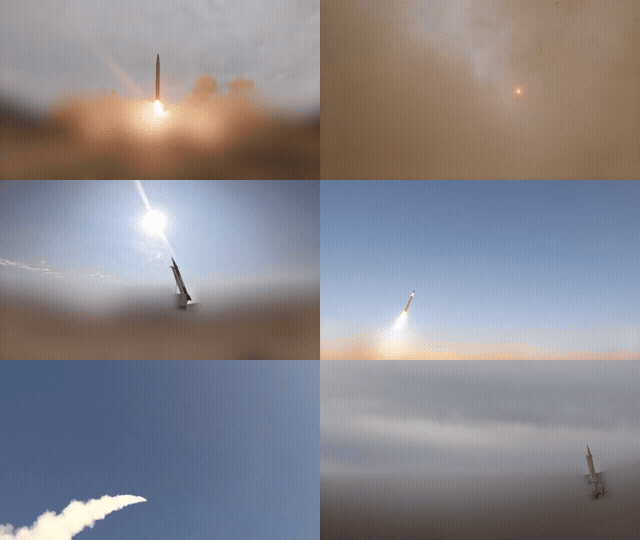
TEHRAN / JERUSALEM — March 16, 2026 : Iran’s Islamic Revolutionary Guard Corps (IRGC) announced on Monday that it has deployed the Sejjil medium-range ballistic missile (MRBM) during the latest wave of missile strikes against Israeli military targets, marking the first confirmed use of the solid-fuel system in the current Iran-Israel conflict.
According to the IRGC statement, the missile was launched as part of the 54th wave of strikes under Operation True Promise 4, targeting Israeli air command centers, defense industrial facilities, troop concentrations, and other military infrastructure. Iranian state media reported that the Sejjil was launched alongside several other ballistic missile systems, including the Khorramshahr, Kheibar Shekan, Qadr, and Emad missiles.
The conflict between Iran and Israel began on February 28, 2026, following joint U.S. and Israeli strikes on Iranian military infrastructure. Since then, Iran has conducted multiple waves of missile and drone attacks targeting Israeli territory and regional military installations.
Sejjil Missile System: Technical Characteristics
The Sejjil is a two-stage, solid-propellant medium-range ballistic missile developed domestically by Iran’s Aerospace Industries Organization, operating under the Iranian Ministry of Defence.
Open-source assessments and Iranian disclosures indicate the missile has the following characteristics:
Dimensions and Mass
-
Length: Approximately 18 meters
-
Diameter: Around 1.25 meters
-
Launch weight: Approximately 23,600 kilograms
Operational Range
-
Estimated range: 2,000–2,500 kilometers
This range allows the missile to strike targets across the Middle East from launch locations inside Iran, including all of Israel, as well as parts of Türkiye, Saudi Arabia, the United Arab Emirates, and several U.S. military installations in the region.
Payload Capacity
-
Payload: Approximately 700 kilograms
Possible warhead configurations include:
-
Conventional high-explosive warheads
-
Fragmentation warheads designed for area effects
-
Penetrator warheads intended for hardened infrastructure
Guidance and Flight Control
Recent variants are believed to incorporate:
-
Improved inertial navigation systems (INS)
-
Jet vane control systems during the boost phase to stabilize trajectory and improve accuracy
Solid-Fuel Propulsion and Operational Advantages
The Sejjil differs from many of Iran’s earlier ballistic missile systems, such as the Shahab-3, which rely on liquid-propellant engines.
Liquid-fuel ballistic missiles typically require extended fueling procedures before launch, often taking several hours. During this preparation period, missiles and support vehicles remain stationary, making them more vulnerable to detection by satellite reconnaissance, airborne surveillance, and preemptive strikes.
In contrast, solid-propellant missiles like the Sejjil are stored fully fueled, enabling immediate launch once authorization is given.
This propulsion design provides several operational advantages:
Rapid Launch Capability
Solid-fuel missiles significantly reduce the time between launch authorization and firing. Instead of requiring lengthy fueling procedures, launch preparation can occur within minutes, allowing faster response during active conflict.
Improved Mobility
Sejjil missiles are deployed using road-mobile transporter-erector-launcher (TEL) vehicles. These platforms allow missile units to disperse across large geographic areas and operate from concealed launch sites.
Greater Survivability
Mobile solid-fuel missile systems can relocate frequently, launch quickly, and move again before enemy reconnaissance assets can track or target them. This mobility complicates pre-launch interception strategies often described as “left-of-launch” operations, where adversaries attempt to destroy missiles before they are fired.
Why the Sejjil Represents a More Capable System
Military analysts note that the Sejjil represents a technological advancement over many earlier Iranian ballistic missiles, primarily because of its propulsion system and operational readiness.
Most of Iran’s earlier long-range missiles—including the Shahab series—are based on liquid-fuel technology derived from earlier Soviet and North Korean designs. While capable of long ranges, those missiles require substantial ground support infrastructure and longer preparation times.
The Sejjil’s solid-fuel architecture provides several advantages over these earlier systems:
-
Faster launch readiness, enabling rapid strike capability
-
Reduced logistical footprint, as no fueling vehicles are required at launch sites
-
Lower detection risk, due to shorter preparation time
-
Higher survivability for launch units, thanks to mobility and rapid relocation
These characteristics make the Sejjil particularly suited for mobile launch operations during sustained conflict, where launch sites may be under constant surveillance.
However, analysts also note that Iran’s stockpile of solid-fuel MRBMs is believed to be smaller than its inventory of liquid-fueled systems, meaning these missiles may be used selectively.
Missile Trajectory and Defensive Countermeasures
Despite its improved propulsion and readiness characteristics, the Sejjil follows a traditional ballistic flight path, which allows early detection by missile defense radars.
Israel’s missile defense network includes the Arrow-2 and Arrow-3 systems, designed to intercept medium-range ballistic missiles during the exo-atmospheric and high-altitude phases of flight.
Iranian strike tactics frequently involve simultaneous launches of multiple missile types, combining systems such as the Sejjil, Khorramshahr, and Kheibar Shekan. Analysts say this strategy is intended to increase pressure on interceptor inventories and complicate radar tracking and engagement sequencing.
Reported Impacts in Central Israel
Israeli emergency services reported impacts in several locations in central Israel, including areas near Tel Aviv, following the latest missile wave.
Authorities said fragments and possible sub-munitions caused damage to residential buildings, vehicles, and infrastructure. Injuries were reported in several urban areas, including Ramat Gan and Bnei Brak, primarily from shrapnel and debris.
Strategic Context of the Deployment
The use of the Sejjil comes as Israeli forces continue to conduct airstrikes against Iranian military infrastructure, particularly in western Iran.
Analysts suggest the deployment of more advanced missile systems may reflect efforts by Iran to maintain a credible strike capability during prolonged military operations, while improving the survivability and responsiveness of its missile forces.
As the conflict enters its third week, both sides continue to employ increasingly advanced weapons systems, with missile and air operations expanding across multiple areas of the region.
——— End of Article ———