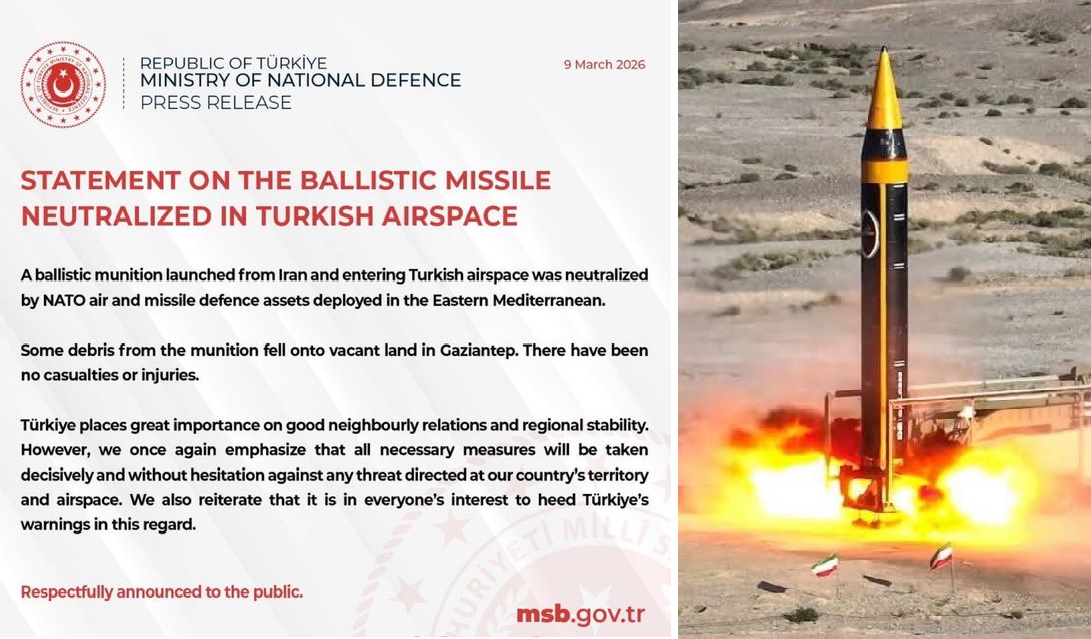
ANKARA, — March 9, 2026 : Turkish authorities reported that a ballistic missile launched from Iran entered Turkish airspace and was intercepted by NATO air and missile defense systems, marking the second such incident within five days as the regional conflict involving Iran, the United States, and Israel continues.
According to Turkey’s Ministry of National Defense, the missile was detected approaching Turkish airspace before being neutralized by NATO defensive systems positioned in the eastern Mediterranean. Debris from the intercepted munition fell onto vacant land in the southeastern province of Gaziantep. Officials confirmed that no casualties or structural damage were recorded.
Gaziantep lies near the Syrian border and approximately 150 kilometers from Incirlik Air Base, which hosts United States military personnel, and about 200 kilometers from a NATO missile defense radar facility in Malatya that supports the alliance’s ballistic missile defense network.
Second Interception Within Five Days
The March 9 interception follows a similar event on March 4, when another ballistic missile launched from Iran traveled through Iraqi and Syrian airspace before being intercepted by NATO systems over the eastern Mediterranean. Debris from that interception fell in Hatay province in southern Turkey. Turkish authorities reported no injuries or damage in that incident.
In both cases, the Turkish Defense Ministry stated that the missiles were detected moving toward Turkish airspace, although officials said the intended targets remain unclear.
The repeated interceptions occurred as the wider regional conflict involving Iran, the United States, and Israel entered its second week.
Turkish Government Response
Following the earlier March 4 interception, Turkey summoned Iran’s ambassador to Ankara to lodge a formal protest and warned against any actions threatening Turkish territory.
Turkish Foreign Minister Hakan Fidan stated that Ankara reserves the right to respond to any threat directed at the country’s sovereignty or territorial integrity. In a statement issued after the March 9 incident, the Turkish Ministry of National Defense reiterated that Turkey would take all necessary measures to protect its airspace and borders.
Iran Denies Targeting Turkey
Iran has previously denied launching missiles toward Turkey. Following the March 4 interception, Iranian Foreign Ministry spokesperson Esmaeil Baghaei stated that Tehran respects Turkey’s sovereignty and that Iranian military operations are defensive in nature.
Baghaei said Iran’s missile and drone operations are directed at adversaries involved in attacks against Iran and should not be interpreted as hostile acts toward neighboring countries.
As of March 9, Iranian officials had not issued an immediate public statement regarding the latest interception reported by Turkey.
NATO Missile Defense Response
NATO increased its ballistic missile defense posture across the alliance after the first interception earlier in March. Alliance officials stated that the defensive measures successfully protected allied territory.
Turkey plays a key role in NATO’s missile defense architecture. The country hosts a NATO early-warning radar installation in Malatya province that contributes to the alliance’s ballistic missile detection network. Turkey also hosts United States forces at Incirlik Air Base, a major installation used for NATO operations in the region.
Although the intercepted missiles entered Turkish airspace, the incidents have not resulted in casualties or significant damage required to invoke NATO’s Article 5 collective defense clause.
Diplomatic sources have indicated that Ankara could consider consultations under Article 4 of the NATO treaty, which allows member states to request discussions with allies when they believe their territorial integrity or security is under threat.
Turkish Military Deployments Increase
Amid the broader regional conflict, Turkey has increased military activity along several strategic fronts.
Turkish authorities have expanded deployments along the Iraqi border, moving ground forces, F-16 fighter aircraft, and additional logistical units into southeastern regions. Military reserves have also been mobilized, and air patrols along the Iranian frontier have increased.
Separately, the Turkish Defense Ministry announced a phased deployment of six F-16 fighter jets and air defense systems to the Turkish Republic of Northern Cyprus as part of broader security measures in the eastern Mediterranean.
Strategic and Diplomatic Considerations
The missile incidents have drawn attention to Turkey’s position within the regional conflict. As a NATO member state hosting alliance missile defense assets and U.S. military personnel, Turkey is directly integrated into Western security structures.
At the same time, Ankara has historically maintained diplomatic and economic relations with Tehran and has occasionally criticized U.S. and Israeli policies toward Iran.
Analysts note that Turkey’s current response reflects a balancing effort between NATO commitments, national security, and regional diplomacy.
Regional Security Concerns
The United States Embassy in Turkey updated its travel advisory on March 9, advising against travel to southeastern Turkish provinces due to security risks linked to the conflict in neighboring countries.
NATO officials stated that missile defense systems will remain on heightened readiness as long as regional missile activity continues.
Turkish authorities have not disclosed details about the missile type or launch location inside Iran, and investigations into the missile trajectories and possible targets are ongoing.
——— End of Article ———