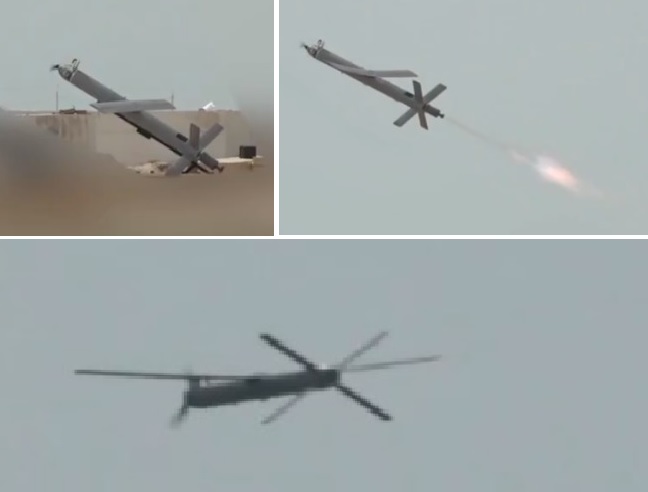
TEHRAN — March 11, 2026 : Iran has introduced a modified variant of its Shahed-101 loitering munition equipped with an electric propulsion system, marking a technical adjustment aimed at reducing the drone’s acoustic signature during flight. The development was identified through analysis of recently circulated imagery was first highlighted on March 10 by Mohammed al-Basha.
The Shahed-101 is a compact fixed-wing loitering munition designed for one-way strike missions. The drone is part of Iran’s broader family of expendable unmanned aerial systems and is intended for relatively low-cost precision attacks against a variety of targets.
Propulsion Changes and Configuration
The most significant modification in the newly observed variant is the propulsion system. Earlier Shahed-series drones, including previous Shahed-101 models, typically used a small gasoline piston engine driving a rear-mounted pusher propeller.
In contrast, the new configuration replaces the gasoline engine with an electric motor powered by an internal battery pack. The propulsion layout has also changed from a rear pusher configuration to a nose-mounted tractor propeller that pulls the aircraft forward.
This electric propulsion system significantly reduces the drone’s acoustic output during flight. The quieter profile is particularly relevant during the terminal approach phase of a mission, when detection by ground personnel or acoustic sensors is more likely. Lower noise levels may allow the drone to approach targets with reduced warning time.
Airframe Design and Materials
Aside from the propulsion modification, the drone retains the overall airframe architecture associated with the Shahed-101 platform.
The aircraft features a cylindrical fuselage constructed primarily from composite materials and carbon fiber. These materials reduce structural weight and contribute to lower radar reflectivity. The wings are straight and fixed, mounted toward the rear portion of the fuselage, while an X-shaped tail assembly provides directional stability and control, particularly during low-altitude flight.
The Shahed-101 measures approximately 1.6 to 2.5 meters in length, with some assessments placing the upper dimension closer to 3.5 meters depending on configuration. The wingspan is generally estimated at around 2.5 to 3 meters.
Launch Mechanism and Deployment
The drone continues to use a rocket-assisted launch system similar to earlier Shahed models. A small solid-fuel rocket booster is mounted beneath the fuselage to provide the initial acceleration required for takeoff.
After launch from a rail, catapult, or mobile launch rack, the booster separates shortly after ignition. Once separation occurs, the onboard electric motor sustains forward flight and guides the drone along a pre-programmed route toward its target.
This launch method allows the system to be deployed from dispersed locations with limited logistical infrastructure. Mobile launch racks and simple ground rails can be used to deploy multiple drones in rapid succession.
Performance and Technical Specifications
Open-source technical assessments place the Shahed-101 within the following capability ranges, depending on payload configuration and flight profile:
The drone’s launch weight is estimated between 26 and 45 kilograms, with some analyses suggesting the operational weight typically falls in the 35 to 45 kilogram range when fully configured.
The munition carries a warhead weighing approximately 5 to 9 kilograms, most commonly around 8 kilograms. The warhead is cylindrical and designed to produce a combination of shaped-charge penetration and fragmentation effects.
In terms of flight performance, the drone can reach maximum speeds between 150 and 200 kilometers per hour, although it generally cruises closer to 120 km/h during most of its flight profile. Operational altitudes can reach up to 3,000 meters.
Range estimates vary. Some sources suggest a theoretical maximum range of up to 1,500 kilometers, while operational assessments more commonly place the effective strike range between 600 and 800 kilometers, depending on payload weight and mission parameters.
Operational Context
The Shahed-101 was first reported to have entered production in Iran around 2024 and has since appeared in multiple operational theaters. Variants of the system have been documented in conflicts and military activities involving Ukraine, Israel, Syria, and Iraq.
The drone is typically used for attacks on lightly protected infrastructure, logistical routes, and radar systems positioned behind frontline areas. Its relatively small size and simple construction allow it to be produced in large quantities using commercially available components.
Role Within Iran’s Drone Arsenal
Within Iran’s expanding unmanned systems portfolio, the Shahed-101 serves as a smaller companion platform to larger loitering munitions such as the Shahed-131, Shahed-136, and the jet-powered Shahed-238.
Military analysts generally categorize the Shahed-101 as a platform suited for mid-range strike roles, positioned between small tactical drones and larger long-range one-way attack systems.
The relatively low production cost of these drones enables saturation tactics in which multiple units are launched simultaneously. Such attacks can complicate air defense responses by forcing defenders to track and intercept numerous incoming targets.
The electric-powered modification does not fundamentally change the drone’s structural design but instead focuses on reducing acoustic detectability while maintaining the platform’s existing operational profile. Analysts note that this adjustment reflects a continuing trend in the incremental evolution of low-cost unmanned strike systems.
——— End of Article ———