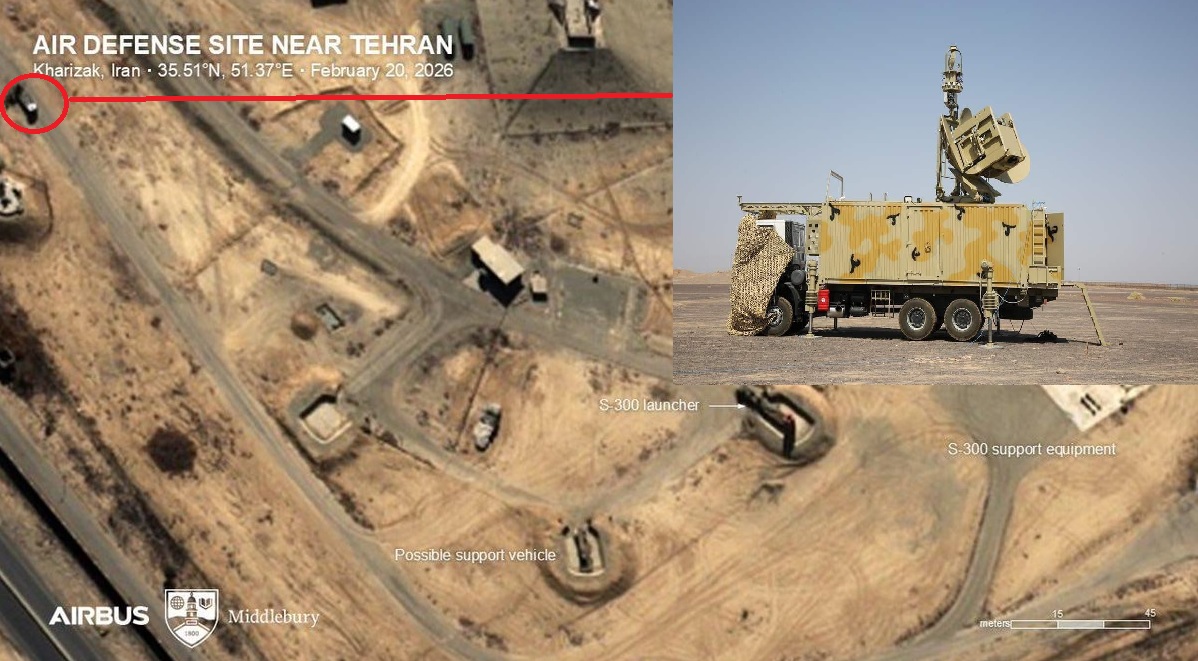
TEHRAN, Feb. 22, 2026 : Iran has deployed its domestically developed Cobra V8 electronic warfare system around key strategic sites, integrating the platform into layered air defense positions near the capital and along the Persian Gulf coast, according to satellite imagery and official statements released in late February.
Recent commercial satellite images dated Feb. 20, 2026, show Cobra V8 units positioned alongside long-range surface-to-air missile batteries, including the indigenous Bavar-373 and the Russian-supplied S-300, on the outskirts of Tehran. Additional deployments have been identified in the Bandar Abbas region near the Strait of Hormuz. The positioning follows renewed diplomatic exchanges between Tehran and Washington concerning Iran’s nuclear program.
System Development and Configuration
The Cobra V8 was developed by Iran Electronics Industries (IEI) under the Ministry of Defence and Armed Forces Logistics and was publicly unveiled in September 2023. The system is mounted on heavy military trucks and consists of a rear container housing its electronic attack suite.
The antenna configuration includes two circular dish-type arrays mounted on either side of two large horizontal plates, with the circular antennas facing inward. Defense analysts have noted its structural similarity to Russia’s 1RL257E Krasukha-4, assessing that the Cobra V8 is likely derived from or influenced by that platform through technical cooperation and localized production.
Iran has expanded domestic electronic warfare development over the past decade, supported by reported bilateral military-technical exchanges with Russia, including operational lessons observed in Syria.
Technical Characteristics
According to Iranian defense sources and open-source assessments, the Cobra V8 is a broadband electronic attack and surveillance system designed to intercept, analyze and jam radar and communications signals from airborne, ground-based and space-based emitters.
The system operates primarily within the 8 GHz to 18 GHz frequency range, enabling it to target X-band and Ku-band radars commonly used by modern combat aircraft, maritime patrol platforms and satellite communications systems. These bands are widely employed in fire-control radars, synthetic aperture radar systems, and airborne early warning platforms.
Iranian officials state that the Cobra V8 can project jamming energy at operational ranges between 250 and 300 kilometers, depending on the altitude of the target and terrain conditions. The system is designed to increase the electromagnetic noise floor within its coverage zone, degrading adversary sensor performance, corrupting data links and reducing situational awareness.
In addition to airborne radar disruption, Iranian sources report that the Cobra V8 is capable of interfering with low Earth orbit (LEO) satellite communications and downlinks. Monitoring groups have previously reported localized disruptions of commercial satellite internet services within Iran, though technical attribution remains based on open-source analysis.
Iranian military officials also state that the system incorporates signal analysis software capable of identifying distinct electronic signatures, or “fingerprints,” of radar emitters. According to these claims, the platform can differentiate between individual aircraft of the same model, including stealth aircraft such as the F-35 Lightning II, by analyzing minute variations in radar wave emissions. Independent verification of this capability has not been publicly released.
Operational Employment
Iran has previously fielded the Cobra V8 in active operational environments. In 2023, a unit was deployed near Bandar Abbas along the Persian Gulf. Iranian officials reported that during this deployment, the system interfered with the sensors of a U.S. Navy Boeing P-8 Poseidon maritime patrol aircraft conducting surveillance operations. According to those reports, the aircraft altered its flight profile following electronic interference. The U.S. Navy has not publicly confirmed the specific technical details of that incident.
The Cobra V8 has also been tested during large-scale military exercises, including the “Shield of Velayat’s Guardians” electronic warfare drill conducted in 2023. The exercise involved coordinated use of fixed, mobile, ground-based and airborne electronic warfare systems against simulated threats such as drones, helicopters and fighter aircraft. During these drills, the Cobra V8 operated alongside modified Bell-205 helicopters equipped with electronic warfare suites.
Integration into Layered Air Defense
Defense analysts assess that the Cobra V8 is intended to operate in conjunction with Iran’s kinetic air defense systems rather than as a standalone platform. By pairing electronic attack capabilities with missile systems such as the Bavar-373 and S-300, Iran is establishing overlapping defensive layers around critical infrastructure.
Within this architecture, the electronic warfare system is tasked with disrupting airborne early warning aircraft, reconnaissance platforms and data links that support strike operations. It may also degrade the guidance of anti-radiation missiles aimed at surface-to-air missile batteries, thereby increasing the survivability of missile launchers and associated radar units.
The combined deployment of electronic and missile defenses near Tehran and along maritime approaches indicates a structured effort to strengthen electromagnetic and airspace control in areas considered strategically sensitive.
Broader Strategic Context
Iran’s expansion of electronic warfare capabilities reflects sustained investment in domestic defense electronics manufacturing. Institutions such as Iran Electronics Industries have expanded production of radar systems, communications equipment and electronic countermeasure platforms as part of a broader military modernization program.
Analysts note that electronic warfare has become a central component of contemporary military doctrine globally, with increasing emphasis on control of the electromagnetic spectrum. Iran’s deployment of the Cobra V8 demonstrates its intent to reinforce air defense networks through non-kinetic measures, supplementing long-range missile systems and enhancing coverage against airborne and space-based surveillance assets.
The Cobra V8 is now assessed to be one of the most advanced electronic warfare platforms currently fielded by Iran, operating as part of a multi-layered defense structure designed to protect national airspace and maritime approaches.
——— End of Article ———