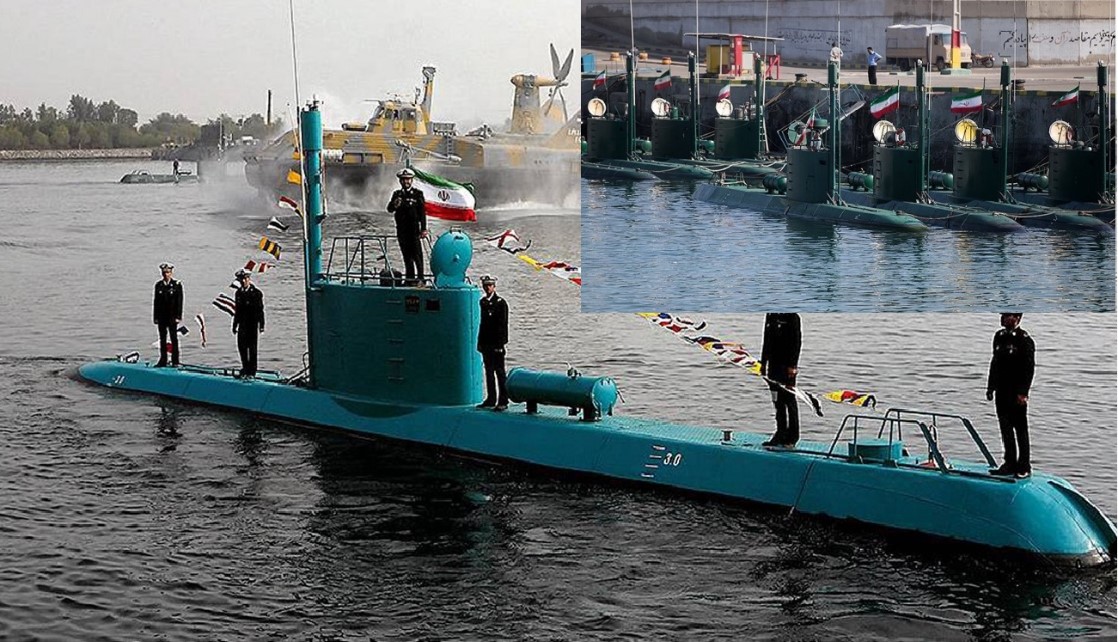
TEHRAN / WASHINGTON : The operational presence of United States Carrier Strike Groups (CSGs) in the Persian Gulf continues to factor into Iranian naval planning, particularly regarding the deployment of Tehran’s Ghadir-class midget submarines. Defense assessments estimate that Iran maintains a submarine fleet of approximately 28 to 30 vessels, the majority optimized for shallow-water operations in the Gulf. Of these, 20 to 23 are believed to be operational Ghadir-class units.
Rather than pursuing parity with U.S. blue-water naval capabilities, Iran’s maritime strategy emphasizes asymmetric systems designed to complicate anti-submarine warfare (ASW) operations, increase surveillance burdens, and impose operational constraints on high-value surface assets transiting confined waterways such as the Strait of Hormuz.
Development and Fleet Composition
Open-source defense intelligence links the origin of the Ghadir-class to the North Korean Yono-class midget submarine design. Following the reported transfer of a Yono-class vessel in 2004, Iran’s defense industry initiated domestic production of modified variants under the Ghadir designation.
The Ghadir-class forms the numerical backbone of Iran’s submarine force. While Iran also operates larger submarines, including Russian-built Kilo-class vessels, the Ghadir fleet is structured specifically for restricted-depth operations in the Persian Gulf. The number of hulls enables distribution across multiple coastal bases and maritime chokepoints, ensuring redundancy and geographic coverage.
Design and Technical Characteristics
The Ghadir-class submarines are configured for littoral warfare. Each vessel measures approximately 29 meters in length with a 9-meter beam. Displacement is estimated at 117 tons surfaced and 125 tons submerged, with a crew complement of around seven personnel.
Powered by a diesel-electric propulsion system, the submarines achieve a maximum surface speed of 10 knots and a submerged speed of 8 knots. Due to size limitations, endurance and payload capacity are restricted, leading to short-duration sorties from coastal facilities rather than extended deployments.
Their compact dimensions allow navigation in shallow waters and complex seabed terrain, where larger submarines face operational constraints. When operating on battery power, the platform maintains a reduced acoustic signature, supporting low-detectability missions in confined maritime environments.
Armament and Weapons Integration
Each Ghadir-class submarine is equipped with two 533 mm torpedo tubes. These are compatible with the domestically produced Valfajr heavyweight torpedo, assessed to carry a 220 to 300 kilogram warhead with an estimated range of 15 to 20 kilometers.
The platform is also reported to deploy the Hoot supercavitating torpedo, a high-speed system with publicly cited speeds approaching 200 knots. Additional capabilities include naval mine deployment and support for limited special operations, including the insertion and extraction of combat divers.
In February 2019, Iranian authorities announced the successful test launch of the Jask-2 anti-ship cruise missile (ASCM) from a Ghadir-class submarine. The Jask-2 is assessed to be conceptually derived from the Nasr-1 missile family. It operates as an encapsulated swim-out weapon, ejected from the torpedo tube before breaching the surface and igniting its propulsion system. The missile has a reported operational range of approximately 35 kilometers, extending engagement options beyond conventional torpedo distance and requiring defensive planning against both subsurface and aerial threats.
Operating Environment in the Persian Gulf
The effectiveness of the Ghadir-class is closely tied to the geographic and oceanographic conditions of the Persian Gulf. The region features shallow average depths, dense commercial shipping lanes, offshore energy infrastructure, and an irregular coastline.
Environmental factors such as elevated salinity, strong currents, and seasonal temperature layering (thermoclines) create complex acoustic conditions. These characteristics can distort sonar propagation and reduce the effectiveness of both active and passive detection systems. High ambient noise from maritime traffic further contributes to acoustic clutter.
Iranian naval doctrine incorporates a “bottom-resting” technique, in which a submarine can shut down propulsion systems and settle on the seabed. In such conditions, a stationary vessel may be more difficult to distinguish from surrounding terrain using sonar, particularly in areas with uneven topography and sediment.
Strategic Implications for U.S. Naval Operations
For U.S. naval planners, the Ghadir-class represents a distributed undersea threat that increases ASW workload rather than a system intended for direct confrontation with carrier strike groups. The positioning of multiple submarines near maritime chokepoints, combined with potential mine deployment, aligns with a layered maritime denial strategy.
Although aircraft carriers avoid the shallowest routes, escorts, logistics vessels, and narrow transit corridors present operational considerations. The presence of small submarines may necessitate reduced transit speeds, expanded protective formations, and sustained ASW patrol operations.
To mitigate these risks, U.S. Carrier Strike Groups deploy MH-60R Seahawk helicopters equipped with advanced dipping sonar systems optimized for shallow-water detection. The U.S. Navy has also expanded the use of unmanned surface and subsurface vehicles to strengthen maritime domain awareness across the Gulf. Despite these measures, tracking small diesel-electric submarines in cluttered littoral environments remains resource-intensive due to environmental and acoustic constraints.
Operational Context
Ongoing and potential future deployments of U.S. naval assets in the Middle East underscore the relevance of littoral-focused submarine forces in regional security planning. Iran’s investment in the Ghadir-class reflects a force structure centered on geographic constraints, dispersal, and layered maritime defense. Within the confined waters of the Persian Gulf, the platform is assessed primarily as a means of increasing operational complexity and surveillance demands rather than conducting sustained blue-water engagements.
——— End of Article ———