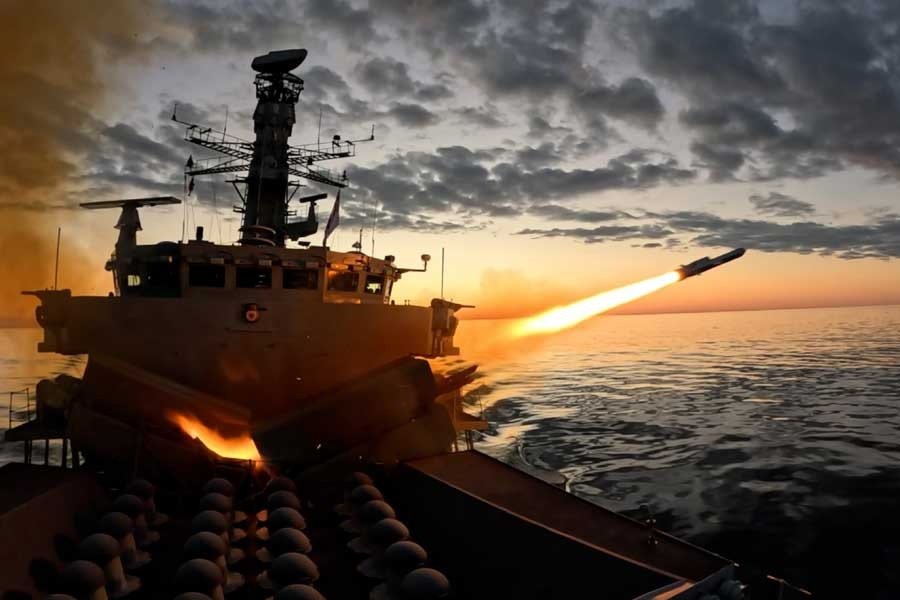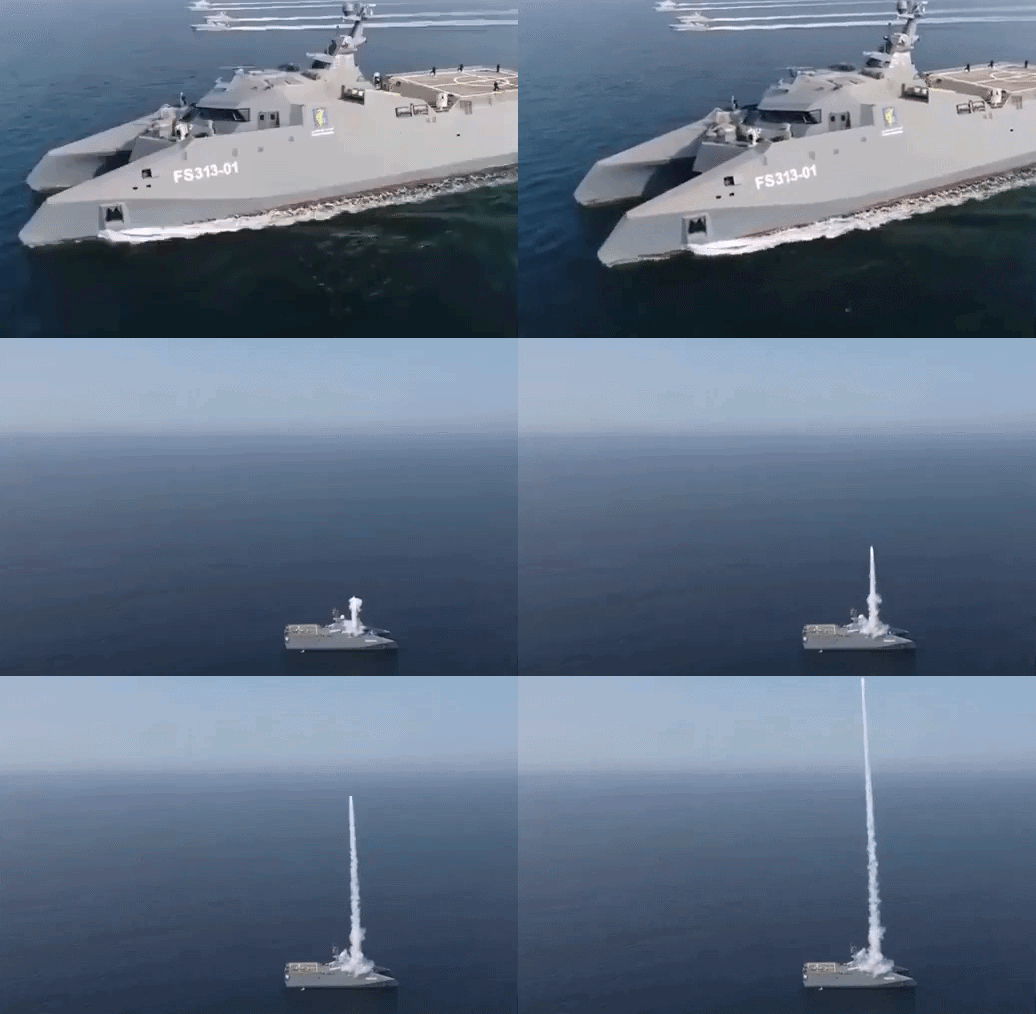
BANDAR ABBAS : Iran has carried out the first naval launch of its Sayyad-3G surface-to-air missile from a warship platform, marking the initial operational firing of the system from a vertical launching system (VLS) at sea. The launch was conducted in the Strait of Hormuz and was followed by the immediate deployment of the vessel to the Gulf of Oman for a bilateral passing exercise (PASSEX) with the Russian Navy.
First Naval Launch of Sayyad-3G
The missile was launched from the vertical launch system aboard the Islamic Revolutionary Guard Corps (IRGC) Navy’s stealth catamaran corvette Shahid Sayyad Shirazi (hull identification FS313-03).
The Sayyad-3G, also referred to as Sayyad-3F, is an interceptor designed for mid-to-long-range air defense. It has an estimated engagement range of approximately 150 kilometers and is intended to provide extended aerial coverage against aircraft and other airborne threats. The missile forms part of Iran’s broader layered air defense architecture and is adapted for naval deployment through vertical launch integration.
The launch took place in the Strait of Hormuz, a strategically significant maritime chokepoint connecting the Persian Gulf to international waters. Conducting the test in this area demonstrates the integration of the missile system into operational fleet units operating in high-traffic and strategically sensitive sea lanes.
Vessel and Platform Details
The Shahid Sayyad Shirazi is a recently commissioned corvette belonging to the Shahid Soleimani class. The class is characterized by its catamaran hull configuration, which enhances stability and speed while reducing radar cross-section. The vessel incorporates a multi-mission vertical launching infrastructure designed to accommodate surface-to-air missiles.
The ship’s stealth-oriented design includes angular superstructure features intended to lower radar detectability. The class has been developed to support air defense, anti-surface warfare, and patrol operations, reflecting Iran’s effort to modernize its surface fleet with modular and vertically launched missile capabilities.
Deployment to Gulf of Oman
One day after completing the missile launch in the Strait of Hormuz, the Shahid Sayyad Shirazi redeployed to the Gulf of Oman to participate in a bilateral PASSEX with the Russian Navy.
The Iranian vessel integrated with units from the Baltic Fleet of the Russian Navy. The Russian contingent was led by the corvette Stoikiy (545), a Project 20380 Steregushchiy-class vessel. Prior to the exercise, the Stoikiy had made a port call at Iran’s First Naval District in Bandar Abbas.
Participating Vessels and Exercise Scope
In addition to the Shahid Sayyad Shirazi and the Stoikiy (545), the PASSEX included the Iranian frigate Alvand and the missile craft Neyze.
A PASSEX is a standard naval exercise format conducted when vessels from different navies operate in proximity. It is designed to ensure safe navigation, improve communication protocols, and enhance interoperability during transit or coordinated activity at sea.
The drill focused on coordinated tactical maneuvering, bridge-to-bridge communications, navigational safety procedures, and maritime traffic deconfliction. The exercise area covered approaches to the Strait of Hormuz, an area of sustained commercial shipping traffic and energy transport routes.
Operational and Strategic Context
The back-to-back sequence of the missile launch and subsequent joint exercise reflects two parallel developments: the operational validation of Iran’s naval vertical launch capability and ongoing maritime coordination between the Iranian Federation and the Islamic Republic of Iran.
The integration of the Sayyad-3G missile into a naval vertical launching system represents an expansion of Iran’s shipborne air defense capacity, extending coverage beyond point-defense systems traditionally used on smaller vessels. The deployment of the Shahid Sayyad Shirazi to a multinational drill immediately after the test indicates the vessel’s readiness for operational missions following the launch event.
The PASSEX with Russian naval forces, including elements of the Baltic Fleet, underscores continued bilateral naval engagement in waters adjacent to the Strait of Hormuz and the Gulf of Oman, areas central to regional maritime security and global energy transit.
No additional operational incidents were reported during the missile test or the joint exercise.
——— End of Article ———