MADRID — March 24, 2026 : Spain has moved forward with a major modernization of its land-based artillery capabilities after Hanwha Aerospace and Indra Group signed a binding agreement to jointly develop and produce a new family of tracked self-propelled artillery systems for the Spanish Armed Forces. The program, valued at approximately €4.5–€4.55 billion, forms part of Spain’s Special Modernisation Programme aimed at strengthening long-range indirect fire capabilities and ensuring domestic industrial control over critical defense systems.
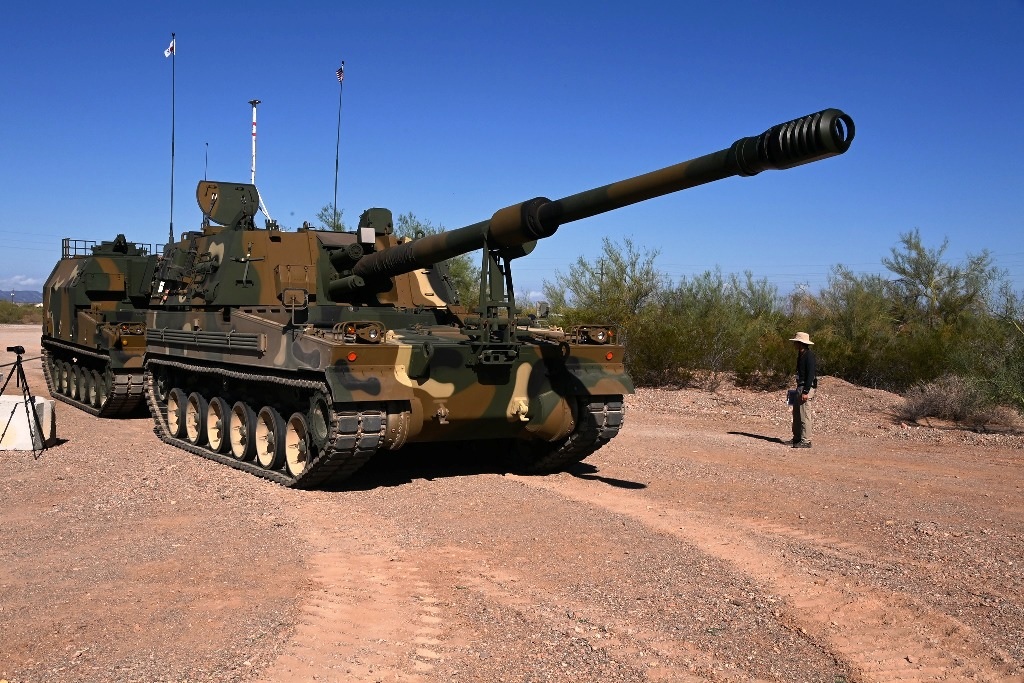
The agreement was formalized at Indra’s headquarters in Madrid and establishes a comprehensive industrial and technological partnership. The program is centered on the K9 155mm/52-caliber self-propelled howitzer platform, a widely used artillery system across NATO and allied countries. Spain will adapt the platform into a national variant while retaining its core firepower and operational performance.
Fleet Composition and Program Structure
The modernization effort includes the acquisition and production of a large fleet of tracked support and combat vehicles. According to program details, the total fleet will comprise approximately 280 to 330 vehicles depending on final configuration adjustments. The core structure includes 128 tracked self-propelled artillery systems based on the K9 platform and between 120 to 128 ammunition resupply vehicles. The program also incorporates 11 to 59 command-and-control vehicles and 21 recovery vehicles designed to support battlefield operations and sustainment.
This fleet structure is intended to provide a fully integrated artillery ecosystem, combining firepower, logistics, command capability, and recovery support within a unified platform family.
Industrial Roles and Technology Integration
Under the terms of the agreement, Spain will lead the overall platform design and production process. Indra will hold design authority over the vehicle hulls and will manufacture them domestically, ensuring national control over key structural components. The company will also be responsible for integrating a wide range of Spanish-developed systems into the platform.
These include mission control software, a 360-degree situational awareness system, battlefield management systems (BMS), advanced communications suites, and command post systems equipped with nuclear, biological, and chemical (NBC) protection. Additional features will include automatic fire and explosion extinguishing systems (AFES), contributing to enhanced survivability.
Hanwha Aerospace will act as the exclusive supplier of the core K9 platform and provide essential structural, mechanical, and firepower components. This includes the gun system, chassis elements, and associated subsystems derived from its proven K9 Thunder design.
Industrial Investment and Economic Impact
To support production and integration requirements, Indra has committed an investment of €130 million to expand its industrial capacity. This includes upgrades to its existing facility in Gijón and the construction of a new integration plant to handle assembly and system integration work.
The expansion is expected to generate approximately 500 direct jobs and an additional 1,000 indirect jobs across the Spanish defense industrial base. The program is positioned as a key driver for strengthening domestic manufacturing capability and sustaining long-term defense sector employment.
Strategic Objectives and Sovereignty
Spanish defense officials have emphasized that the primary objective of the program is to achieve technological sovereignty and operational autonomy. By securing design authority, domestic manufacturing, and lifecycle support capabilities, Spain aims to reduce dependence on external suppliers for critical land combat systems.
The agreement includes provisions for technology transfer, enabling Indra to develop and sustain its own tracked vehicle family while maintaining compatibility with NATO standards. This approach allows Spain to independently manage upgrades, maintenance, and future system evolution.
Operational Capabilities and Platform Features
The K9-based system is designed to deliver high rates of indirect fire at extended ranges with improved accuracy. The platform incorporates a high degree of automation, reducing crew requirements while increasing operational efficiency. Advanced targeting, digital fire control, and integrated battlefield networking will allow for faster response times and coordinated fire missions.
The system is already in service with multiple NATO members, including Norway, Poland, Finland, Estonia, and Romania, as well as Australia, providing a proven operational foundation for Spain’s adaptation.
Export Potential and International Cooperation
Beyond domestic requirements, the partnership carries broader commercial implications. Establishing a production and integration hub in Spain is expected to facilitate access to export markets, particularly in Latin America. The collaboration is designed to position both companies competitively in future international artillery procurement programs.
The agreement also enables bidirectional technological exchange. Spanish-developed systems integrated by Indra may be incorporated into future Hanwha platforms, while Spain benefits from the maturity and reliability of the K9 system.
Ongoing Development of Future Variants
In parallel with the Spanish program, Hanwha Aerospace continues development of next-generation artillery systems. The K9A2 variant is focused on increased automation, including a fully automated ammunition handling system aimed at improving sustained rates of fire and reducing crew size. Development of the K9A2 is targeted for completion by 2027.
The company is also advancing the K9A3, an extended-range system designed to exceed 80 kilometers in range. The K9A3 may incorporate options for reduced crew operation or fully unmanned configurations, reflecting broader trends in artillery modernization.
Leadership Statements
Indra Chairman Ángel Escribano stated that the partnership enables Spain to achieve full sovereignty and autonomy across the lifecycle of a new generation of land platforms. Hanwha Aerospace President and CEO Jaeil Son highlighted that the collaboration combines the reliability of the K9 system with Spain’s industrial and technological capabilities to deliver a solution tailored to national requirements.
Frank Torres, Chief Procurement Officer of Indra Group and Managing Director of Indra Land Vehicles, noted that the agreement supports the development of a scalable vehicle family with commercial potential while strengthening Spain’s industrial base.
——— End of Article ———