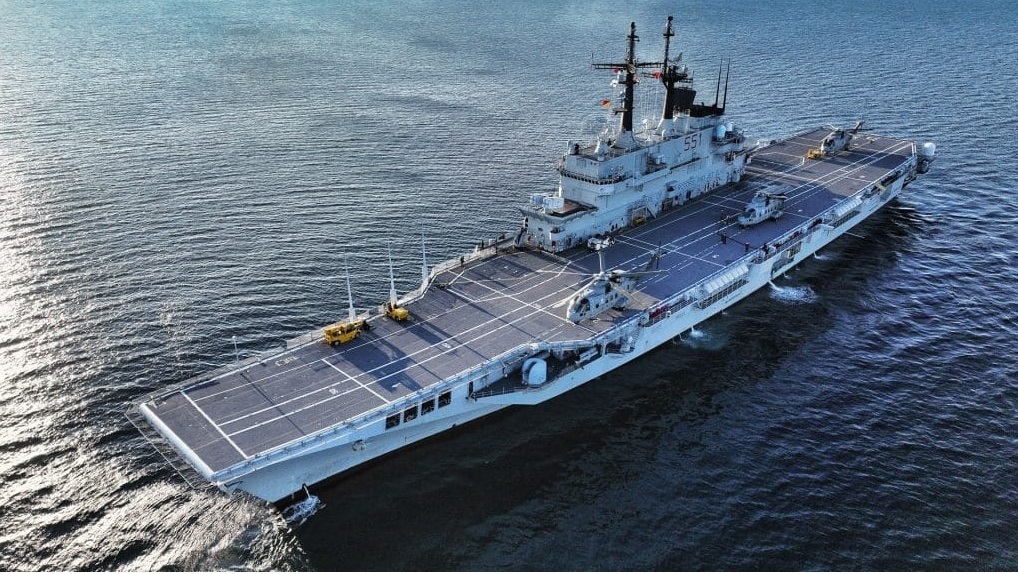
JAKARTA, INDONESIA : The Indonesian government has formally agreed to acquire the decommissioned Italian aircraft carrier Giuseppe Garibaldi from the Government of Italy. The 40-year-old vessel will be transferred as a direct grant, while Indonesia will finance its modernization and operational integration through two separate foreign loan arrangements totaling $1 billion.
The agreement represents one of the most significant naval acquisitions undertaken by Indonesia in recent years and signals an expansion of the Indonesian Navy’s aviation and maritime support capabilities.
Financial Structure and Modernization Plan
Although the hull itself is being transferred without purchase cost, Indonesia’s Ministry of Defense has arranged two financial packages to prepare the vessel for active service.
The first package consists of a $450 million modernization loan, designated for extensive refitting and structural adaptation. The funds will be used to convert the ship from its original configuration as a fixed-wing aircraft carrier into a platform optimized for rotary-wing aircraft and unmanned aerial vehicles (UAVs). The conversion aligns with Indonesia’s maritime security priorities, including surveillance, disaster response, and maritime domain awareness across its archipelago.
The modernization process is expected to include modifications to the flight deck layout, hangar facilities, aviation support systems, command and control infrastructure, and maintenance capabilities. The vessel will no longer operate short take-off and vertical landing (STOVL) fighter aircraft, and instead will be configured exclusively for helicopters and drones.
The second package, valued at $550 million, has been approved specifically for the procurement of Italian-manufactured helicopters. These aircraft will form the primary aviation component aboard the converted carrier. The financing arrangement restricts expenditures to equipment sourced from Italy under the existing bilateral defense cooperation framework.
Together, the two loan mechanisms total $1 billion, covering both the ship’s physical transformation and the aviation assets required to render it operational.
Vessel Background and Technical Specifications
The Giuseppe Garibaldi was constructed by Italian shipbuilder Fincantieri and commissioned into the Italian Navy in 1985. The vessel served for nearly four decades before being officially retired in October 2024. As of early 2026, it has been out of active service for approximately one and a half years.
At the time of retirement, the carrier’s baseline technical specifications included:
-
Standard displacement: 10,100 tons
-
Length: 180.2 meters
-
Maximum speed: 30 knots
During its operational service, the carrier was capable of deploying up to 18 AV-8B Harrier II fighter aircraft. It also operated mixed air wings that combined fixed-wing jets with helicopters such as the Agusta SH-3D and AW101. The original configuration supported short take-off and vertical landing operations.
Under Indonesia’s modernization plan, the fixed-wing fighter capability will be removed, and the ship will be reconfigured solely for helicopter and UAV operations.
Administrative Process and Delivery Timeline
Negotiations are ongoing between Indonesia’s Ministry of Defense, the Italian Navy, and Fincantieri to finalize the administrative transfer procedures and define the detailed scope of the technical refit.
Indonesian Navy Chief of Staff Admiral Muhammad Ali has stated that the government is targeting delivery of the vessel prior to October 5, 2026, which marks the 81st anniversary of the Indonesian National Armed Forces (TNI). The timeline includes both the formal handover and completion of initial modernization work necessary for operational deployment.
Intended Operational Role
Once fully refitted and staffed, the carrier is expected to serve as a mobile aviation and logistics platform within the Indonesian Navy. Defense officials have indicated that the vessel will primarily support non-combat military missions.
Its planned operational roles include:
-
Disaster response and humanitarian assistance
-
Large-scale logistics support operations
-
Extended maritime patrol missions
-
Surveillance across Indonesia’s territorial waters
As the world’s largest archipelagic state, Indonesia faces logistical and maritime security challenges due to its dispersed geography. The modified carrier is intended to enhance rapid deployment capability and enable sustained aviation operations across remote and strategically significant regions.
The acquisition, structured as a grant-supported transfer combined with foreign financing for modernization and aviation assets, expands Indonesia’s naval aviation infrastructure without the procurement of a new-build carrier platform.
——— End of Article ———