Jakarta / London : Indonesia and the United Kingdom have taken a decisive step in transforming their £4 billion Maritime Partnership Programme from a policy framework into an operational undertaking, following a concrete agreement covering two additional Arrowhead 140 frigate design licences. Announced on 21 January 2026 by Babcock International, the deal deepens defence-industrial ties between the two countries and reinforces Indonesia’s long-term naval modernisation strategy at a time of mounting maritime security pressures.
The agreement represents the first binding contract to emerge from the Maritime Partnership Programme unveiled in late 2025, giving substance to a political understanding that had until now remained largely aspirational. By expanding the Arrowhead 140 programme, Jakarta is anchoring British naval design expertise within Southeast Asia while accelerating its own ambitions to field a more capable, resilient and domestically supported surface fleet.
From Strategic Alignment to Industrial Delivery
Under the new agreement, Indonesia will receive licences for two additional Arrowhead 140 frigate designs, supplementing the two licences originally concluded in 2021. A parallel Letter of Intent (LoI) outlines plans to construct a further pair of frigates domestically, bringing the Red White / Balaputradewa-class programme to at least four ships. The LoI was signed on behalf of President Prabowo Subianto and Babcock’s chief executive, signalling strong political endorsement and growing momentum in discussions with Indonesia’s Ministry of Defence.
The timing is significant. The announcement comes only weeks after the launch of KRI Balaputradewa, Indonesia’s first domestically built Arrowhead 140–derived frigate and the largest principal surface combatant ever constructed in the country. Together, the developments underscore Jakarta’s determination to align naval capability growth with domestic industrial advancement.
Maritime Pressures Driving Naval Modernisation
For the world’s largest archipelagic state, naval modernisation is inseparable from sovereignty protection and economic security. Indonesia faces persistent grey-zone activity in and around the North Natuna Sea, as well as along key sea lines of communication linking the Malacca Strait with the Pacific Ocean. Recurrent incursions by foreign coast guard and fishing vessels into Indonesia’s exclusive economic zone (EEZ) have blurred the line between law-enforcement and military operations, placing sustained strain on naval forces.
Within this environment, the Balaputradewa-class frigates are intended to provide a versatile and credible maritime presence. Designed for high-end combat roles—including task group escort and area air defence—as well as routine patrol and deterrence missions, the class is positioned as a cornerstone of Indonesia’s future surface fleet. By embedding the frigate programme within the wider Maritime Partnership Programme, Jakarta is framing naval modernisation not only as a tool of deterrence, but also as a means of protecting fisheries, securing trade routes, and safeguarding coastal communities.
Beyond Minimum Essential Force
The partnership aligns closely with Indonesia’s evolving defence planning philosophy. For years, force development was guided by the Minimum Essential Force (MEF) concept, aimed at restoring baseline readiness after decades of underinvestment. More recently, Jakarta has articulated a shift toward an Optimum Essential Force (OEF) objective, seeking a more integrated, networked and technologically advanced military by the end of the decade.
Within this context, the Maritime Partnership Programme functions as more than a procurement mechanism. It is designed to combine capability acquisition with industrial and technological gains, channelling investment into domestic shipbuilding, supporting skills transfer in systems integration and complex programme management, and reinforcing Indonesia’s strategy of diversifying defence partnerships across Europe, Türkiye and the wider Indo-Pacific.
Understanding the £4 Billion Figure
Babcock’s £4 billion estimate does not represent the price of individual warships or a fixed contract for a specific number of frigates. Instead, it reflects the projected total value of the Indonesia–UK Maritime Partnership Programme over many years and across multiple sectors. The Arrowhead 140 element itself consists of phased design licence agreements, rather than a single shipbuilding contract.
Actual construction costs—particularly for locally built frigates—will be negotiated separately, spread over several years, and shaped by decisions on combat systems, weapons integration, and local content requirements. To date, no official per-ship cost has been publicly disclosed, nor has a single value been assigned to the original licences, the additional licences, or a four-ship package. The £4 billion figure is best understood as an umbrella estimate, reflecting the long-term economic and industrial scale of the partnership rather than a guarantee tied solely to frigate construction.
Beyond warship design, the partnership encompasses long-term industrial collaboration, technology transfer, workforce development, and support for domestic shipbuilding at PT PAL in Surabaya. It also extends into maritime security initiatives, including fisheries protection, coastal infrastructure, as well as training, sustainment, and lifecycle support for platforms delivered under the programme.
Arrowhead 140 as a Global Frigate Family
For the United Kingdom, the Indonesian agreement further consolidates Arrowhead 140 as an international frigate family, rather than a single national programme. The same core design underpins the Royal Navy’s Type 31 frigates and Poland’s future Miecznik-class, demonstrating the export potential of a common naval architecture adaptable to different operational requirements and industrial ecosystems.
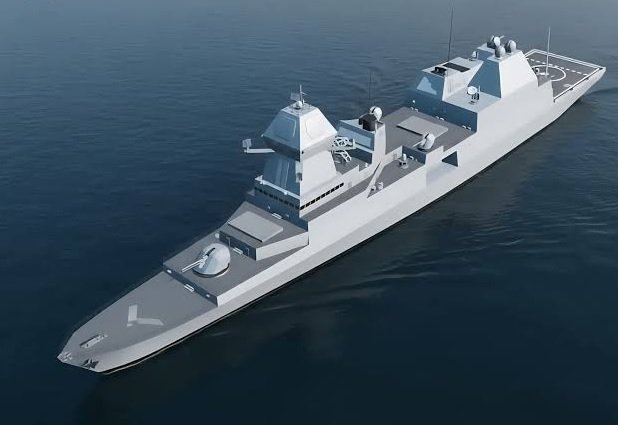
Derived from the Danish Iver Huitfeldt-class hull, Arrowhead 140 measures approximately 138–140 metres in length with a beam of around 20 metres and a displacement of 6,000–7,000 tonnes, depending on configuration. A combined diesel-and-diesel propulsion system enables speeds in excess of 28 knots and endurance suitable for sustained blue-water and littoral operations. Its open, modular architecture allows customer navies to integrate national sensors, weapons, and combat management systems, combining a proven hull and machinery package with a high degree of customisation.
From an industrial perspective, the programme supports skilled employment in the UK, particularly at Rosyth, while reinforcing London’s ambition to remain a credible and enduring defence partner in the Indo-Pacific.
Indonesia’s Adapted Frigate Concept
Indonesia’s Arrowhead 140–derived frigates are being built by state-owned shipbuilder PT PAL, with adaptations tailored to the demands of Indonesia’s vast maritime environment. While detailed combat system specifications have not been fully disclosed, the design is expected to incorporate multifunction and surveillance radars, hull-mounted sonar, electronic warfare systems, and decoy launchers, providing layered situational awareness and survivability.
A substantial midships section is reserved for a universal vertical launch system (VLS), reportedly intended to accommodate Turkish surface-to-air missiles, complemented by anti-ship missiles and twin triple torpedo launchers. Once fully equipped, the Balaputradewa-class is expected to rank among the most heavily armed and capable surface combatants in the current Indonesian Navy.
A Partnership With Strategic Weight
The first concrete agreement under the Indonesia–UK Maritime Partnership Programme marks a clear transition from political intent to tangible naval capability and industrial cooperation. With the Balaputradewa-class on track to form a four-ship core of Indonesia’s future surface fleet, the programme combines an export-proven European design with domestic construction, technology transfer, and nationally tailored combat systems.
For Indonesia, the deal offers a pathway toward a credible blue-water presence and stronger maritime domain control. For the United Kingdom, it demonstrates how long-term defence partnerships and export-oriented shipbuilding can underpin domestic industry while extending strategic engagement in one of the world’s most geopolitically significant regions.
——— End of Article ———