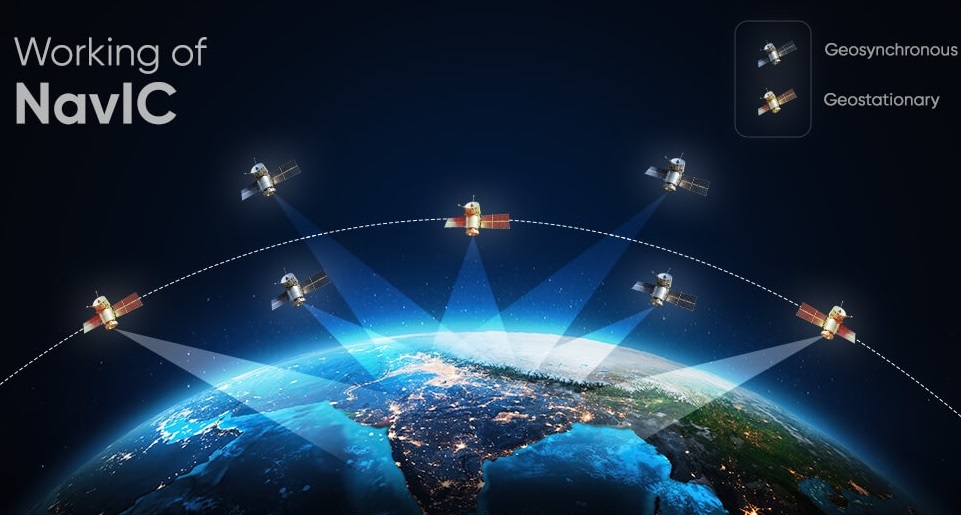
BENGALURU — March 14, 2026 : India’s regional satellite navigation network, Navigation with Indian Constellation (NavIC), is currently operating below its minimum operational threshold after the failure of the final onboard atomic clock aboard the IRNSS-1F satellite. The malfunction has reduced the number of satellites capable of providing full Positioning, Navigation and Timing (PNT) services to three, according to the Indian Space Research Organisation.
NavIC is designed to provide accurate regional navigation coverage across India and up to roughly 1,500 kilometers beyond its borders. The system requires at least four fully functional satellites with working atomic clocks to deliver reliable navigation services. With the loss of IRNSS-1F, the constellation has temporarily dropped below that operational requirement.
IRNSS-1F Completes Mission Life Before Clock Failure
IRNSS-1F was launched on March 10, 2016 as part of the original NavIC constellation deployment. The satellite was designed for a mission life of ten years and officially completed its planned operational lifespan on March 10, 2026.
On March 13, 2026, the last remaining rubidium atomic clock aboard the satellite stopped functioning. Two redundant clocks on the spacecraft had previously failed, leaving the satellite unable to generate navigation signals once the final clock ceased operation.
Although IRNSS-1F can no longer support navigation services, ISRO stated that the spacecraft will remain in orbit. It will continue to broadcast one-way messaging services used for certain societal and disaster-management applications.
Atomic clocks are the core component of satellite navigation systems. Precise time measurement allows satellites to calculate signal travel time to receivers on Earth. Even very small timing errors can produce large inaccuracies in determining position.
Current Operational NavIC Satellites
Since 2013, ISRO has launched a total of eleven satellites to establish and maintain the NavIC constellation. Following the IRNSS-1F failure, only three satellites currently retain functioning atomic clocks capable of providing full navigation services.
The operational satellites currently supporting PNT services are IRNSS-1B, launched in April 2014; IRNSS-1I, launched in April 2018 as a replacement satellite; and NVS-01, the first second-generation NavIC satellite launched in May 2023.
These spacecraft are now carrying the primary navigation workload for the system.
First-Generation Satellite Failures
Several first-generation IRNSS satellites have lost navigation capability primarily due to failures in imported rubidium atomic clocks used during the initial phase of the program.
-
IRNSS-1A, launched in July 2013 with a 10-year design life, became non-operational for navigation after all three of its atomic clocks failed.
-
IRNSS-1C, launched in October 2014, also lost navigation capability due to clock malfunctions.
-
IRNSS-1D, launched in March 2015, experienced similar atomic clock failures that degraded its ability to provide navigation services.
-
IRNSS-1E, launched in January 2016, suffered comparable issues affecting its onboard timing systems.
-
IRNSS-1F, launched in March 2016, has now joined the list after its final clock failure in March 2026.
-
IRNSS-1G, launched in April 2016, also experienced clock-related issues affecting navigation performance.
Replacement Satellite History
To maintain the constellation, ISRO launched IRNSS-1H in August 2017 as a replacement satellite. However, the mission failed when the payload fairing of the PSLV-C39 launch vehicle did not separate, preventing the satellite from reaching orbit.
IRNSS-1I was subsequently launched successfully in April 2018 to replace IRNSS-1A and remains operational today.
Under the second-generation NavIC program, NVS-01 was launched in May 2023. The spacecraft introduced upgraded navigation payloads and an indigenously developed rubidium atomic clock.
Another replenishment satellite, NVS-02, was launched on January 29, 2025 aboard a GSLV-F15 rocket. Although the launch itself was successful, the spacecraft failed to reach its intended operational orbit.
NVS-02 Orbital Failure Investigation
On February 25, 2026, ISRO released the failure analysis report for NVS-02. Investigators determined that a loose connector prevented a drive signal from reaching a critical pyro-valve responsible for oxidizer flow in the satellite’s propulsion system.
Because the valve did not open correctly, oxidizer could not reach the engine. As a result, the satellite was unable to perform orbit-raising maneuvers required to reach its designated circular navigation orbit. Consequently, NVS-02 is not contributing to NavIC navigation services.
Next-Generation NavIC Satellites
To restore the constellation to full capability, ISRO is accelerating development of additional satellites under the second-generation NVS series.
The agency plans to launch three more satellites — NVS-03, NVS-04 and NVS-05 — before the end of 2026. These spacecraft are intended both to restore the minimum operational threshold and to gradually replace aging first-generation satellites such as IRNSS-1B and IRNSS-1I.
The new satellites incorporate several upgrades. Each spacecraft carries five indigenously developed rubidium atomic clocks to improve redundancy and reliability. The satellites also introduce additional signal bands, including L1 signals, to improve compatibility with civilian and military navigation receivers.
Officials at ISRO’s Space Applications Centre have noted that procurement delays for certain components used in the indigenous clocks have slowed the replenishment schedule.
Importance of Maintaining the Constellation
NavIC represents India’s independent regional navigation capability and is used for civilian navigation, disaster management, transportation tracking and strategic applications.
With only three satellites currently capable of delivering full navigation services, restoring the constellation through replacement launches has become a priority for ISRO. The planned deployment of additional NVS satellites is intended to bring the system back to its full operational configuration in the coming years.
——— End of Article ———