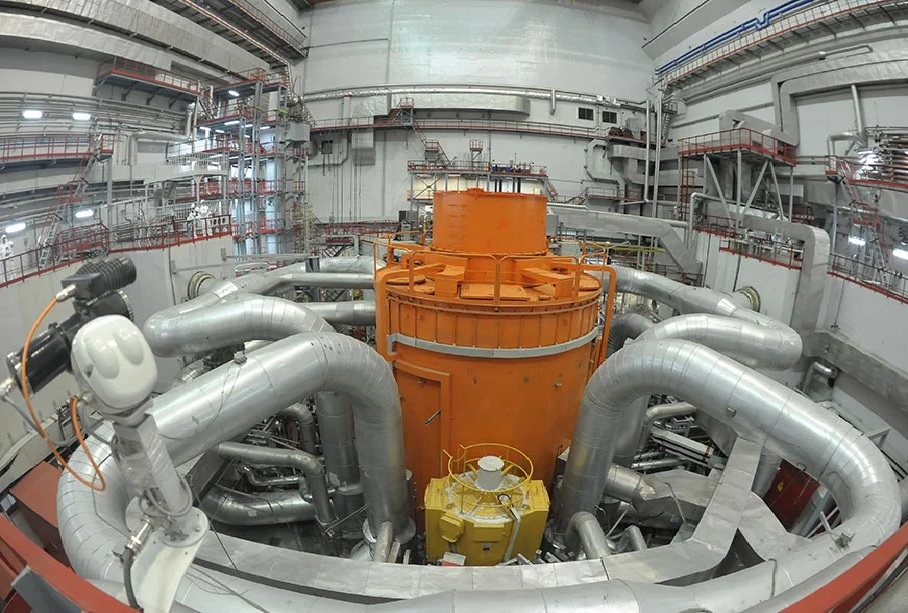
Kalpakkam, Tamil Nadu, — April 7, 2026 : India’s indigenously developed 500 MWe Prototype Fast Breeder Reactor (PFBR) at Kalpakkam attained first criticality on April 6, 2026, at 20:26 IST, marking the initiation of a controlled, self-sustaining nuclear fission chain reaction. The milestone represents a key operational phase preceding calibrated power escalation and eventual commercial electricity generation, and formally advances India into Stage II of its three-stage nuclear power programme.
The PFBR has been designed by the Indira Gandhi Centre for Atomic Research (IGCAR) and constructed by Bharatiya Nabhikiya Vidyut Nigam Limited (BHAVINI), a public sector enterprise under the Department of Atomic Energy (DAE). The reactor is located at the Madras Atomic Power Station site in Kalpakkam. Its commissioning follows regulatory clearance from the Atomic Energy Regulatory Board (AERB), which conducted detailed safety evaluations after the completion of initial core loading.
Fuel loading for the reactor began in October 2025. The first criticality achieved on April 6, 2026, signifies that the reactor has entered a stable configuration where the nuclear chain reaction is self-sustaining under controlled conditions. The next operational steps will involve low-power physics experiments, followed by a gradual and closely monitored increase in power levels before synchronization with the electricity grid. Commercial operations are scheduled to commence by September 2026.
Technical Configuration and Reactor Design
The PFBR is a sodium-cooled fast breeder reactor that operates using a uranium-plutonium mixed oxide (MOX) fuel core. Surrounding the core is a blanket of fertile uranium-238. Unlike conventional thermal reactors, which rely on moderated neutrons, the PFBR uses fast, unmoderated neutrons to sustain fission and facilitate breeding.
During reactor operation, neutron interactions convert uranium-238 in the blanket into fissile plutonium-239. This breeding process enables the reactor to generate more fissile material than it consumes, supporting a closed nuclear fuel cycle. The system is designed to reprocess spent fuel and reintroduce it into the reactor, improving fuel utilization efficiency and reducing dependence on imported uranium.
A dedicated Fast Reactor Fuel Cycle Facility (FRFCF) is under construction at the Kalpakkam site to support reprocessing and refuelling operations associated with the PFBR and future fast breeder reactors.
Role in India’s Three-Stage Nuclear Programme
The PFBR forms the central component of Stage II of India’s long-term nuclear power strategy, originally conceptualized by Dr. Homi J. Bhabha. The programme is structured to optimize the use of limited domestic uranium resources while leveraging abundant thorium reserves.
Stage I of the programme is based on pressurised heavy water reactors (PHWRs) fueled by natural uranium, which produce plutonium-239 as a byproduct. Stage II utilizes this plutonium in fast breeder reactors such as the PFBR to multiply fissile material inventories. Stage III is planned to deploy thorium-based systems, where thorium-232 will be transmuted into uranium-233 for sustained nuclear power generation.
The PFBR is designed with provisions to incorporate thorium into its blanket in future configurations. This will enable the production of uranium-233, which is intended to fuel advanced systems such as the 300 MWe Advanced Heavy Water Reactor (AHWR), currently under development.
Industrial Participation and Expansion Plans
The construction and development of the PFBR involved participation from more than 200 Indian industries, including micro, small, and medium enterprises (MSMEs), contributing to the expansion of the domestic nuclear manufacturing ecosystem.
India’s prior operational experience in fast reactor technology includes the 13.5 MWe Fast Breeder Test Reactor (FBTR), which has been in service at Kalpakkam since 1985. The PFBR builds on this experience at a commercial scale.
Following the PFBR, plans are in place to construct six additional fast breeder reactors with capacities of 600 MWe each. Two of these units are planned at a site adjacent to the PFBR, while a separate location is to be identified for the remaining four reactors.
Strategic and International Context
Upon achieving full operational capability and grid connectivity, India is expected to become the second country after Russia to operate a commercial-scale fast breeder reactor. The development supports long-term energy security objectives by enabling efficient utilization of domestic nuclear resources within a closed fuel cycle framework.
Prime Minister Narendra Modi acknowledged the milestone on April 6, 2026, stating that the reactor’s ability to produce more fuel than it consumes reflects advancements in domestic scientific and engineering capabilities. He noted that the PFBR represents a significant step toward enabling thorium utilization in the future stages of India’s nuclear programme.
The attainment of first criticality at the PFBR marks the transition from construction and commissioning into operational testing, with subsequent phases focused on validation, scaling, and integration into the national power grid.
——— End of Article ———