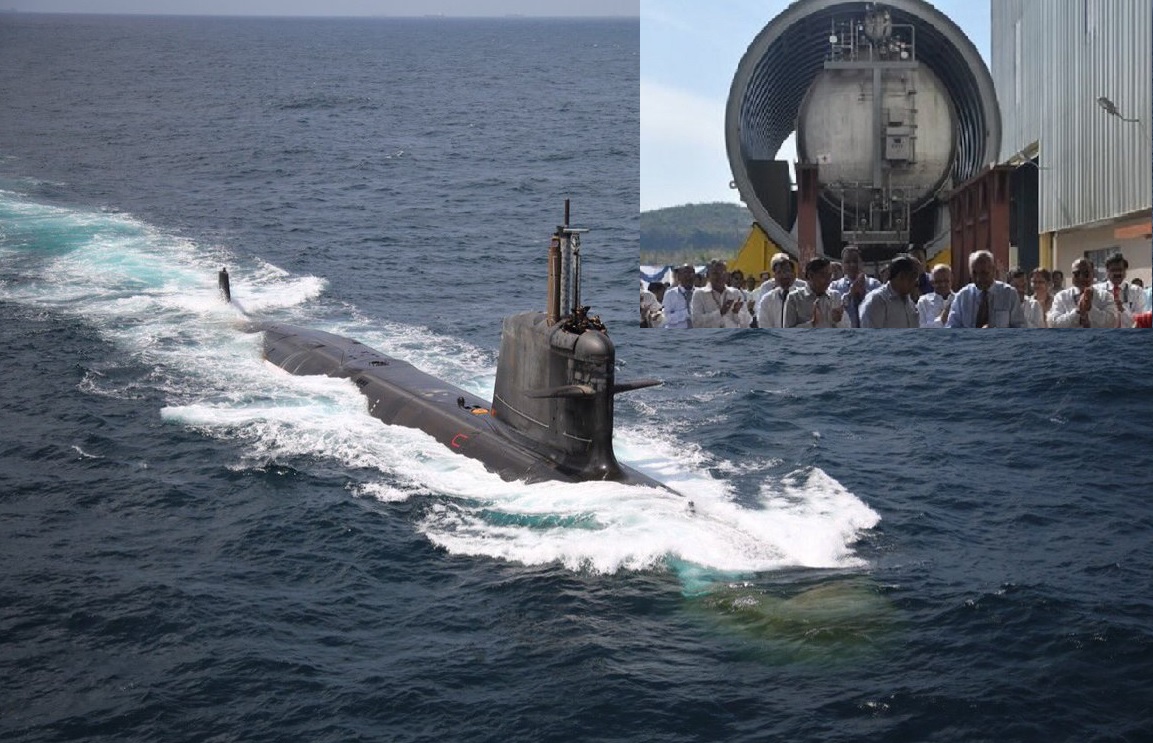
NEW DELHI — March 2026 : The Indian Navy is preparing to install its first indigenously developed Air-Independent Propulsion (AIP) system on INS Khanderi, the second submarine of the Kalvari class, during a scheduled refit expected to begin later in 2026. Once the upgrade is completed, the submarine is projected to return to operational service by the end of 2026, becoming the first vessel in the Indian fleet equipped with a domestically developed AIP capability.
The system has been developed by the Defence Research and Development Organisation (DRDO)’s Naval Materials Research Laboratory (NMRL) with Larsen & Toubro (L&T) acting as the principal industry partner for manufacturing. Integration of the AIP module into the submarine will be carried out by Mazagon Dock Shipbuilders Limited (MDL) in Mumbai, where the Kalvari-class submarines were constructed under Project-75 in collaboration with France’s Naval Group.
INS Khanderi will undergo structural modification during the refit, including the insertion of a dedicated AIP “plug” into the submarine’s hull. Following installation, the submarine is expected to undergo extended sea trials beginning around mid-2027 to validate the system under operational conditions.
Indigenous Fuel-Cell Propulsion System
The Indian AIP system is a 270-kilowatt fuel-cell-based power generation module that uses phosphoric acid fuel cells (PAFC). The technology produces electricity through an electrochemical reaction between hydrogen and oxygen, with phosphoric acid acting as the electrolyte.
Hydrogen required for the reaction is generated onboard using a chemical process involving sodium borohydride, eliminating the need to store hydrogen in high-pressure tanks. Oxygen is carried in stored form within the submarine. When the two react within the fuel cell stack, electricity is produced and supplied directly to the submarine’s electrical systems. The process generates water as the only by-product, which reduces detectable emissions and contributes to quiet underwater operation.
Unlike many foreign AIP designs that require large volumes of stored hydrogen, the Indian system generates hydrogen on demand. According to defence research officials, this configuration improves operational safety and simplifies logistics while maintaining efficient power output.
The electricity generated by the system can power both onboard equipment and propulsion systems, allowing the submarine to operate silently without needing to surface or snorkel to recharge its batteries.
Operational Advantages of AIP
Air-independent propulsion allows conventional diesel-electric submarines to remain submerged significantly longer than those relying solely on batteries. Without AIP, such submarines typically need to surface or snorkel every two to three days to recharge their batteries using diesel generators.
With AIP installed, underwater endurance can increase to approximately two weeks, depending on operational conditions. This extended endurance reduces exposure to radar, infrared, and visual detection when the submarine would otherwise need to operate near the surface.
For navies operating in regions with dense surveillance networks, including the Indian Ocean Region, increased submerged endurance provides improved survivability and operational flexibility.
Global Air-Independent Propulsion Technologies
Air-independent propulsion technologies used worldwide fall into four primary categories, each with distinct operating principles.
-
Closed-cycle diesel engines operate by supplying stored oxygen to a conventional diesel engine while recirculating exhaust gases after removing carbon dioxide. This allows the engine to function underwater but requires complex gas management systems.
-
Closed-cycle steam turbine systems, such as the French MESMA (Module d’Energie Sous-Marine Autonome) system, generate steam by burning ethanol with oxygen. The steam drives a turbine that produces electricity.
-
Stirling engine systems are used in Swedish Gotland-class submarines and early Japanese Sōryū-class submarines. These engines burn diesel fuel with stored oxygen to create heat, which drives pistons in a closed cycle using an inert working gas such as helium.
-
Fuel-cell systems, including proton exchange membrane (PEM) fuel cells used in German Type 212 and Type 214 submarines, produce electricity through electrochemical reactions rather than mechanical combustion. India’s design uses a phosphoric acid fuel cell variant, which operates at higher temperatures and offers stable long-duration output.
More than 50 AIP-equipped submarines are currently in service globally across several navies, including those of China, Germany, Japan, South Korea, and Sweden.
Development Timeline
Research on India’s indigenous AIP technology began at NMRL around 2005–2006, following an earlier attempt during the late 1990s to develop a closed-cycle diesel propulsion system.
After more than a decade of research and laboratory testing, the programme achieved a major milestone when a land-based prototype completed user-specific trials on 8 March 2021, demonstrating endurance and power performance.
To prepare the technology for submarine integration, DRDO signed an agreement with Naval Group in January 2023 to undertake detailed integration design and certification for the Kalvari-class platform. The collaboration ensured compatibility between the indigenous propulsion module and the French-designed Scorpène hull structure.
In June 2023, DRDO awarded Larsen & Toubro a contract to manufacture two AIP system modules under a technology transfer arrangement. Subsequently, in December 2024, India’s Ministry of Defence approved contracts worth approximately ₹877 crore for construction of AIP plugs and integration work on Kalvari-class submarines.
From the start of research to operational readiness, the project has progressed over nearly two decades, with significant technological maturation occurring after the successful prototype trials in 2021.
Integration Plan for Kalvari-Class Submarines
The AIP system was initially planned to be installed during construction of the fifth and sixth Kalvari-class submarines, but the schedule was later revised. The Indian Navy decided instead to retrofit the technology during the submarines’ first major refits, which occur roughly every seven years.
INS Kalvari, the lead submarine of the class, is currently undergoing its refit cycle but will not receive the AIP module during this maintenance period. The first operational installation will therefore occur on INS Khanderi (S22).
Following installation and sea trials, the Navy plans to equip the remaining submarines in the class with the indigenous AIP during their respective refits.
The six submarines in the Kalvari class are:
- INS Kalvari (S21)
- INS Khanderi (S22)
- INS Karanj (S23)
- INS Vela (S24)
- INS Vagir (S25)
- INS Vagsheer (S26)
The insertion of the AIP module will slightly increase the submarine’s hull length but is expected to significantly improve underwater endurance and operational flexibility.
Role in Future Submarine Programs
The modular design of the AIP system allows it to be adapted for different submarine platforms beyond the Kalvari class. Indian defence planners have indicated that the technology may also support future indigenous submarine programmes, including those under Project-76, which aims to develop next-generation conventional submarines with advanced stealth and endurance features.
Defence officials have confirmed that shore-based testing has met all required technical benchmarks, allowing the system to proceed toward fleet integration without further design changes.
Once INS Khanderi completes its refit and testing cycle, the submarine will become the first operational platform in the Indian Navy equipped with an indigenous AIP propulsion system, marking a significant milestone in India’s efforts to develop domestic naval propulsion technologies.
——— End of Article ———